8.10 - Development Aid
What is development aid?
Development aid refers to assistance, typically in the form of money or resources, provided to a country to enhance its human development. Human development involves improving people's quality of life through factors like health, education, and economic opportunities. This aid comes from various sources and aims to support long-term growth or address immediate crises.
Aid can be classified based on the provider and purpose, which influences how it is delivered and used.
Types of development aid providers
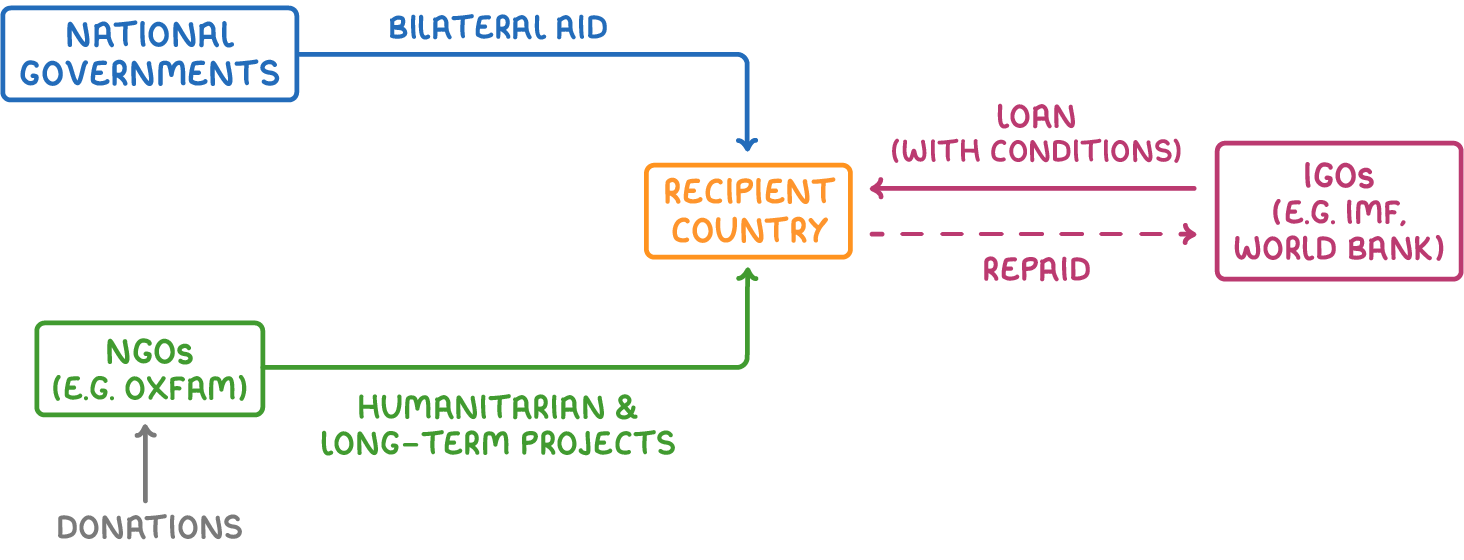
National governments:
- Provide bilateral aid, which is transferred directly from the donor country's government to the recipient country's government.
- Often focus on large-scale, long-term projects such as building infrastructure or promoting economic growth.
- Choices of recipients may be influenced by the donor's geopolitical interests, meaning aid aligns with political or strategic goals.
Intergovernmental organisations (IGOs):
- Organisations like the International Monetary Fund (IMF) and the World Bank offer financial assistance, usually as loans that must be repaid.
- Loans may come with conditions, such as requiring the recipient to adopt specific economic policies, to ensure the aid leads to sustainable development.
- Other IGOs, like the World Trade Organization (WTO), might link aid to trade-related reforms.
Non-governmental organisations (NGOs):
- Raise funds through charitable donations from the public, businesses, and sometimes governments or IGOs.
- Provide humanitarian assistance during crises, such as supplying food, emergency shelters, and medical aid.
- Work on long-term community projects to boost human development, including education and health initiatives.
Example of an NGO: Oxfam
Oxfam is a confederation of 21 NGOs operating in over 90 countries, originally founded in the UK. It focuses on reducing poverty and inequality through various aid efforts.
Key aspects of Oxfam's operations:
- Funding sources - Includes donations and legacies (money left in wills), government grants, sponsored events, and sales from charity shops. In 2021, it raised £105 million from donations and legacies, plus £27.9 million from the UK government.
- Aid activities - Provides clean water supplies during emergencies, such as wars or natural disasters. For instance, Oxfam supported water access after the 2010 Haiti earthquake.
Successes of development aid
Development aid has led to significant improvements in global human development by addressing health crises and promoting equality. These successes demonstrate how coordinated efforts can reduce mortality and enhance rights, particularly in developing countries.
Tackling malaria through aid
Malaria is a life-threatening disease transmitted by mosquitoes, preventable through measures like mosquito nets and antimalarial drugs. It disproportionately affects women and children in developing countries, causing hundreds of thousands of deaths annually.
Collaborative aid efforts against malaria:
- IGOs, NGOs (such as Nets For Life), and donors like The Global Fund have partnered to combat malaria, aligning with the UN's Millennium Development Goals.
- Initiatives include funding awareness campaigns and distributing mosquito nets, diagnosis kits, and medicines. For example, the UN supplied 30 million mosquito nets to Nigeria.
- Global malaria death rates decreased by 50% between 2000 and 2020, showing the impact of these aid strategies.
Promoting gender equality
Gender inequality refers to the disparity in rights and opportunities between men and women, often more pronounced in countries with conservative values. Aid programmes aim to empower women by addressing these gaps.
Aid programmes for gender equality:
- Development organisations provide small loans for women to start businesses.
- They train communities to prevent violence against women and girls.
- They run global initiatives like UN Women's "Safe Cities and Safe Public Spaces for Women and Girls".
- Efforts operate at national and local levels to reduce violence and improve access to education and healthcare.
Improvements in gender equality:
- More girls are attending and completing school.
- Maternal mortality rates (deaths related to pregnancy and childbirth) have declined.
- Women's representation in parliaments has increased globally.
- The Gender Inequality Index (GII), which measures inequality on a scale from 0 (perfect equality) to 1 (complete inequality), has fallen in most countries since 1997.
These trends highlight how aid has contributed to gradual progress, though challenges remain in achieving full equality.
Criticisms of development aid
While aid has achieved notable successes, it faces criticism for potentially hindering long-term development. Critics argue that aid can create unintended problems, reducing its overall effectiveness in promoting sustainable human development.
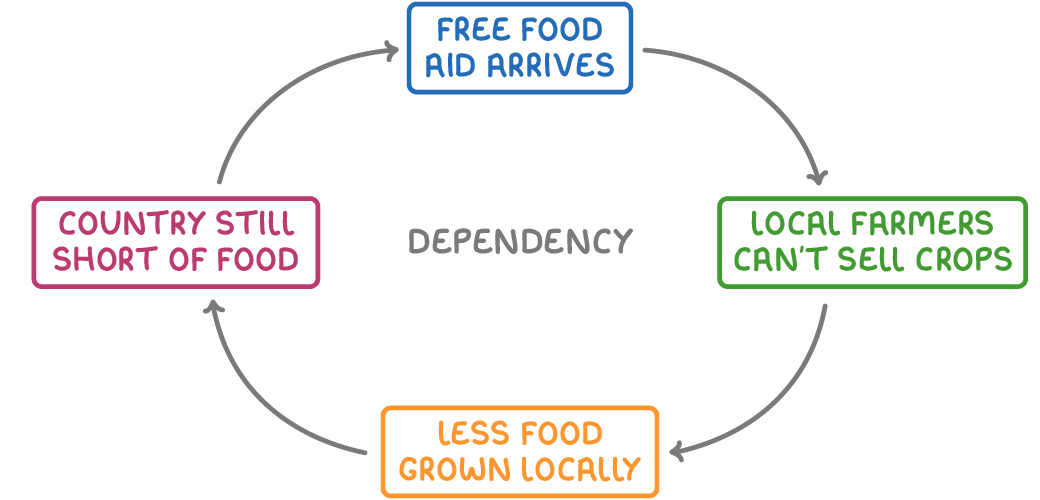
Dependency
- Countries receiving long-term aid may rely on it for basic services, reducing motivation to develop independent solutions. For example, food aid can discourage local food production.
- Recipients might prioritise donors' demands over their own development agendas.
- If aid is provided as loans, it can lead to debt dependency, trapping countries in cycles of repayment.
Corruption
- Aid funds or resources can be stolen by corrupt officials or directed towards projects benefiting a small elite rather than the wider population.
- Conditions imposed by donors to prevent corruption may not always work; research indicates that aid to highly corrupt countries can exacerbate corruption.
- As a result, aid often fails to reach those most in need, undermining its purpose.
Case study: Humanitarian aid in Haiti
Haiti, a developing country in the Caribbean, faced a devastating earthquake in 2010, highlighting both the potential and limitations of humanitarian aid. In 2021, 30% of its population lived in extreme poverty, and the country is prone to natural disasters.
Background and aid response
The 2010 earthquake:
- The earthquake killed an estimated 220,000 to 300,000 people and displaced hundreds of thousands, leading to makeshift tent cities.
- These camps were later affected by a cholera outbreak, which killed over 9,000 people by 2016.
- Global donors, including governments, IGOs (like the UN), NGOs (such as the Red Cross and Oxfam), and the public, raised about US$10 billion.
- Funds were used for emergency shelters, home repairs, and restoring clean water access.
Results:
- Positive outcomes included immediate relief for survivors through shelters and supplies.
- However, two years later, around 500,000 people remained in temporary shelters, indicating slow progress.
Limitations:
- Foreign governments pledged US$5.6 billion with an 18-month spending deadline to prevent corruption, but only 40% was spent in that time.
- Haiti's government and NGOs lacked capacity to use funds effectively, with much money reportedly spent on salaries and accommodation for foreign NGO workers rather than local development.
- The time limit, intended to ensure efficient use, sometimes led to rushed spending that did not prioritise long-term needs, showing how aid conditions can backfire.