8.5 - Millennium & Sustainable Development Goals
Introduction to the Millennium Development Goals
The Millennium Development Goals (MDGs) were established by the United Nations (UN) in 2000 as a global framework to address major challenges in human development. These goals aimed to reduce inequality, promote sustainability, eliminate extreme poverty, and narrow the development gap between the world's wealthiest and poorest nations. All UN member states committed to achieving these goals by 2015, with annual monitoring to track progress.
Core aims of the MDGs
The MDGs focused on improving quality of life in developing countries through targeted actions. Each goal included specific targets to measure success, such as halving certain rates or ensuring universal access.
The eight Millennium Development Goals
- Goal 1: Eradicate extreme poverty and hunger - This aimed to halve the proportion of people living in extreme poverty or experiencing hunger.
- Goal 2: Achieve universal primary education - The target was to ensure all children completed a full course of primary schooling.
- Goal 3: Promote gender equality and empower women - This focused on increasing girls' and women's participation in education and paid work.
- Goal 4: Reduce child mortality - The goal sought to cut the death rate among children under five by two-thirds.
- Goal 5: Improve maternal health - This targeted a three-quarters reduction in maternal mortality rates related to pregnancy or childbirth.
- Goal 6: Combat HIV/AIDS, malaria, and other diseases - Efforts concentrated on halting and reversing the spread of major diseases like HIV/AIDS and malaria.
- Goal 7: Ensure environmental sustainability - This included protecting the environment, promoting sustainable development, and halving the number of people without access to clean water and basic sanitation.
- Goal 8: Develop a global partnership for development - The aim was to foster international cooperation to support developing countries.
Variations in success of the MDGs
While the MDGs achieved some global successes, progress was uneven across regions and countries. Globally, targets like halving extreme poverty were met, with the number of people living on less than US $2.15 per day (the current definition of extreme poverty since 2022) dropping significantly between 2000 and 2015. However, regional differences highlighted challenges, such as ongoing issues in Sub-Saharan Africa where poverty numbers rose overall, despite a temporary decline of 8% between 1996 and 2005.
Factors influencing uneven progress
Some areas excelled in certain goals but lagged in others. For instance, India nearly halved its extreme poverty rate but saw only a slow decline in child malnutrition, from 53.5% to 40% between 1990 and 2015.
Transition to the Sustainable Development Goals
In 2015, the UN replaced the MDGs with the Sustainable Development Goals (SDGs).
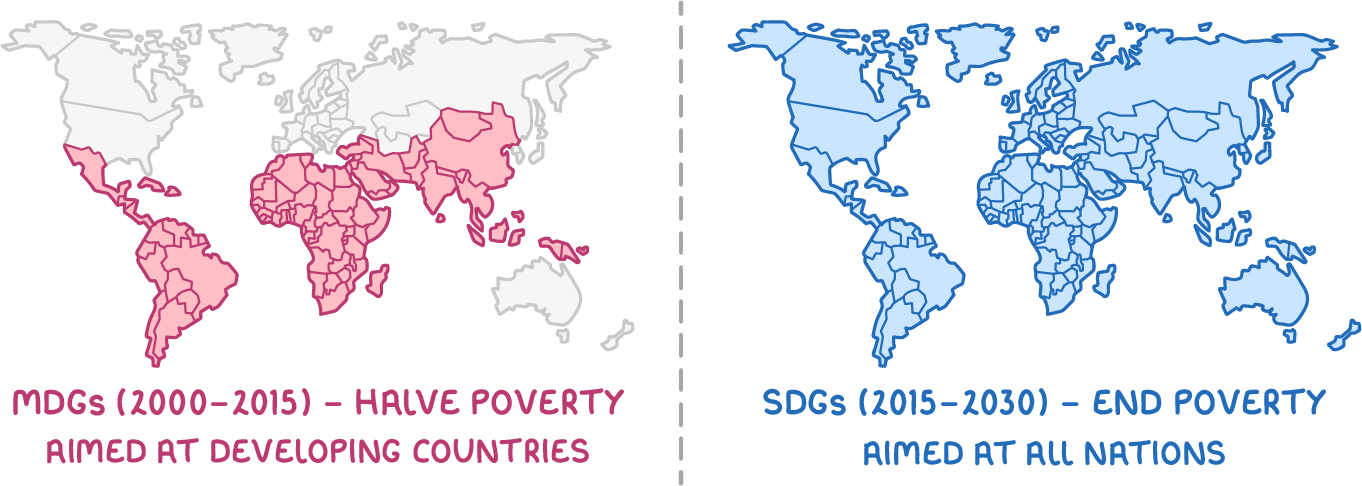
Unlike the MDGs, which targeted developing countries, the SDGs apply to all nations and place a stronger emphasis on environmental sustainability. This ensures that economic growth and human development do not harm the planet or future generations. The SDGs are more ambitious, expanding to 17 goals with a target completion date of 2030.
Key differences from the MDGs
The SDGs extend the MDGs by integrating sustainability into core aims. For example, while MDG 1 sought to halve poverty, SDG 1 aims to end poverty entirely in all forms. They also explicitly link economic development with social and environmental factors, promoting fairer global practices.
Core focuses of the Sustainable Development Goals
The 17 SDGs are grouped into categories that continue MDG themes but add new priorities. Seven goals directly build on MDG aims, often with added sustainability elements.
Goals continuing MDG aims with sustainability
- End poverty in all its forms everywhere.
- End hunger, achieve food security, improve nutrition, and promote sustainable agriculture.
- Ensure healthy lives and promote wellbeing for all ages.
- Ensure inclusive and equitable quality education and lifelong learning opportunities for all.
- Achieve gender equality and empower all women and girls.
- Ensure availability and sustainable management of water and sanitation for all.
- Build a global partnership for sustainable development.
Goals emphasising economic development
- Promote sustained, inclusive, and sustainable economic growth, full and productive employment, and decent work for all.
- Reduce inequality within and among countries.
Goals promoting fairer and more sustainable human activities
- Ensure access to affordable, reliable, sustainable, and modern energy for all.
- Build resilient infrastructure, promote inclusive and sustainable industrialisation, and foster innovation.
- Make cities and human settlements inclusive, safe, resilient, and sustainable.
- Ensure sustainable consumption and production patterns.
- Promote peaceful and inclusive societies for sustainable development, provide access to justice for all, and build effective, accountable, and inclusive institutions at all levels.
Goals focused on environmental protection
- Take urgent action to combat climate change and its impacts.
- Conserve and sustainably use the oceans, seas, and marine resources for sustainable development.
- Protect, restore, and promote sustainable use of terrestrial ecosystems, sustainably manage forests, combat desertification, halt and reverse land degradation, and halt biodiversity loss.
Progress and challenges with the SDGs
Progress on the SDGs has been mixed since their adoption. By early 2020, global advancement was too slow to meet the 2030 targets for many goals. External factors, such as the COVID-19 pandemic and climate change, have further hindered efforts by disrupting economies, health systems, and environmental initiatives.