8.8 - Global Organisations
Formation and aims of the United Nations
The United Nations (UN) emerged as a key international organisation in the aftermath of the Second World War, designed to foster cooperation among countries and prevent future conflicts.
Origins and membership of the UN
The UN was established in 1945 as the first major intergovernmental organisation (IGO) created after the war. Its creation aimed to build a more peaceful and equitable world. Today, the UN includes 193 member countries, giving it significant authority since nearly every nation worldwide participates.
The UN Charter
When a country joins the UN, it must agree to the United Nations Charter, a foundational document that outlines the core rules for international relations and the UN's main functions.
Main aims of the UN according to the Charter:
- To maintain global peace and security
- To develop friendly relations between nations
- To use cooperation to solve international problems
- To bring countries together to settle disputes
Structure and agencies of the United Nations
The UN operates through various specialised agencies and bodies, each focusing on specific global issues. This structure allows the organisation to tackle complex problems by dividing responsibilities among expert groups.
Key areas addressed by UN agencies
The UN addresses a range of global challenges through its agencies, promoting sustainable development and stability.
Main categories of UN activities:
- Environmental issues - Agencies like the United Nations Framework Convention on Climate Change, established in 1992, create international treaties to encourage member countries to combat climate change.
- Socio-economic issues - Organisations such as the UN Development Programme focus on reducing poverty and inequality, while the UN Refugee Agency supports vulnerable groups.
- Political issues - Bodies like the UN Security Council handle global peace and security, and the General Assembly serves as a forum for nations to discuss and decide on matters such as trade, health, and human rights.
Composition and role of the UN Security Council
The UN Security Council is a central part of the UN's structure, responsible for addressing threats to international peace. Its makeup reflects a balance between permanent powers and rotating members, but differences in political views can complicate decision-making.
Membership structure of the Security Council
The Security Council consists of 15 member countries. It includes five permanent members and ten non-permanent members elected for two-year terms.
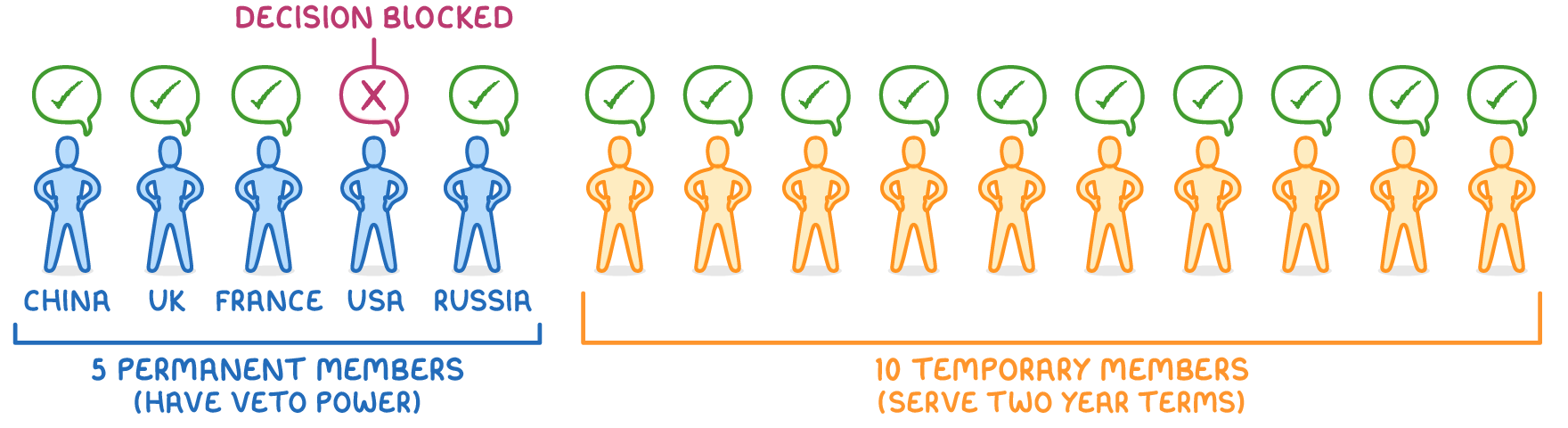
Permanent and non-permanent members:
- Permanent members - China, France, Russia, the United Kingdom, and the United States; these countries hold veto power, allowing any one of them to block a decision supported by the others.
- Non-permanent members - Ten countries elected regionally, including representatives from Africa, Asia-Pacific, Latin America, Western Europe (including Australia, Canada, New Zealand, and Turkey), and Eastern Europe.
The permanent members often have contrasting political systems – such as China's authoritarian governance compared to France's democratic model – which can lead to disagreements on issues like human rights interventions.
Decision-making and veto power
The Security Council votes on responses to threats to global peace, such as conflicts or crises. Decisions require agreement, but the veto right of permanent members can halt actions. For instance, in 2020, the United States used its veto to block a Security Council resolution on counter-terrorism.
UN interventions to maintain peace
The UN intervenes in conflicts to uphold peace, security, and human rights, using a range of methods. These efforts aim to resolve crises but have varying degrees of success.
Types of UN interventions
Interventions can be indirect or direct, depending on the severity of the situation.
Methods used in UN interventions:
- Diplomatic and economic pressure - This includes sending official communications to leaders or imposing economic sanctions, such as trade embargoes that limit a country's access to goods and markets.
- Military intervention - In extreme cases, the Security Council authorises peacekeeping forces to stabilise regions.
While some interventions successfully prevent escalation, others fail to fully resolve underlying issues, leading to ongoing instability.
Case study: UN intervention in the DRC
The DRC, located in central Africa and bordered by countries like Rwanda and Angola, experienced severe violence starting in 1998.
Background to the conflict
Conflict erupted in 1998 among rival ethnic and political groups, exacerbated by involvement from neighbouring countries such as Rwanda supporting one side and Angola another. This led to over 5 million deaths between 1998 and 2008.
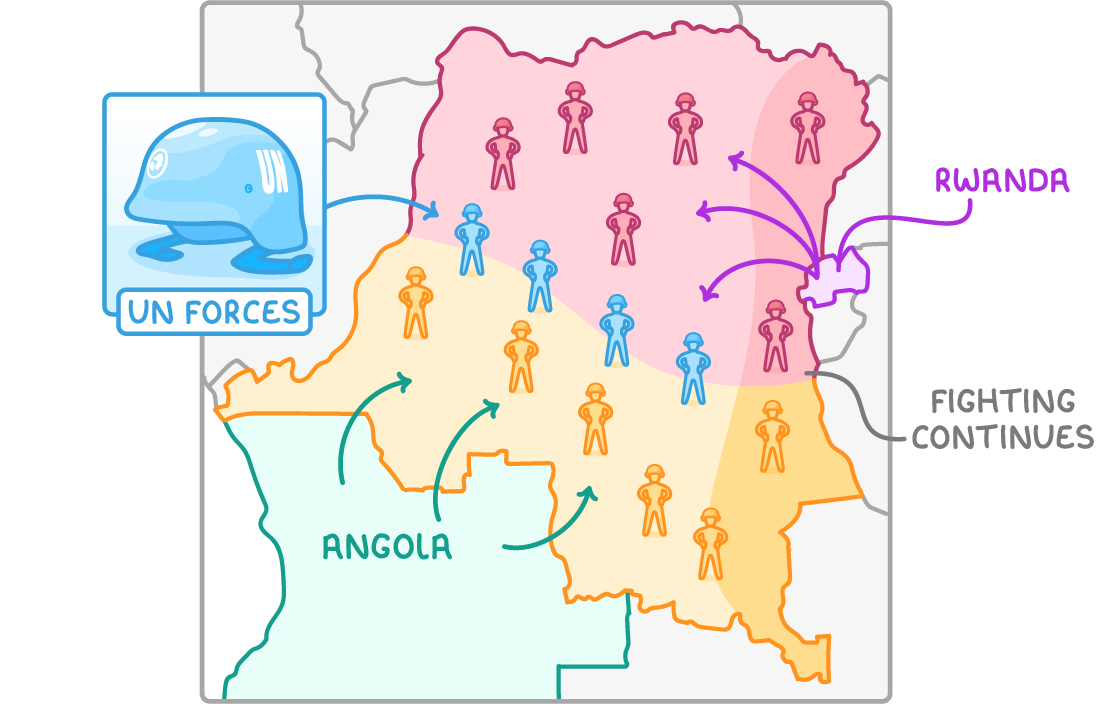
UN methods and procedures
The UN Security Council responded by calling for a ceasefire and urging external countries to avoid interference, though some, like Zimbabwe, ignored this by sending over 10,000 troops and holding prisoners of war. In 1999, the UN established a peacekeeping mission, deploying over 19,000 troops to facilitate agreements, end regional fighting, and support democratic elections.
Results and ongoing efforts
The mission achieved partial success, resolving conflicts in some areas and enabling the first democratic elections in over 40 years. However, violence persisted in eastern DRC. In 2013, the Security Council created an Intervention Brigade to actively combat armed groups and stabilise the region. By the end of 2022, approximately 12,800 UN soldiers remained deployed, but conflicts continued, showing slow progress.
Independent interventions by UN member countries
Despite the UN's framework, some member countries conduct their own interventions without Security Council approval. This often happens due to disagreements over when intervention is justified or the best approach.
Reasons and examples of independent actions
A coalition led by the United States and the United Kingdom intervened in Afghanistan in 2001 and Iraq in 2003, framing these as part of a 'war on terror' to prevent terrorism by stabilising fragile states. Similarly, Russia has provided military support to the Syrian government against rebels since 2015.
Consequences of bypassing UN approval
These actions often lack Security Council endorsement because of debates over necessity and potential human rights outcomes. By ignoring the UN Charter's principles, such interventions strain international relations and can destabilise regions. For example, the Iraq intervention resulted in prolonged conflict, displacing millions and contributing to violence in neighbouring areas, ultimately threatening broader global stability.