8.9 - IGOs: Trade & Financial Flows
Key intergovernmental organisations in global trade
Intergovernmental organisations (IGOs) are bodies formed by multiple countries to cooperate on international issues, including trade and economics. After the Second World War, several IGOs were established to promote international trade and support capitalist systems. Three major ones continue to shape the global economy today.
The three main IGOs and their functions
- World Trade Organisation (WTO) - Established to boost trade among member countries and settle disputes. It creates rules for fair trading practices between nations.
- International Monetary Fund (IMF) - Oversees the global economy, offers advice to governments on improving their finances, and provides loans to countries facing economic difficulties.
- World Bank - Supplies loans to developing countries for investments in essential areas such as health, education, and infrastructure.
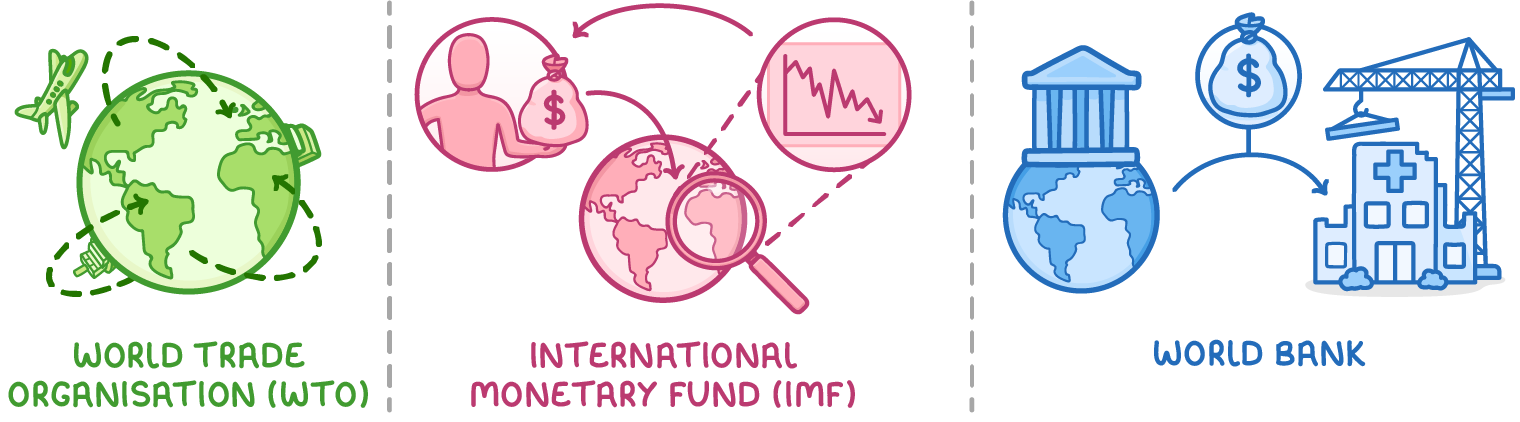
These organisations are headquartered in Western countries: the IMF and World Bank in the USA, and the WTO in Switzerland. They promote a Western capitalist model, which emphasises certain core principles.
Core principles promoted by these IGOs
- Free trade - Minimising barriers to trade both between countries and within them to allow goods and services to flow more easily.
- Privatisation and deregulation - Encouraging private ownership of companies and resources for better efficiency, while reducing government controls to limit interference in the economy.
- Democracy - Supporting freedoms for people to choose their governments, media, and other aspects of life.
Through these principles, the IGOs influence global economic management. For instance, they oversee international agreements, provide loans to avert crises, and condition financial aid on adopting free trade policies, thereby spreading their capitalist approach.
Impacts of IGO policies on developed countries
IGO policies have generally supported economic growth in developed countries by fostering open trade and providing financial stability. These nations benefit from exporting goods and importing cheaper products from elsewhere, which stimulates their economies.
Benefits through trade and economic policies
- Policies promoting international trade and removing barriers enable developed countries to sell more goods abroad and access affordable imports, leading to higher gross domestic product (GDP) – the total value of goods and services produced in a country.
- For example, the USA's involvement in the WTO is estimated to add around US $87 billion to its GDP annually.
Advantages in borrowing and influence
The IGOs establish rules for lending that help prevent or resolve economic crises in developed countries. Loans are typically granted only to address urgent financial issues.
- In 1976, the UK received approval for a $3.9 billion IMF loan to avert a crisis, which helped lower interest rates and stabilise the economy, even though not all funds were used.
- Developed countries hold significant sway in these organisations. For instance, the USA has a 16.5% share of voting rights in the IMF, allowing it to influence decisions in its favour.
As a result, these policies often align with the interests of wealthier nations, enhancing their global economic position.
Restructuring policies in developing countries
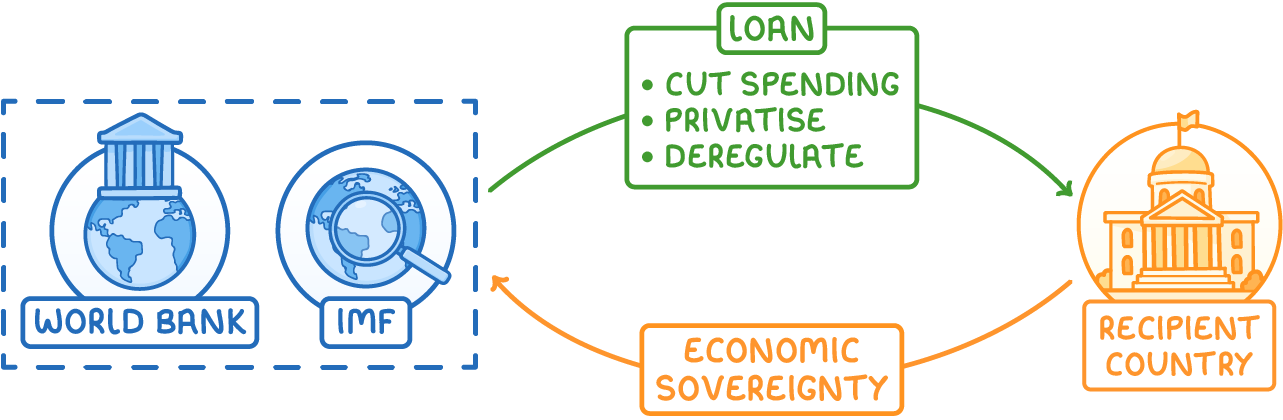
To receive loans or debt relief from IGOs like the IMF and World Bank, developing countries must often implement economic reforms. These conditions aim to promote growth but can have varied outcomes, including challenges to national control over economic decisions.
Main types of restructuring conditions
- Structural Adjustment Programmes (SAPs) - Loans are provided if countries make major policy changes, such as cutting government spending, privatising state-owned industries, and reducing regulations to attract foreign investment.
- Heavily Indebted Poor Countries (HIPC) initiative - Debt relief is offered to qualifying countries that adopt reforms and work towards poverty reduction, freeing up funds for social services.
Mixed results and criticisms
In some cases, SAPs have driven economic growth, and HIPC has allowed governments to redirect money from debt repayments to health and education. However, negative effects have occurred in other instances.
These policies have been criticised for eroding economic sovereignty – the ability of countries to make independent financial choices – as IGOs use their leverage to impose Western models.
Case study: Structural adjustment in Jamaica
Jamaica, a developing country in the Caribbean, faced economic challenges in the 1970s and 1980s, including recessions and high debt. This led to accepting loans from the IMF and World Bank tied to structural adjustment conditions.
Key features of Jamaica's programme
- In the initial phase, austerity measures were imposed, which involved slashing government spending on public services like health care. This resulted in a 60% drop in the number of registered nurses.
- By 1991, further adjustments focused on deregulation, including policies to keep wages low to draw in foreign investment.
Impacts on social and economic wellbeing
- Education outcomes declined: in 1990, 97% of children completed primary school, but by 2019, this figure fell to 85%.
- A significant portion of government spending is still allocated to repaying foreign debts, limiting investments in health and education.
- Jamaica's debt burden remains high, but its upper-middle-income status based on GDP disqualifies it from HIPC relief, as it is considered too wealthy for such aid.
This case illustrates how SAPs can lead to long-term social declines, even if intended to stabilise economies.
Regional trade blocs alongside global IGOs
While nearly all countries join global IGOs like the IMF, World Bank, and WTO to participate in the world economy, many also form regional trade blocs. These groups focus on reducing trade barriers within specific areas, offering localised benefits.
North American Free Trade Agreement (NAFTA)
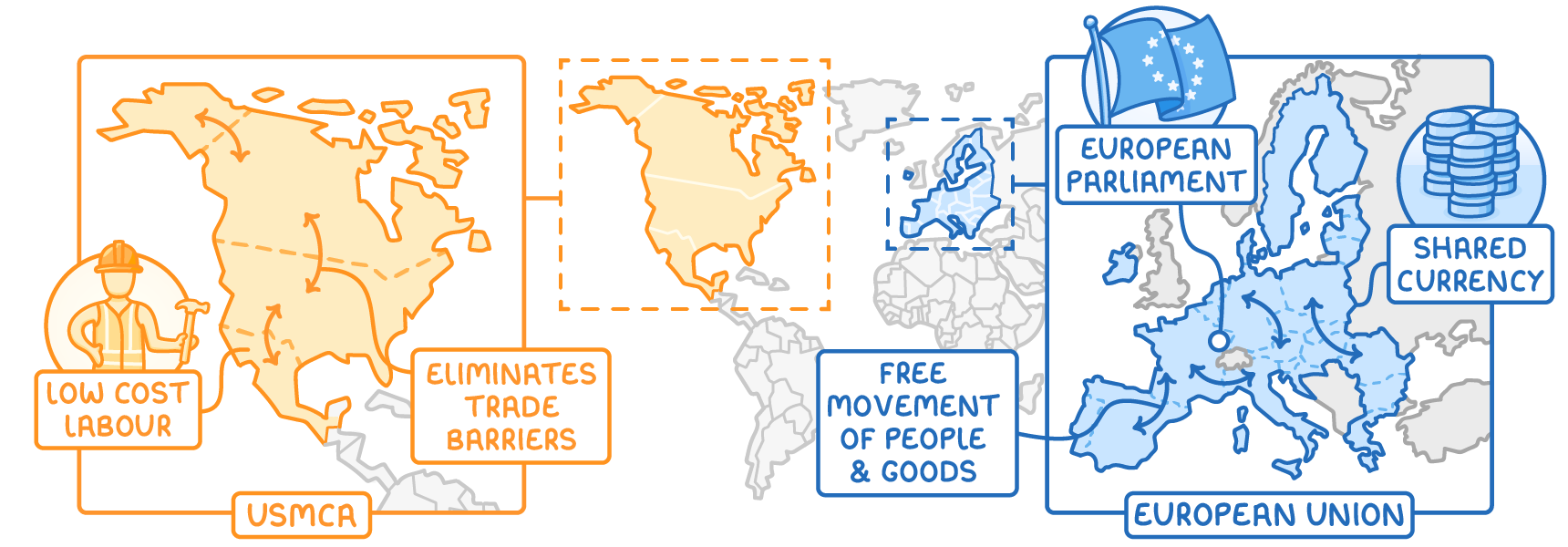
NAFTA was a 1992 agreement between Canada, the USA, and Mexico to eliminate trade barriers such as tariffs – taxes on imports – and customs duties. It facilitated easier movement of goods and resolved disputes among members.
Advantages:
- Increased trade and investment between member countries.
- Canadian and US firms benefited from Mexico's lower labour costs, while Mexico gained access to high-quality imports.
Disadvantages:
- Some sectors suffered, such as Mexican family farmers who could not compete with cheap US agricultural products.
NAFTA was replaced in 2020 by the United States-Mexico-Canada Agreement (USMCA), which updated these arrangements.
European Union (EU)
The EU operates as a common market, removing most barriers to the movement of people, goods, money, and services among member states. Some countries share the euro currency to further ease transactions.
Beyond trade, the EU includes political elements, with institutions like the European Parliament making joint decisions on issues such as agriculture, climate change, and foreign policy. This has fostered greater political unity among members, extending cooperation from economics to broader governance.