8.13 - Measuring Success of Intervention
Ways to measure success in interventions
Development interventions aim to improve conditions in countries, but measuring their success can vary depending on perspectives. Success might focus on whether the primary goal was met, such as removing an oppressive government, or on wider effects like changes to human rights. It is also important to weigh short-term outcomes against long-term impacts to get a full picture.
Key approaches to assessing success
- Achieving the main objective - This looks at whether the core aim of the intervention, like overthrowing a regime, was accomplished.
- Evaluating broader impacts - This considers wider consequences, such as improvements in living standards or unintended effects on society.
- Comparing time frames - Short-term results, like immediate stability, are balanced against long-term effects, such as sustained economic progress.
Indicators used to measure success
Various indicators help evaluate the effectiveness of interventions. These focus on human wellbeing, rights, and how well challenges are handled. Human development refers to improvements in people's quality of life beyond just economic factors, while human rights involve protections like equality and free expression.
Indicators of human development
These measure progress in living standards and suggest whether an intervention has boosted overall wellbeing.
They include:
- Improved health - Access to better medical care and reduced disease rates, leading to healthier populations.
- Higher life expectancy - An increase in average lifespan, often due to better nutrition and healthcare.
- Increased access to education - More people gaining schooling, which can enhance skills and opportunities.
Indicators of human rights
These assess how well freedoms and equalities are protected, showing if an intervention has promoted fairness.
They include:
- Gender equality - Equal opportunities for men and women in areas like employment and education.
- Freedom of speech - The ability to express opinions without fear of punishment, fostering open societies.
Managing negative consequences
- Interventions can create problems, and success depends on how these are addressed. For example, military actions often lead to displacement, where people are forced from their homes.
- Many interventions cause large-scale movement of people, such as the 6.8 million who have left Syria since the civil war began in 2011. Governments or non-governmental organisations (NGOs), which are independent groups providing aid, may establish refugee camps with facilities for safety and health.
- However, camps often suffer from poor sanitation and inadequate food supplies. Refugees may also face dangers, such as travelling in small boats on risky routes to reach safer areas.
Strengthening democracy as a sign of success
Some countries and intergovernmental organisations (IGOs), like the International Monetary Fund (IMF), promote democracy and capitalism as key to progress. Democracy involves people having a say in governance, while capitalism emphasises free markets. These groups view stronger democracy as a success marker, believing it drives economic growth by allowing free choices in politics and economics.
Steps to build a stronger democracy
Progress towards democracy typically involves key changes to enhance freedoms and institutions.
1. Increasing freedom of expression
- People can share beliefs without government censorship, though limits exist for highly offensive views to prevent repression.
- Open discussion of ideas helps inform decisions, and leaders must be accountable, meaning they answer to those who elected them.
- Criticism of government is allowed, either individually or via media, supported by removing censorship laws and aiding independent outlets like newspapers or radio stations.
2. Creating or strengthening democratic institutions
- Democratic institutions are elected bodies that govern, such as the USA's House of Representatives and Senate.
- This may involve drafting a new constitution, a set of fundamental laws, or reforming existing ones.
- Supporting organisations, like an independent judiciary (a system of courts and judges separate from government), protect freedoms and reinforce democracy.
Example: Democracy in Iraq after intervention
The 2003 intervention by the USA and allies aimed to establish democracy in Iraq. Elections for a National Assembly occurred in 2005, leading to a new president and constitution. Further elections followed in 2010, 2014, 2018, and 2021, viewed as successes by democracy advocates. However, ongoing corruption and security threats have limited further progress.
Prioritising economic growth
Not all nations follow Western democratic models. Some emphasise economic growth, meaning increases in a country's output of goods and services, as the main success indicator. This approach may overlook human rights or democracy if they slow progress, contrasting with holistic development, which balances economic, social, and environmental factors for overall wellbeing.
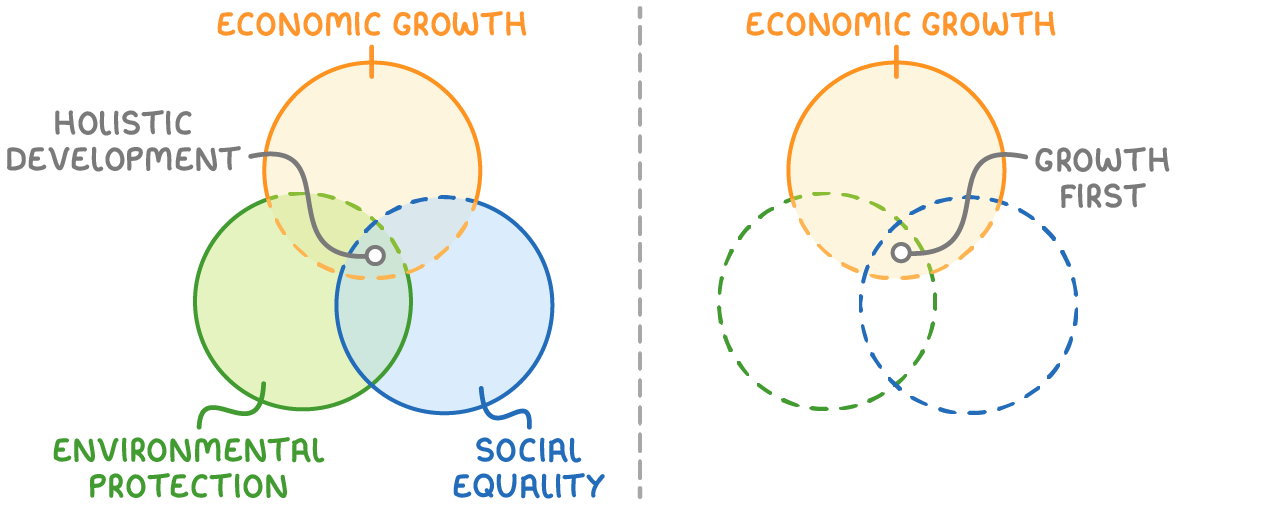
Reasons for focusing on economic growth
- Strategies target rapid economic development rather than broad wellbeing.
- Democratic processes, like debates on policies, might delay growth, so they are sometimes deprioritised.
Case study: Viet Nam's development approach
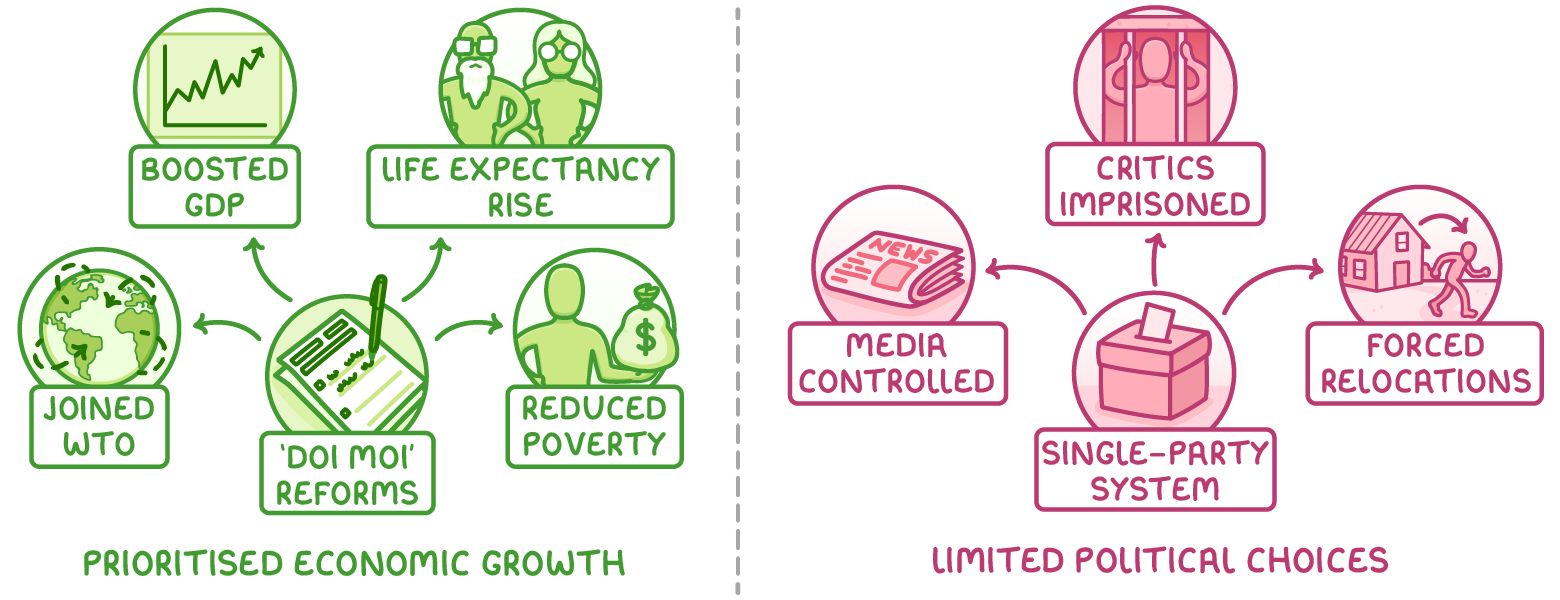
Viet Nam provides an example of prioritising economic growth, led by its government under the Vietnamese Communist Party (VCP). This single-party system limits political choices, but reforms have driven economic advances.
Political and governance context
Citizens vote in elections but only for representatives within the VCP, Viet Nam's sole political party, restricting genuine choice in governance.
Economic reforms and growth
- In 1986, the 'Doi Moi' reforms shifted from a centrally planned socialist system to a more capitalist one.
- Viet Nam reduced trade restrictions and tariffs (taxes on imports) and joined the World Trade Organisation (WTO), an IGO promoting global trade.
- These changes attracted foreign investment, boosting gross domestic product (GDP), the total value of goods and services produced, from $12 billion in 1983 to over $380 billion in 2023.
Impacts on poverty and human development
- The percentage of the population below the international poverty line fell from 48% in 1990 to 1.5% in 2020.
- Life expectancy rose by 7 years since 1988, reflecting better living conditions.
Human rights concerns
- Freedom of expression is restricted; the government controls media, and critics face intimidation, attacks, or imprisonment, as condemned by NGOs.
- Land is collectively owned by farmers but controlled by the government, enabling forced relocations for development. For instance, farmers were displaced for an Ecopark project 15 km from Hanoi, the capital, to prioritise economic progress.