8.11 - National Identity
The concept of nationalism
Nationalism plays a central role in shaping cultures, politics, and societies around the world. It influences everything from daily interactions to broader debates about identity and loyalty.
Key components of nationalism that connect individuals to their nation
- Identity - A shared sense of belonging to a specific nation or group, often shaped by common history, culture, or values.
- Loyalty - A strong allegiance to one's nation, which can sometimes include negative feelings towards perceived threats from other groups or countries.
Reinforcing national identity and loyalty
Various aspects of society, including sports, politics, and education, help strengthen people's connection to their nation by reinforcing their national identity and loyalty.
Reinforcement through sport
-
Sporting events often serve as powerful tools for building national pride, as they bring people together to support their country against others.
-
People rally behind their national teams in global competitions, such as the football World Cup or the Olympics.
-
Victories in these events can heighten feelings of national pride, with successes symbolising the strength or superiority of the nation.
-
For instance, following the 2012 London Olympics, surveys showed that many British people felt greater pride in their Olympic team than in traditional symbols like the royal family.
Reinforcement through politics
-
Political figures and parties frequently use nationalism to gain public support, emphasising elements that resonate with national identity.
-
Politicians highlight their dedication to key national institutions, such as the NHS in the UK, which many view as a cornerstone of British society.
-
They also promote national values and ideals, like the British notion of 'fair play', which embodies ideas of equality and adherence to rules.
-
This approach fosters loyalty by linking political agendas to widely held beliefs about what makes the nation unique.
Reinforcement through education
-
Educational systems can instil national values from an early age, helping to shape students' sense of identity and loyalty.
-
In the UK, since 2014, schools have been required to promote 'British Values', which include democracy, the rule of law, individual liberty, and mutual respect and tolerance for different faiths and beliefs.
-
This curriculum aims to build a collective national identity among young people.
-
In other countries, such as the USA, daily routines like reciting a pledge of allegiance or singing the national anthem reinforce loyalty by starting the school day with expressions of patriotism.
Various bases and symbols of national identity
National identity draws from a wide array of elements that people associate with their country. These can include cultural practices, institutions, and stereotypes. Different people may feel loyalty to different understandings and symbols of what the nation represents.
Key bases of national identity
- Cultural elements - These encompass food, language, clothing, religion, and traditions that people see as distinctive to their nation.
- Legal systems - Pride in a nation's justice processes, such as Britain's jury system, which some view as fairer than alternatives, can strengthen identity by highlighting perceived superiority.
- Methods of governance - Systems like parliamentary democracy are often celebrated; for example, in the USA, laws require agreement between the House of Representatives and the Senate, reinforcing democratic principles.
- National character - Stereotypical traits attributed to a nation's people, such as Germans being seen as hardworking and efficient, Italians as passionate, or British people as having a 'stiff upper lip' (enduring hardship without complaint), can foster identification even if they are generalisations.
Landscapes and English national identity
Certain landscapes hold deep symbolic meaning in national identity, evoking ideas of history, beauty, and belonging. In England, rural imagery has long been tied to notions of what it means to be English, often idealised in art and literature. This connection builds on nostalgic views of the countryside, linking it to a pre-industrial era.

Idealised images of the English countryside
- England's landscapes are diverse, but many people envision the countryside as green and peaceful, a view reinforced through cultural works.
- Art, music, and literature, such as William Blake's poem Jerusalem describing 'England's green and pleasant land', have popularised this image for centuries.
- This ideal may not reflect current realities or may never have fully existed, but it remains influential, often tied to nostalgia for a time before urbanisation and increased multiculturalism.
Specific landscapes as national symbols
-
Certain sites embody national themes and are used to evoke patriotism.
-
The White Cliffs of Dover symbolise Britain as an independent island nation, associated with defence and the idea of 'home', especially during events like the Second World War when they were highlighted in government campaigns.
-
Other examples include the Chiltern Hills, representing rolling rural beauty, and Stonehenge, linking to ancient heritage and mystery.
Challenges to identity in a globalised world
In today's interconnected world, national identity and loyalty are not always straightforward. Most countries host diverse populations from various ethnic backgrounds, and globalisation has accelerated the mixing of cultures. This diversity can enrich societies but also create complexities in how people define their allegiances.
Impacts of globalisation and diversity
-
Globalisation promotes the exchange of people, ideas, and cultures, leading to more multinational societies.
-
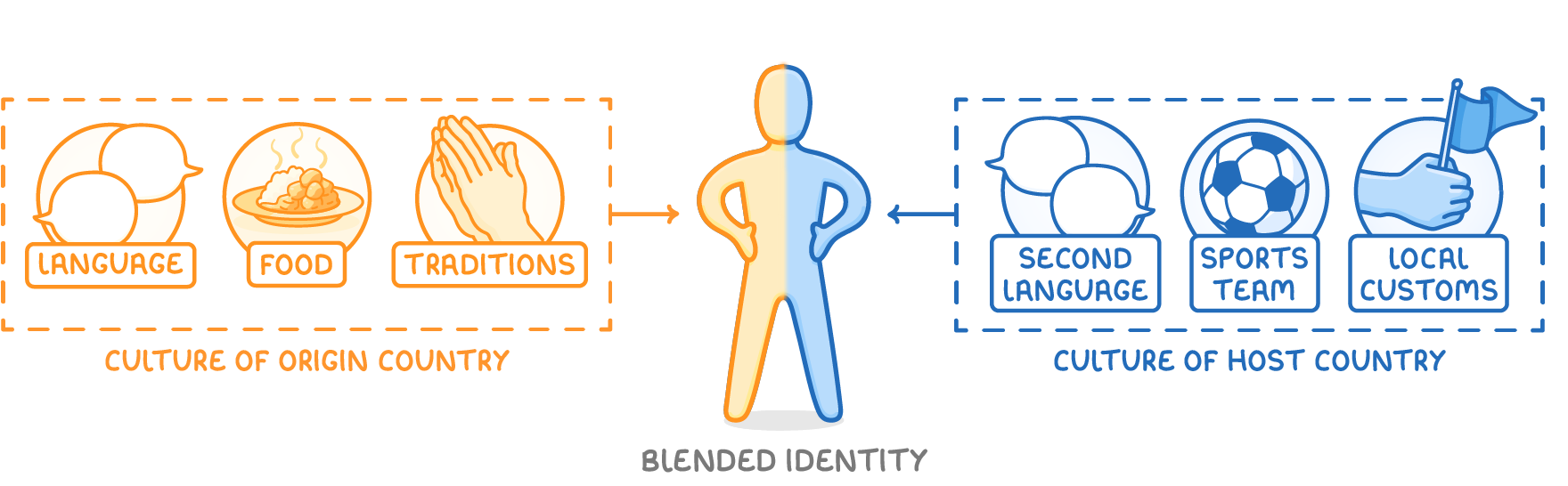
Immigrants and ethnic minorities may maintain elements of their original culture, such as language, customs, food, and traditions, while also adopting aspects of their host country.
-
This can result in blended identities, where individuals support sports teams from both their home and host nations, for example.
Potential tensions and new understandings
-
Diversity can challenge traditional views of loyalty, but it also fosters inclusive perspectives.
-
Some people believe loyalty should be exclusive to one nation, leading to tensions; for instance, they might argue that immigrants should fully adopt the host country's language and values, or view support for multiple teams as disloyal.
-
However, this can also inspire evolved ideas of national identity that celebrate diversity, creating more inclusive definitions of what it means to belong to a nation.