17.4 - Common Shapes of Complexes
- 1
What stereoisomerism is
- 2
Cis-trans isomerism in complex ions
- 3
The role of cis-platin as an anti-cancer drug
Stereoisomers and complex ions
Stereoisomers are compounds with the same structural formula but different three-dimensional arrangements of their atoms.
Complex ions exhibit stereoisomerism because their ligands can arrange in various spatial positions around the central metal ion.
Cis-trans isomers in complex ions
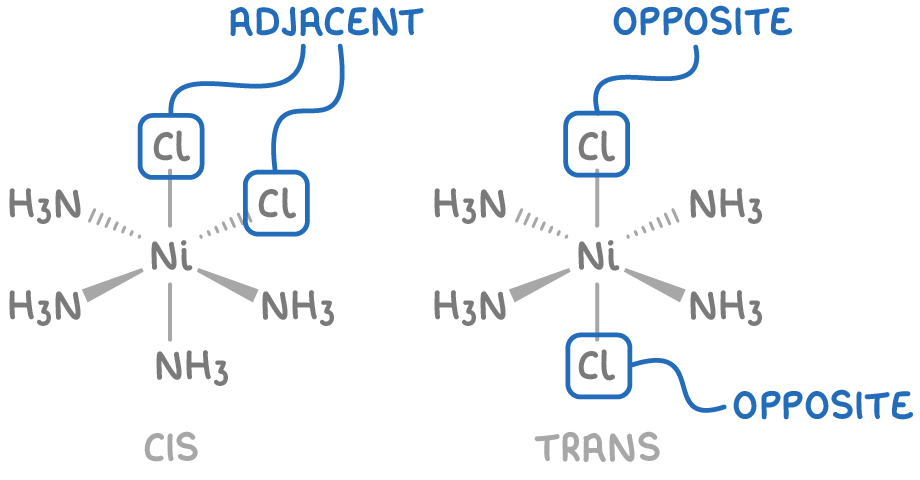
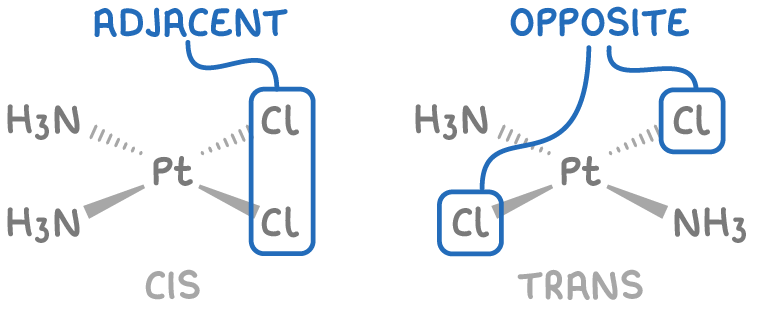
Cis-trans isomers are types of stereoisomers where identical groups can be positioned either adjacent (cis) or opposite (trans) to each other.
Cis-trans isomerism occurs in:
- Octahedral complexes with 4 monodentate ligands of one type and 2 monodentate ligands of another. For example, in the complex ion Ni(NH3)4Cl2, the Cl- ligands are either adjacent to each other (cis-isomer) or on opposite corners of the octahedron (trans-isomer).
- Square planar complexes with 2 pairs of monodentate ligands, for example, Pt(NH3)2Cl2.
For example, in the complex ion Pt(NH3)2Cl2, the Cl- ligands are either adjacent to each other (cis-isomer) or diagonally opposite to each other (trans-isomer).
Cisplatin: A medicinal application of cis-trans isomerism
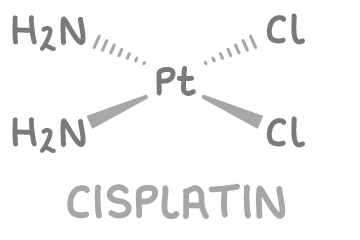
One of the most well-known examples of cis-trans isomerism is the anti-cancer drug cis-platin.
Key points about cis-platin:
- It is a square planar platinum(II) complex with the formula Pt(NH3)2Cl2.
- The cis isomer, with adjacent Cl and NH3 ligands, is used to treat various cancers.
- The trans isomer is toxic and not used medically.
This example highlights the critical importance of isomerism in medicine, as different isomers can have vastly different biological effects. Ensuring the correct isomer is used is essential for patient safety and treatment efficacy.