17.5 - Ligand Exchange Reactions
- 1
Ligand exchange reactions and their effect on complex geometry
- 2
Entropy changes and complex ion stability
- 3
Predicting products of unfamiliar exchange reactions
- 4
The role of Fe2+ complexes in haemoglobin for oxygen transport
Ligand exchange reactions
Ligands bound to a central metal ion in a complex can be exchanged with other ligands in solution. This is called a ligand exchange, or ligand substitution reaction. This often leads to a colour change in the solution.
If incoming and outgoing ligands are similar in size, the coordination number and geometry do not change. For example:
[Cr(H2O)6]3+(aq) + 6NH3(aq) ➔ [Cr(NH3)6]3+(aq) + 6H2O(l)
- H2O and NH3 are similar in size, so the chromium ion complex remains octahedral with six coordinated ligands.
- The colour changes from pale purple to purple.
If ligands differ in size, the coordination number and geometry change. Examples include:
[Cu(H2O)6]2+(aq) + 4Cl-(aq) ➔ [CuCl4]2-(aq) + 6H2O(l)
[Co(H2O)6]2+(aq) + 4Cl-(aq) ➔ [CoCl4]2-(aq) + 6H2O(l)
- Cl- ions are much larger than H2O so the complex ion changes from 6-coordinate octahedral to 4-coordinate tetrahedral.
- For copper - The colour changes from pale blue to yellow.
- For cobalt - The colour changes from pale pink to blue.
Substitution can also be partial. For example:
[Cu(H2O)6]2+(aq) + 4NH3(aq) ➔ [Cu(NH3)4(H2O)2]2+(aq) + 4H2O(l)
- NH3 partially replaces H2O ligands but the copper ion complex remains octahedral with six coordinated ligands.
- The colour changes from pale blue to dark blue.
Entropy changes and complex stability
Ligand exchange reactions involving the replacement of monodentate ligands with multidentate ligands are essentially irreversible because multidentate ligands form more stable complexes compared to monodentate ligands.
For example, the bidentate ligand ethylenediamine (en) replaces monodentate ammonia ligands:
[Co(NH3)6]2+(aq) + 3en(aq) ➔ [Co(en)3]2+(aq) + 6NH3(aq)
The enhanced stability provided by multidentate ligands can be explained by the increase in entropy:
- When monodentate ligands get substituted for multidentate ligands, the number of separate particles in solution increases (in the reaction above, the number of particles increases from 4 to 7).
- More particles means higher entropy. Reactions with a large positive ΔSsystem value are more thermodynamically favourable.
- Reversing these reactions would decrease entropy, making the formation of multidentate complexes essentially irreversible.
Haemoglobin oxygen transport
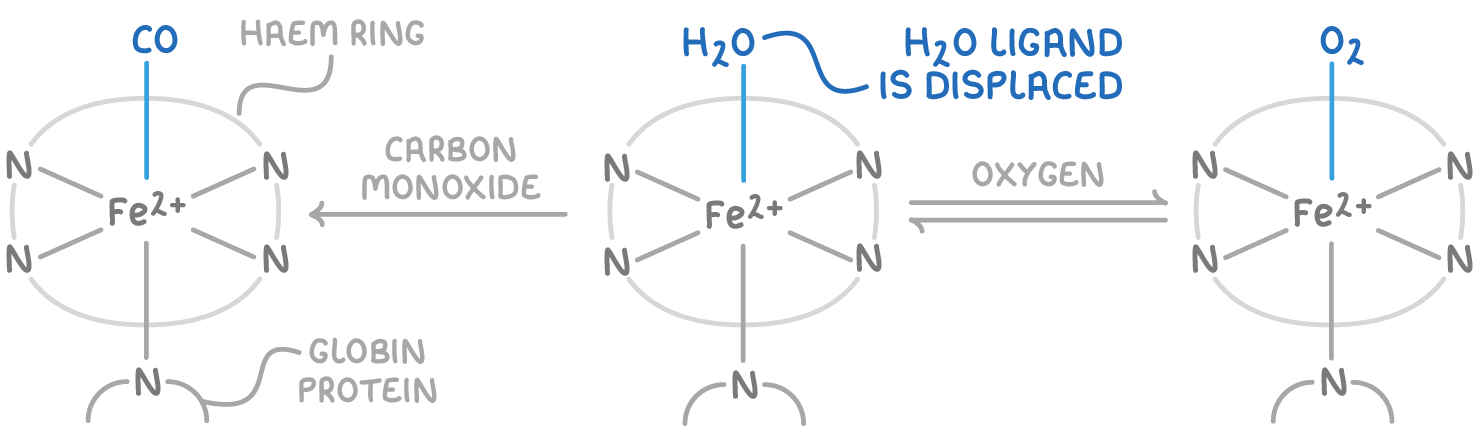
Haemoglobin provides an important example of ligand exchange occurring in the body for oxygen transport:
- Haemoglobin is an iron(II) complex containing a multidentate ligand called a haem group. Four nitrogen atoms within the haem molecule provide four coordination bonds to the Fe. A fifth nitrogen from a globin protein provides another ligand. The sixth ligand position starts off occupied by a water molecule.
- In the lungs, where oxygen concentration is high, the water ligand is substituted by an oxygen molecule (O2). This forms oxyhaemoglobin, which travels around the body.
- At body tissues lacking oxygen, the O2 is exchanged back for a water ligand as oxyhaemoglobin releases its oxygen.
- If carbon monoxide (CO) is inhaled, haemoglobin substitutes its water ligand for the CO. This is dangerous because CO binds to the haemoglobin irreversibly, preventing further oxygen transport.
- CO binds irreversibly, forming a stronger coordination bond than O2.
Worked example 1 - Predicting the outcomes of unfamiliar ligand substitutions
Excess ethylenediamine (en)(aq) is added to a solution of [Fe(H2O)6]2+ ions.
Write an equation for this ligand exchange reaction and predict the shape of the complex ion formed.
Step 1: Predict extent of substitution
H2O is a monodentate ligand whereas en is a bidentate ligand. Full substitution of H2O with en leads to increased stability of the complex. Six H2O ligands are replaced by three en ligands.
Step 2: Predict the shape of the complex ion formed
Substitution will occur with no change in coordination number or geometry so the shape of the complex ion formed remains octahedral.
Step 3: Consider the overall charge of the complex ion formed
Since both H2O and en ligands have no charge, the overall charge of the complex remains 2+.
Step 4: Equation
[Fe(H2O)6]2+(aq) + 3en(aq) ➔ [Fe(en)3]2+(aq) + 6H2O(aq)