6.6 - Conduction
- 1
Understanding thermal conduction and its similarities with electrical conduction
- 2
Exploring thermal conduction in solids, liquids, and gases
- 3
Defining thermal conductivity and its units
- 4
Calculating the rate of energy transfer using the thermal conductivity equation
- 5
Investigating the factors affecting thermal conductivity
Thermal conduction
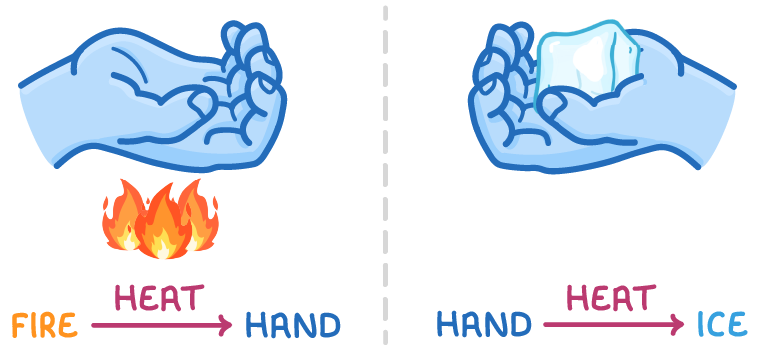
Conduction is the process of heat transfer from a high temperature to a lower temperature within a material or between materials in contact. This phenomenon is experienced in everyday life, such as burning a hand on a hot stove or melting ice in the hand.
Conductors - Materials which allow heat to pass through them easily, such as metals.
Insulators - Materials which do not allow heat to pass through them easily, such as gases.
How conduction works
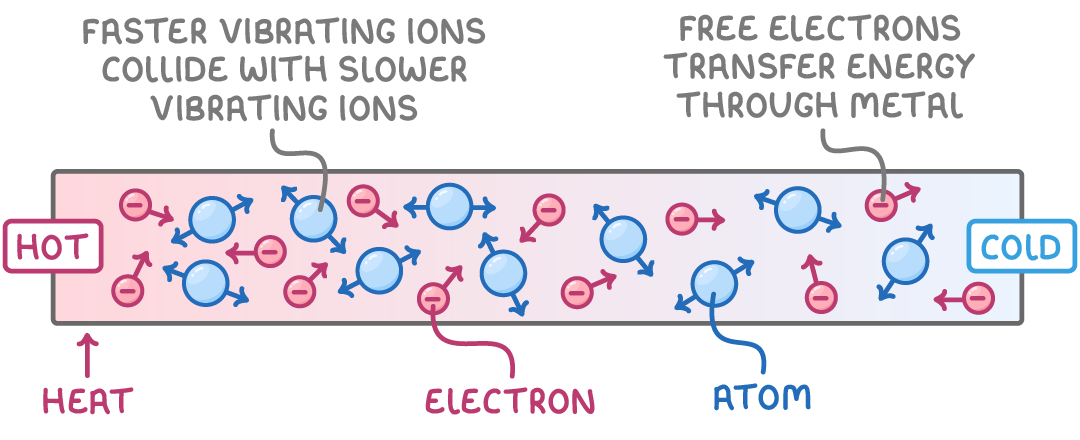
Conduction can occur in solids, liquids, and gases. In solids, the ions vibrate about their fixed positions, and the higher the temperature, the greater their average kinetic energy. The ions transfer energy to free electrons, which redistribute this energy throughout the material until it reaches a uniform temperature.
In gases and liquids, conduction is less effective due to the weaker inter-atomic connections and larger distances between atoms compared to solids. In these materials, convection often plays a more significant role in energy transfer.
Thermal conductivity
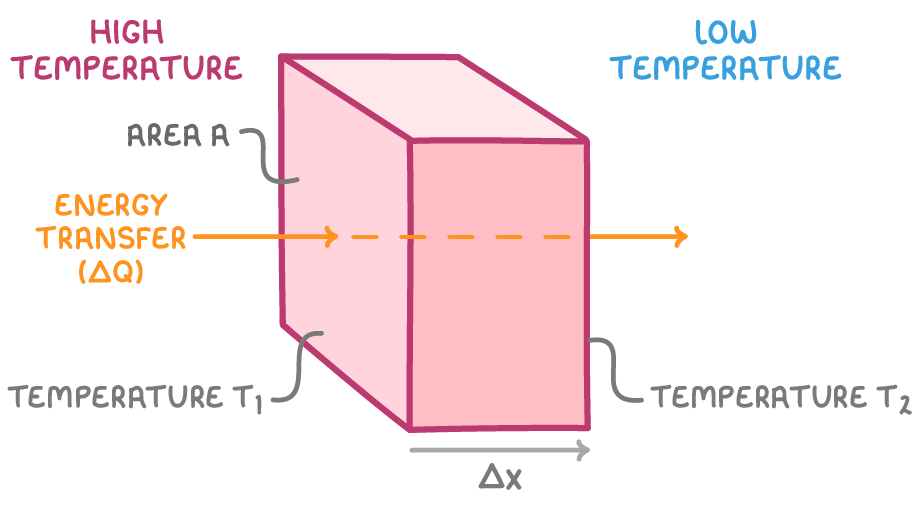
Thermal conductivity (k) is a measure of a material's ability to conduct heat when in a steady state, where the temperature at any point does not change with time. It is defined as the rate of energy transfer per unit area and temperature gradient across the conductor.
The equation for thermal conductivity is:
$\text{k = }\frac{\Delta \text{Q}}{\Delta \text{t}}\times\frac{\Delta \text{x}}{\text{A}\Delta \text{T}}$
Where:
- k = thermal conductivity (W m-1 K-1)
- $\frac{\Delta Q}{\Delta t}$ = rate of energy transfer (W)
- A = cross-sectional area (m2)
- $\frac{\Delta T}{\Delta x}$ = temperature gradient (K m-1)
Worked example - Calculating the rate of energy transfer using thermal conductivity
Calculate the rate of energy transfer through a copper rod that is 1 m long and has a cross-sectional area of 0.01 m². The temperature difference between the two ends of the rod is 100 K. The thermal conductivity of copper is 401 W m⁻¹ K⁻¹.
Step 1: Formula
$\text{k = }\frac{\Delta \text{Q}}{\Delta \text{t}} \times \frac{\Delta \text{x}}{\text{A } \Delta \text{T}}$
Step 2: Rearrangement
$\frac{\Delta \text{Q}}{\Delta \text{t}}\text{ = k }\times \frac{\text{A } \Delta \text{T}}{\Delta \text{x}}$
Step 3: Substitution and correct evaluation
$\frac{\Delta Q}{\Delta t} = 401 \times \frac{0.01 \times 100}{1}=401$W
Factors affecting thermal conductivity
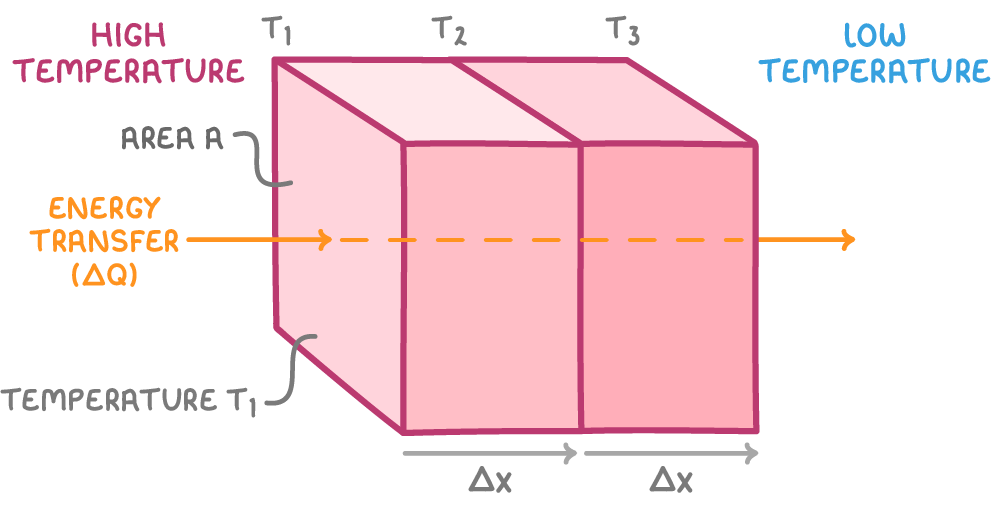
The thermal conductivity equation shows that:
- Doubling the cross-sectional area (A) doubles the rate of energy transfer, assuming constant temperature difference and conductor length.
- Doubling the time (Δt) for the transfer doubles the total energy transferred, assuming all other factors remain unchanged.
When two identical slabs are joined together with the same energy transfer through both, the temperature difference across each slab is the same (ΔT), resulting in a total temperature difference of 2ΔT across a width of 2Δx.
For a steady state, the power input to the slab must equal the power output, meaning there should be no energy transfer out of the sides of the slab.
Range of thermal conductivity values
Thermal conductivity values vary widely, ranging from excellent conductors to poor insulators. The table below provides some examples of thermal conductivity values for different materials.
| Material | Thermal Conductivity (W m K) |
|---|---|
| Copper | 401 |
| Aluminium | 237 |
| Steel | 50.2 |
| Glass | 0.8 |
| Air | 0.024 |