7.2 - Albedo
- 1
Defining the solar constant and its value
- 2
Factors influencing variations in the solar constant
- 3
The effect of Earth's atmosphere on incoming solar radiation
- 4
Understanding albedo and its role in Earth's energy balance
- 5
Calculating the average intensity of solar radiation absorbed by Earth's surface
The solar constant
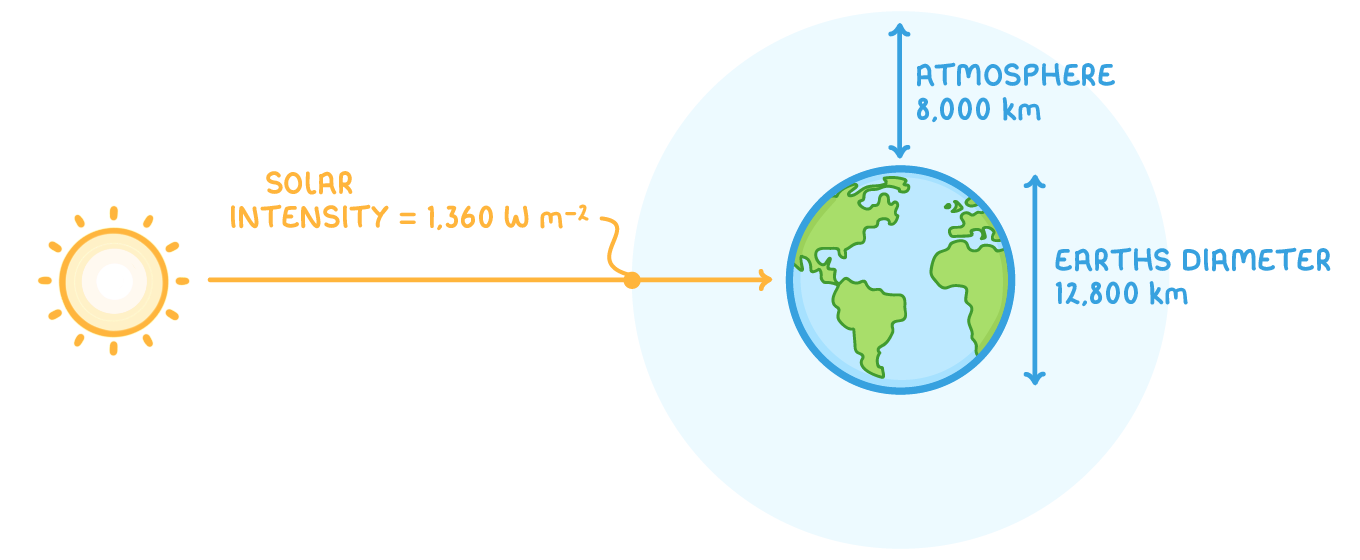
The solar constant (S) is the intensity of solar radiation across all wavelengths incident on a plane perpendicular to the line joining the centres of the Sun and Earth, at their mean distance apart. It represents the power per unit area at the top of Earth's atmosphere.
The solar constant can be estimated using:
$\text{S = }\frac{\text{P}_{\text{Sun}}}{\text{A}_{\text{sphere}}}$
Where:
- $\text{P}_{\text{Sun}}$ = power output of the Sun (W)
- $\text{A}_{\text{sphere}}$ = surface area of an imaginary sphere with a radius equal to the Earth-Sun distance (m$^2$)
The measured value of the solar constant is approximately 1,360 W m$^{-2}$. This value represents the average intensity of solar radiation at the top of Earth's atmosphere, before any atmospheric effects.
Factors affecting the solar constant
The solar constant varies periodically due to several factors:
- The Sun's output varies by about 0.1% during its 11-year sunspot cycle, causing small fluctuations in the solar constant over this period.
- Earth's elliptical orbit causes a 7% variation in the solar constant between January (when Earth is closest to the Sun) and July (when Earth is farthest from the Sun).
- Longer-period cycles in the Sun's luminosity and Earth's orbit, ranging from hundreds to thousands of years, can also affect the solar constant over geological timescales.
The role of Earth's atmosphere
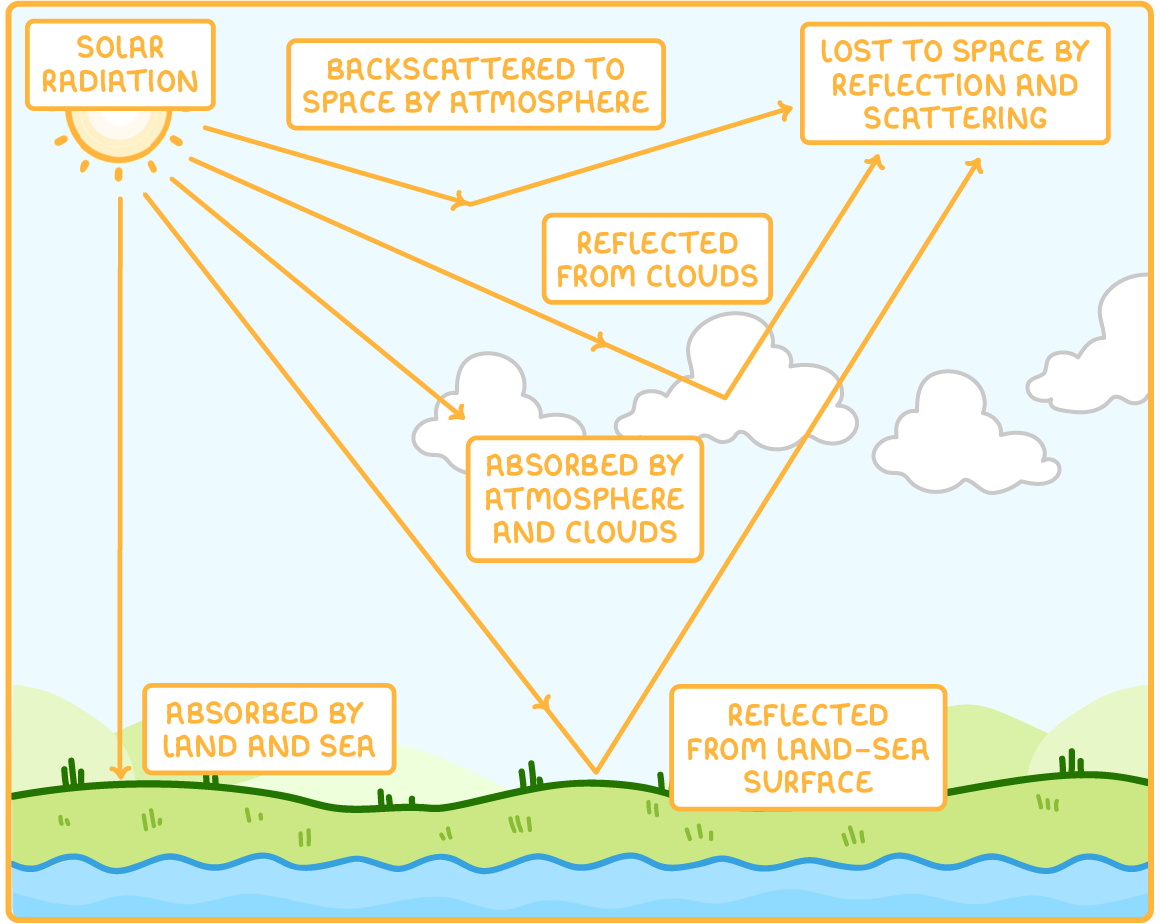
As solar radiation enters and travels through Earth's atmosphere, it undergoes absorption and scattering by various atmospheric constituents, such as gases, aerosols, and clouds. This process reduces the energy that ultimately reaches Earth's surface.
The average incident intensity ($\text{I}_{\text{avg}}$) at any point on Earth's surface over a 24-hour period, accounting for the reduction due to atmospheric effects, is:
$\text{I}_{\text{avg}} = \frac{\text{S}}{4}$
Substituting the solar constant value:
$\text{I}_{\text{avg}} = \frac{1,360}{4} = 340 \text{ W m}^{-2}$
This equation shows that the average intensity of solar radiation reaching Earth's surface is approximately one-quarter of the solar constant, due to the geometric effect of Earth's spherical shape and the attenuation by the atmosphere.
Albedo
Albedo ($\alpha$) is the ratio of the total energy scattered by a surface to the total energy incident on it. It ranges from 0 (no scattering) to 1 (complete scattering).
$\alpha = \frac{\text{total scattered power}}{\text{total incident power}}$
Earth's average annual albedo is approximately 0.3, meaning about 30% of the incoming solar radiation is scattered back into space. The remaining 70% is absorbed by Earth's surface and atmosphere.
Factors influencing albedo include:
- Cloud cover - Thin clouds have an albedo between 0.3 - 0.4, while thick cumulonimbus clouds have an albedo of up to 0.9
- Latitude - Higher albedo at the poles due to ice and snow cover
- Surface terrain and material - Snow has a high albedo, while forests have a low albedo
Average intensity absorbed by Earth's surface
The average intensity absorbed by the Earth's surface ($\text{I}_{\text{absorbed}}$) can be calculated using the average incident intensity and Earth's average albedo:
$I_{\text{absorbed}} = (1 - \alpha) \frac{S}{4}$
This equation accounts for the fraction of incident solar radiation that is not scattered back to space (1 - $\alpha$) and the geometric factor of $\frac{1}{4}$ due to Earth's spherical shape.
Worked example - Calculating the average intensity of solar radiation absorbed by Earth's surface
Calculate the average intensity of solar radiation absorbed by Earth's surface, given the solar constant (1,360 W m$^{-2}$) and Earth's average albedo of 0.3.
Step 1: Formula
$I_{\text{absorbed}} = (1 - \alpha) \frac{S}{4}$
Step 2: Substitution and correct evaluation
$I_{\text{absorbed}} = (1 - 0.3)\times \frac{1360}{4}$
$I_{\text{absorbed}} = 0.7 \times 340$
$I_{\text{absorbed}} = 238 \text{ W m}^{-2}$
This result represents the average power per unit area absorbed by Earth's surface, accounting for atmospheric effects and Earth's reflectivity (albedo). This absorbed energy drives various climate processes, such as atmospheric and oceanic circulation, and plays a crucial role in maintaining Earth's energy balance.