9.1 - First Law Of Thermodynamics
- 1
Defining systems, surroundings, and the universe in thermodynamics
- 2
Distinguishing between closed and isolated systems
- 3
Understanding the First Law of Thermodynamics
- 4
The Clausius sign convention for heat, internal energy, and work
- 5
Interpreting pressure-volume (P-V) diagrams
- 6
Calculating work done by a gas using P-V diagrams
Systems, surroundings, and the universe
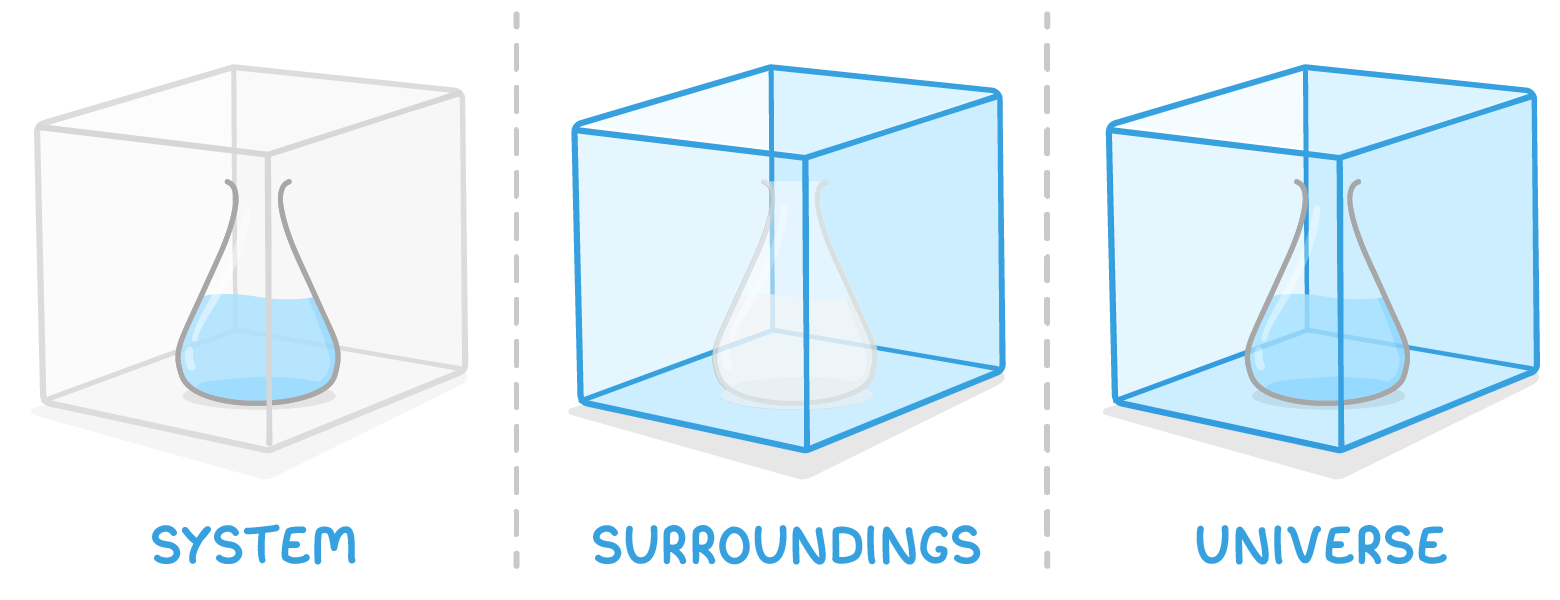
In thermodynamics, we focus on a particular part of the world, called the system. The system is the region of interest, and it can be a gas, a liquid, a solid, or a combination of these. Everything outside the system is called the surroundings. Together, the system and its surroundings make up the universe. The boundaries between the system and its surroundings can be real or imaginary, depending on the situation.
Closed and isolated systems
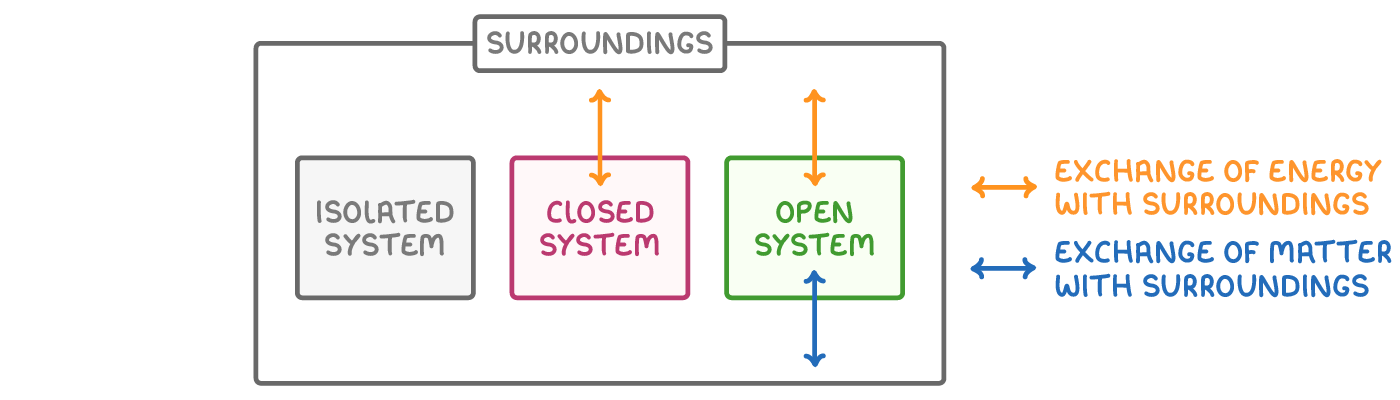
There are important types of systems in thermodynamics:
- Closed system - In a closed system, the number of particles within the system remains constant, but energy can flow into or out of the system in the form of heat or work. An example of a closed system is a gas in a sealed container, where the container walls allow heat transfer but not mass transfer.
- Isolated system - In an isolated system, neither matter nor energy can enter or leave the system. An example of an isolated system is a perfectly insulated container, where no heat or mass transfer occurs between the system and its surroundings.
- Open system - In an open system, both matter and energy can enter or leave the system. A cup of coffee represents an open system as both heat and mass can be transferred to the surroundings.
The First Law of Thermodynamics
The First Law of Thermodynamics is a statement of the conservation of energy principle. It states that energy cannot be created or destroyed, only converted from one form to another. The law relates the change in a system's internal energy to the energy transferred as heat and the work done by or on the system. The mathematical expression for the First Law is:
$Q = \Delta U + W$
Where:
- Q = heat energy transferred (J)
- $\Delta$U = change in internal energy (J)
- W = work done by the system (J)
To maintain consistency when applying the First Law, we use the Clausius sign convention. This convention defines the signs of heat, internal energy change, and work as follows:
- Positive Q - Heat energy is transferred from the surroundings to the system
- Positive $\Delta$U - The system's internal energy increases
- Positive W - Work is done by the system on the surroundings
Pressure-volume (P-V) diagrams
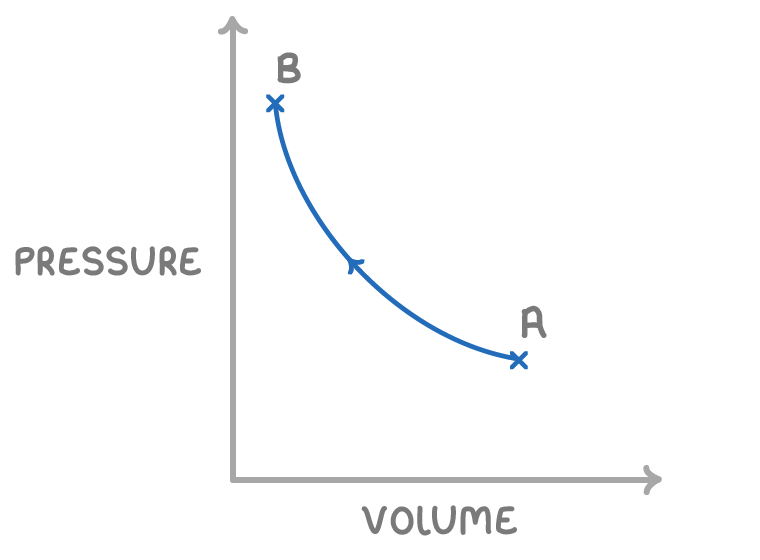
Pressure-volume (P-V) diagrams are graphical representations of gas processes, showing how pressure and volume change in a system. They are particularly useful for visualising the work done by or on a gas during a process. In a P-V diagram, pressure is plotted on the vertical axis, and volume is plotted on the horizontal axis.
Calculating work using P-V diagrams
Consider an ideal gas in a cylinder with a movable piston. As the gas expands, it does work on the surroundings by pushing the piston. The work done by the gas during a small volume change $\Delta$V at constant pressure P is given by:
$W = P\Delta V\text{ = P }\left(V_2\text{ - V}_1\right)$
Where:
W = Work done by the gas (J)
P = Pressure (Pa)
$\Delta$V = change in volume (m^3^)
V_2_ = final volume (m^3^)
V_1_ = initial volume (m^3^)
In a P-V diagram, this work is represented by the area under the curve for the process. To calculate the total work done during a process, we need to find the area under the curve between the initial and final states.
Worked example - calculating work done by an expanding gas
An ideal gas expands from 2 m3 to 4 m3 at a constant pressure of 100 kPa. Calculate the work done by the gas.
Step 1: Identify the relevant quantities
V_1_ = 2 m^3^
V_2_ = 4 m^3^
P = 100 kPa = 100,000Pa
Step 2: Calculate the change in volume
$\Delta V = V_2 - V_1 = 4 - 2 = 2 \text{ m}^3$
Step 3: Use the formula for work done
$W = P\Delta V = 100,000 \times 2 = 200,000 \text{ J} = 200 \text{ kJ}$
The positive value indicates that the gas does work on the surroundings, as per the Clausius sign convention.
Worked example - calculating work done by a contracting gas
A piston compresses an ideal gas from 5 L to 2 L at a constant pressure of 200 kPa. Calculate the work done on the gas.
Step 1: Convert litres to cubic metres
To convert from litres to cubic metres, divide by 1,000:
V_1_ = 5 L = 0.005 m^3^
V_2_ = 2 L = 0.002 m^3^
Step 2: Convert kilopascals to pascals
To convert from kilopascals to pascals, multiply by 1,000:
P = 200 kPa = 200,000 Pa
Step 3: Calculate the change in volume
$\Delta V = V_2 - V_1 = 0.002 - 0.005 = -0.003 \text{ m}^3$
Step 4: Use the formula for work done and evaluate
$W = P\Delta V = 200,000 \times (-0.003) = -600 \text{ J}$
The negative value indicates that work is done on the gas by the surroundings.
Internal energy
The internal energy of an ideal gas is directly proportional to its temperature as given by:
$\text{U = }\frac{3}{2}\text{ n R T = }\frac{3}{2}\text{ N k T}$
Where:
- n = number of moles of ideal gas (mol)
- R = ideal gas constant (8.31 J K^-1^ mol^-1^)
- T = temperature (K)
- N = number of particles
- k = Boltzmann constant (1.38 x 10^-23^ J K^-1^)