20.7 - Line Emission Spectra
- 1
Continuous spectrum of light
- 2
Line emission spectra from gases
- 3
Line absorption spectra
- 4
How to compare emission and absorption spectra
Continuous spectrum of light
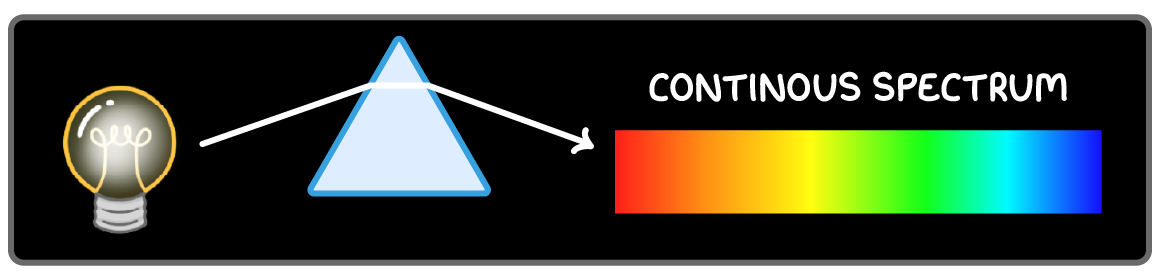
The spectrum of white light is continuous.
Hot objects emit a continuous spectrum of light in the visible and infrared region.
All wavelengths are observed because the electrons are not confined to discrete energy levels.
Passing the light through a prism allows a continuous spectrum of wavelengths to be observed.
Line emission spectra
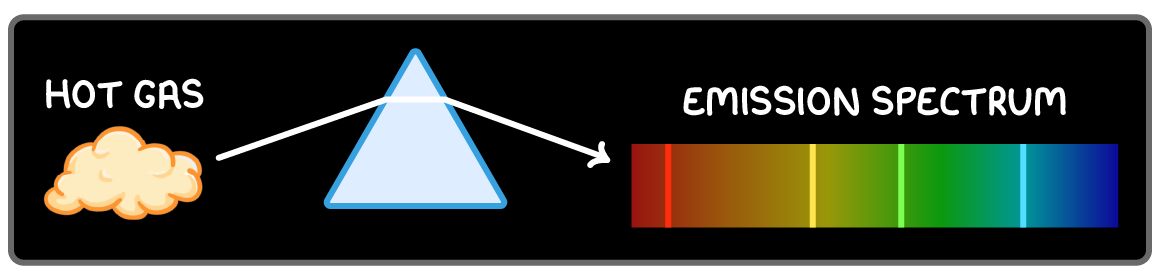
When light from excited gases passes through a prism, particular wavelengths are separated into a line emission spectrum.
Each line corresponds to a wavelength of light emitted.
This shows the discrete electron energy level transitions emitting those wavelengths in the gas.
Each element has a unique line emission spectra.
Line absorption spectra
A line absorption spectrum occurs when white light passes through a gas.
Atoms in the gas absorb particular wavelengths, leaving dark absorption lines in the continuous spectrum.
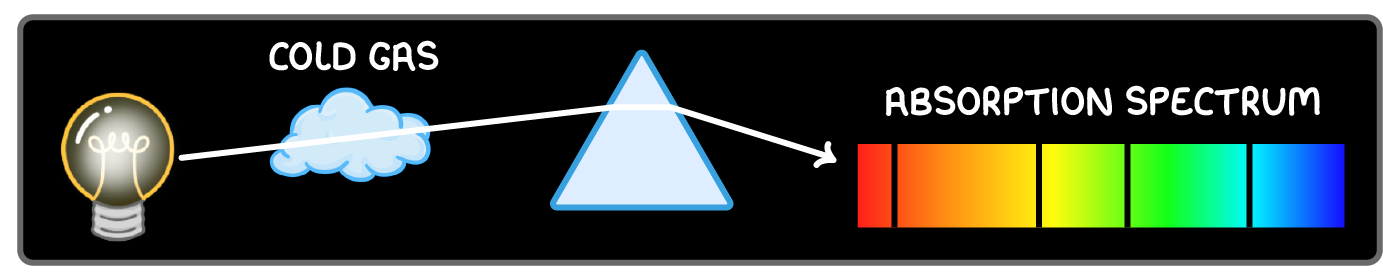
Each absorbed wavelength corresponds to electron transitions in the gas atoms.
Comparing emission and absorption spectra
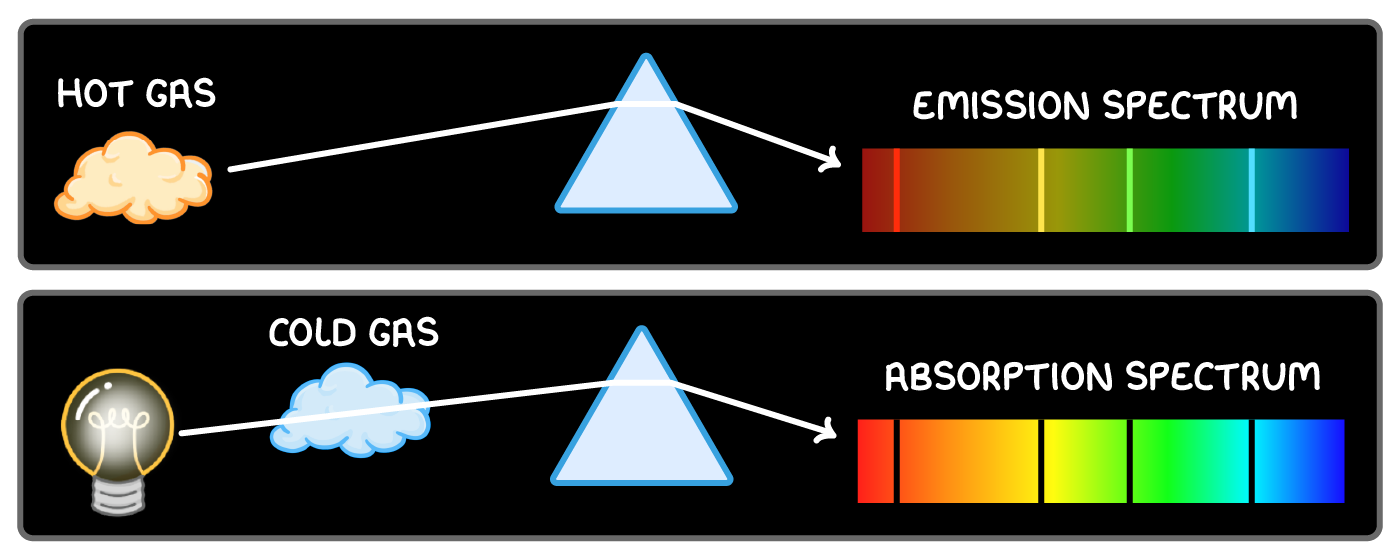
- Emission spectra show bright lines from emitted wavelengths.
- Absorption spectra show dark lines from absorbed wavelengths.
Both confirm quantised energy levels in gas atoms, since emitted or absorbed photons have energies equal to energy level differences.
Worked example - Calculating the energy difference between energy levels
The line emission spectra below show the wavelengths of light emitted by hydrogen gas.

a) Calculate the energy of the photon corresponding to a wavelength of 486 nm.
Step 1: Formula
$\text{E = }\frac{\text{h c}}{\lambda}$
Step 2: Convert nm to m
To convert from nm to m, multiply by 1 x 10^-9^
486 nm = 486 x 10^-9^ m
Step 3: Substitution and correct evaluation
$\text{E = }\frac{6.63\times10^-34\times3\times10^8}{486\times10^{-9}}\text{ = 4.09 x 10}^{-19}\text{ J}$
b) The energy levels of hydrogen are shown below.
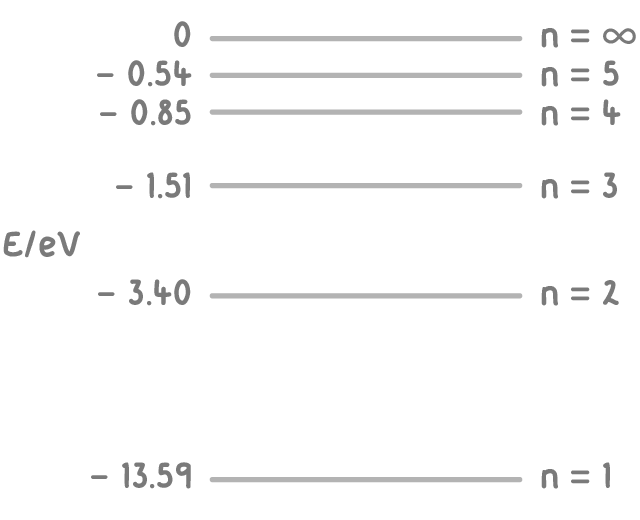
Determine which level the electron de-excited from to produce a photon of wavelength 486 nm.
Step 1: Convert J into eV
To convert from J to eV, divide by 1.6 x 10^-19^
4.09 x 10^-19^ J = 2.55 eV
Step 2: Compare to the energy level diagram
A difference of 2.55 eV corresponds to the difference in energy between n = 4 and n = 2
$\Delta \text{E = -0.85 - -3.40 = 2.55 eV}$