4.1 - Moments & Torque
- 1
Defining torque as the rotational equivalent of force
- 2
The relationship between torque, moment of inertia, and angular acceleration
- 3
Calculating torque using the angle between force and radius
- 4
Newton's first law of motion in rotational terms
- 5
The principle of moments for objects in rotational equilibrium
Torque as the rotational equivalent of force
In linear mechanics, Newton's second law states that the net force acting on an object is equal to its mass multiplied by its acceleration (F = ma).
In rotational motion, we have similar equivalents:
- Moment of inertia (I) is the rotational equivalent of mass (m)
- Angular acceleration (α) is the rotational equivalent of linear acceleration (a)
The rotational equivalent of Newton's second law is:
$\tau = I\alpha$
Where:
- τ = torque (N m)
- I = moment of inertia (kg m$^2$)
- α = angular acceleration (rad s$^{-2}$)
Calculating torque using the angle between force and radius
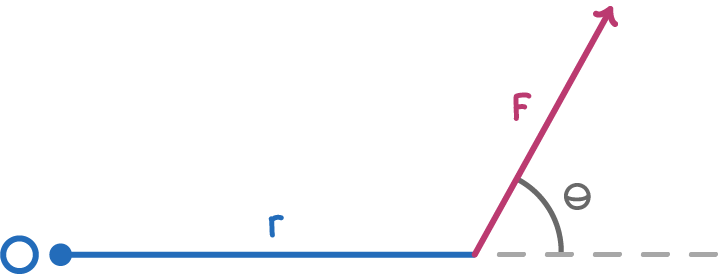
Torque can be calculated using the following formula:
$\tau = Fr\sin\theta$
Where:
- F = force (N)
- r = radius (m)
- θ = angle between the force and the radius (rad)
This can also be thought of as: $\tau = F \times (r\sin\theta)$
Where $(r\sin\theta)$ is the perpendicular distance from the line of action of the force to the centre of rotation.
For a given force (F) and radius (r), the maximum torque occurs when θ = 90° (sin θ = 1). In this case: $\tau_\text{max} = Fr$
Worked example - Calculating torque
A 10 N force is applied to a wrench at a distance of 0.5 m from the pivot point. The force is applied at an angle of 30° to the wrench. Calculate the torque exerted by the force.
Step 1: Formula
$\tau = Fr\sin\theta$
Step 2: Substitution and correct evaluation
$\tau = 10 \times 0.5 \times \sin30\text{ = 2.5 N m}$
Newton's first law of motion in rotational terms
Newton's first law of motion states that an object remains at rest or moves with constant velocity unless acted upon by an external force. The rotational equivalent is:
An object moves at a constant angular velocity (which may be zero) unless an external torque acts on it.
In other words, for an object to be in rotational equilibrium, no external resultant torque can act on it.
For an object to be in rotational equilibrium, the total clockwise torque acting on the object must equal the total counter-clockwise torque. This statement is known as the principle of moments.
$\sum\tau_\text{clockwise} = \sum\tau_\text{counter-clockwise}$
Worked example - Calculating the net torque on an object
A uniform rod of length 2 m and mass 10 kg is pivoted at its centre. Two forces, 20 N and 15 N, are applied at the ends of the rod, both acting perpendicularly to the rod but in opposite directions. The 20 N force causes a counter-clockwise torque and the 15 N force provides a clockwise torque. Calculate the net torque on the rod.
Step 1: Determine the torques caused by each force
For the 20 N force:
$\tau_1 = Fr = 20 \times 1 = 20\text{ N m}$ (counter-clockwise)
For the 15 N force:
$\tau_2 = Fr = 15 \times 1 = 15\text{ N m}$ (clockwise)
Step 2: Calculate the net torque
$\tau_\text{net} = \tau_2 - \tau_1 = 15 - 20 = -5\text{ N m}$
The negative sign indicates that the net torque is counter-clockwise.