10.4 - Resistivity
- 1
The role of length, area, and resistivity in determining resistance
- 2
What resistivity means and its units
- 3
Common resistivity values for conductors
- 4
The concept of Ohm's law in the context of ohmic conductors
- 5
How to calculate the resistivity of a wire by measuring its resistance
Understanding Ohm's law and ohmic conductors
Ohmic conductors, at a steady temperature, obey Ohm's law.
The potential difference across a component is directly proportional to the current flowing through it and the resistance of the component.
$V = IR$
Where:
- V = Voltage (V)
- I = Current (A)
- R = resistance (Ω)
Key points:
- Doubling the voltage results in a doubled current.
- The resistance remains constant under these conditions.
- This law does not apply to non-ohmic materials at varying temperatures.
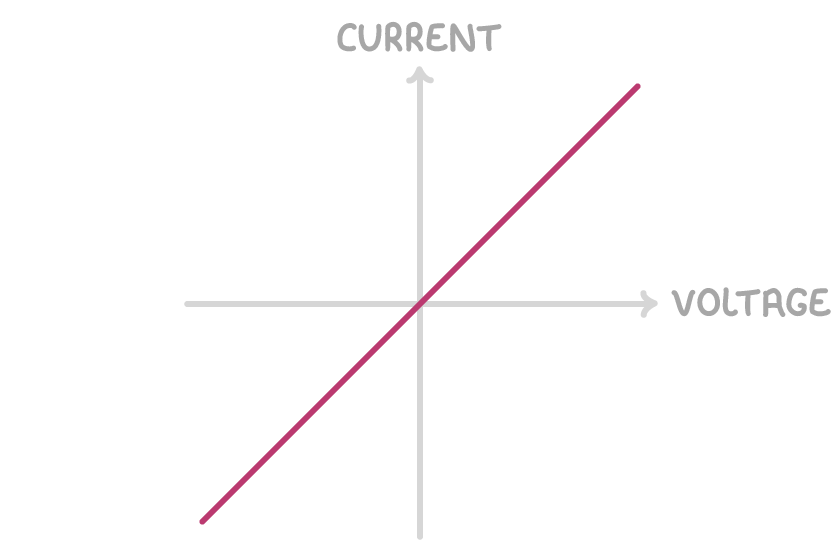
Three key factors influencing resistance
The resistance (R) of a conductor is influenced by:
- Length (L) - The longer the wire, the greater its resistance.
- Area (A) - Wires with a larger cross-sectional area have reduced resistance.
- Resistivity ($\rho$) - This is a property unique to the material, which varies with temperature.
Resistivity is defined as the resistance encountered in a material that is 1 metre long and has a cross-sectional area of 1 square metre. Its units are ohm-metres (Ωm).
The formula linking these factors is:
$R = \frac{\rho L}{A}$
Where:
R = resistance ($\Omega$)
$\rho$ = resistivity ($\Omega$ m$)$
L = length (m)
A = area (m$^2$)
Worked example - Calculating the resistance of a copper wire
We will calculate the resistance of a copper wire that is 2 metres long and 1 mm in diameter.
The resistivity of copper is 1.72 x 10⁻⁸ $\Omega$ m.
Step 1: Calculate the Cross-sectional Area (A)
$A = \pi \times r^2$
$A = \pi \times 0.0005^2 = 7.85 \times 10^{-7} \text{ m}^2$
Step 2: Formula
$\text{R = }\frac{\rho\text{ l}}{\text{A}}$
Step 3: Substitution and correct evaluation
$R = \frac{1.72 \times 10^{-8}\times 2 }{7.85 \times 10^{-7} }=0.044\text{ } \Omega$
Determining the resistivity of a wire experimentally
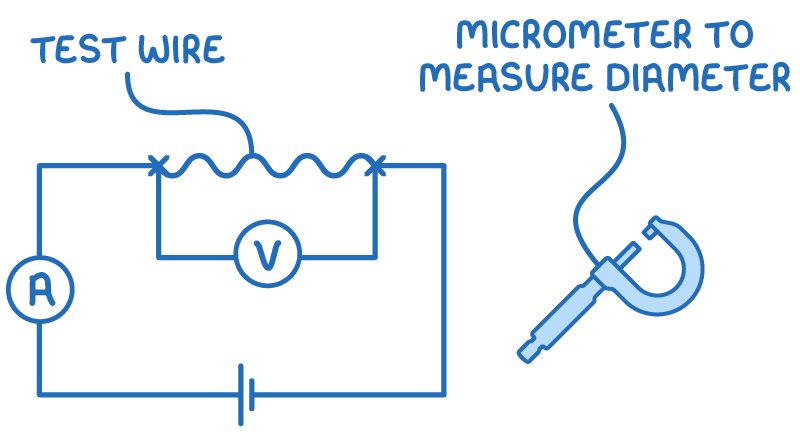
To find out the resistivity of a wire:
- Measure the diameter of the wire using a micrometer and calculate its cross-sectional area: $A = \frac{\pi d^2}{4}$ .
- Set up a circuit with the wire, power supply, ammeter and voltmeter
- Record the voltage and current readings.
- Vary the length of the wire and record the new voltage and current readings.
- Calculate the resistance for each length using: $R = \frac{V}{I}$
- Create a graph plotting length against resistance.
- The gradient of this graph equals $\frac{\rho}{A}$
- Multiply the gradient by A to obtain the wire's resistivity.