22.3 - Compton Scattering
- 1
The Compton effect
- 2
How to investigate the Compton effect experimentally
- 3
Analysing the interaction between X-ray photons and electrons
- 4
Calculating the wavelength shift and recoil angle using Compton's equations
- 5
Comparing Compton scattering with atom scattering
Introduction to the Compton effect
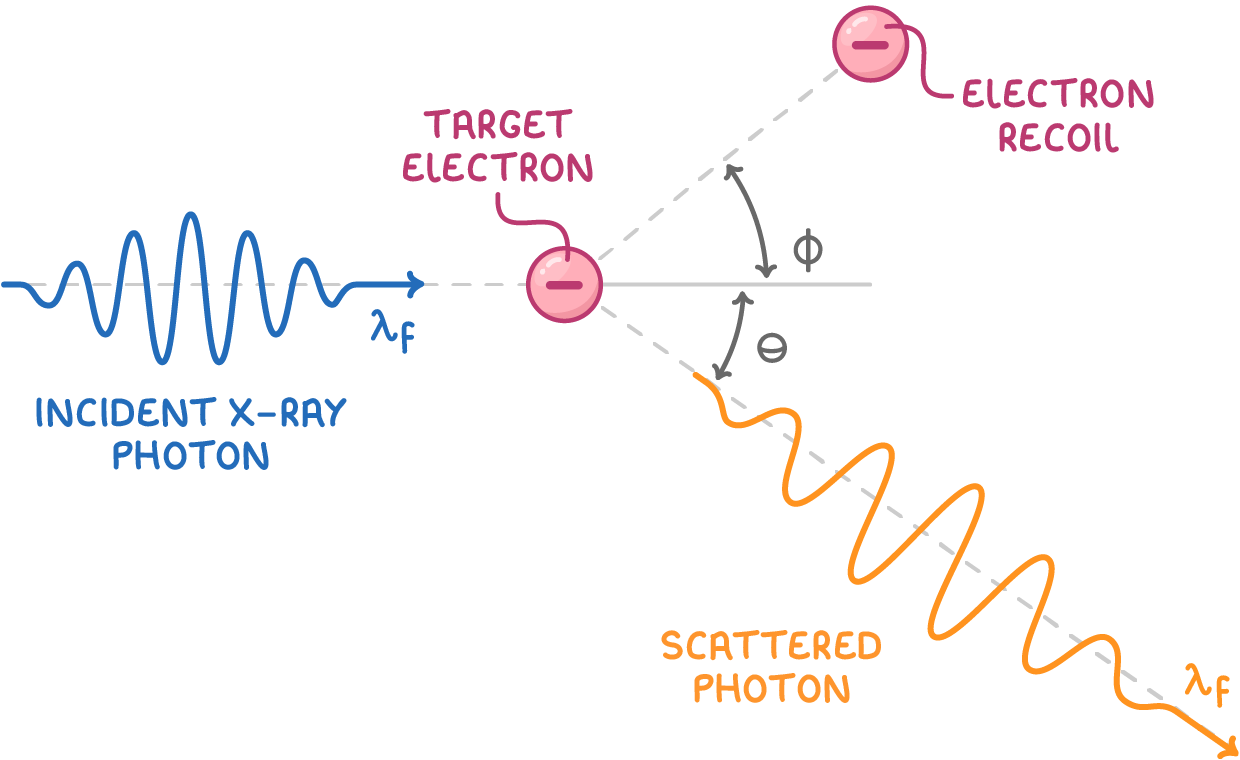
In the early 1920s, Arthur H. Compton, an American physicist, conducted groundbreaking experiments on the scattering of high-energy X-rays by elements with low atomic numbers. His findings revealed that the wavelength of the scattered X-rays increased after the interaction with the electrons in the target material, a phenomenon now known as the Compton effect. This discovery provided strong evidence for the particle nature of light and challenged the classical wave model.
Compton's experimental setup and results
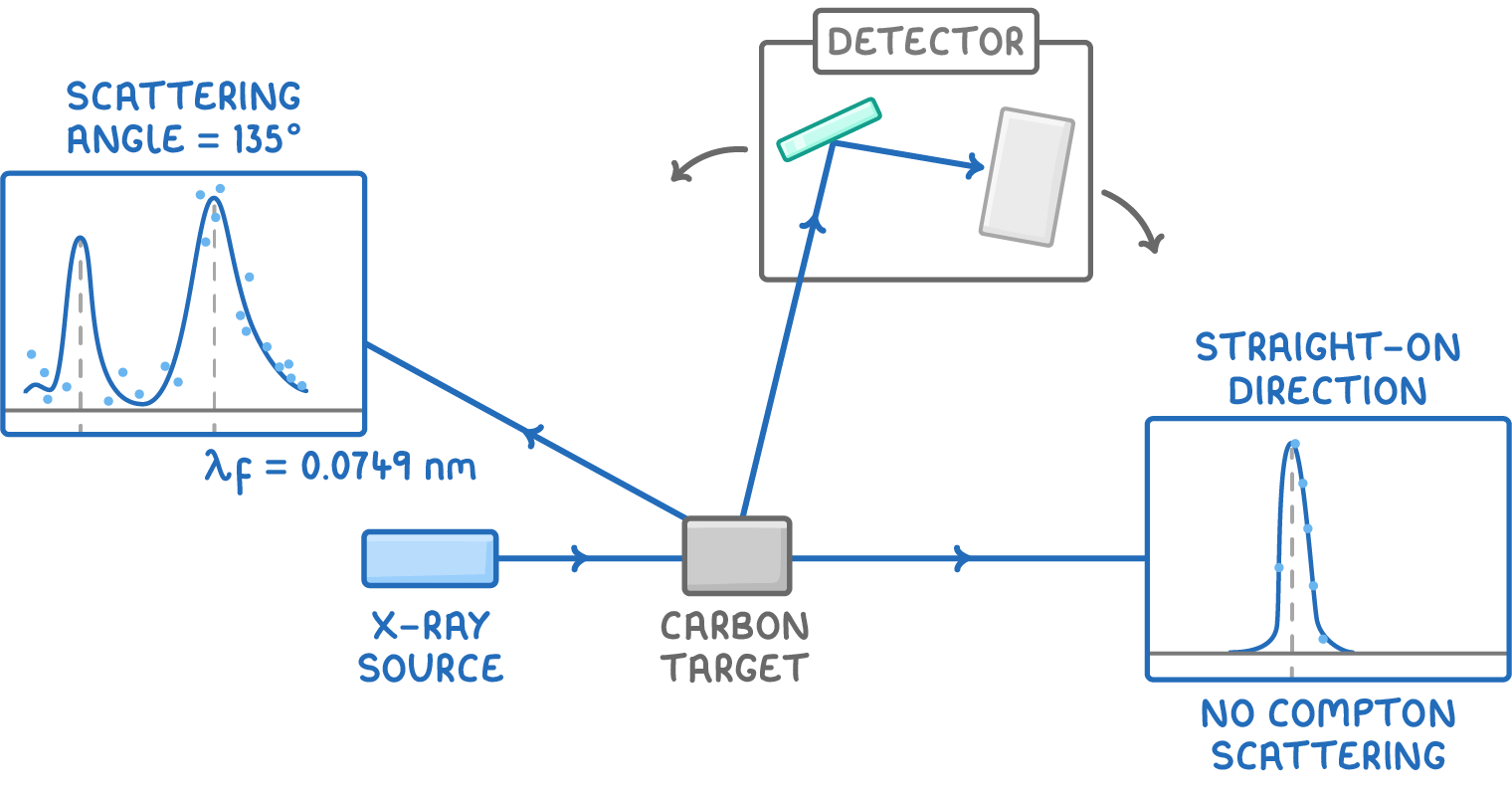
Compton's experimental arrangement involved directing a beam of high-energy X-rays, produced by accelerating electrons through a potential difference of 17 kV, onto a carbon target. The scattered X-rays were then observed using a detector consisting of a single diffracting crystal and an ionisation chamber. By measuring the intensity and wavelength of the scattered X-rays at various angles, Compton was able to study the interaction between the incident photons and the electrons in the target.
Compton observed two peaks in the spectrum of scattered X-rays at each scattering angle, except for the straight-on direction. The larger peak corresponded to free-electron scattering (Compton scattering), while the smaller peak was attributed to atom scattering. Notably, the wavelength shift of the larger peak increased with increasing scattering angle, indicating that the scattered photons had lost energy in the interaction with the electrons.
Interaction between x-ray photons and electrons
When an x-ray photon interacts with a free electron in the carbon target, the photon transfers a portion of its energy and momentum to the electron, causing the electron to recoil. The scattered photon emerges with a longer wavelength and lower energy compared to the incident photon, while the electron recoils with a specific angle and kinetic energy. This interaction can be analysed using the principles of conservation of energy and momentum in a two-dimensional collision.
The energy of the scattered X-ray photon can be calculated using the equation:
$E = \frac{hc}{\lambda}$
Where:
- E = energy of the photon (J)
- h = Planck's constant (J s)
- c = speed of light (m s-1)
- λ = wavelength of the photon (m)
Compton's equations for wavelength shift and recoil angle
Compton derived mathematical expressions for the wavelength shift (Δλ) and the recoil angle (ϕ) of the electron based on the conservation of energy and momentum in the interaction between the incident photon and the electron:
$\Delta \lambda = \lambda_f - \lambda_i = \frac{h}{m_ec}(1 - \cos \theta)$
$\frac{1}{tan\phi}=\left(1+\frac{hf}{m_ec^2}\right)tan\left(\frac{\theta}{2}\right)$
Where:
- $\Delta\lambda$ = change in wavelength (m)
- $\lambda_f$ = final wavelength (m)
- $\lambda_i$ = initial wavelength (m)
- h = Planck's constant
- m_e_ = electron mass (kg)
- c = speed of light (m s^-1^)
- $\theta$ = scattering angle (rad)
- $\phi$ = electron recoil angle (rad)
Worked example - Calculating the wavelength shift using Compton's equation
An X-ray photon with an initial wavelength of 0.01 nm is scattered at an angle of 90°. Calculate the wavelength shift and the final wavelength of the scattered photon.
Step 1: Formula for wavelength shift
$\Delta \lambda = \lambda_f - \lambda_i = \frac{h}{m_ec}(1 - \cos \theta)$
Step 2: Convert degrees to radians
to convert from degrees to radians multiply by $\frac{\pi}{180}$
90° = $\frac{\pi}{2}$ rad
Step 2: Substitution and correct evaluation
$\cos \theta = \cos \left(\frac{\pi}{2}\right) = 0$
$\Delta \lambda = \frac{6.63 \times 10^{-34}}{9.11 \times 10^{-31} \times 3 \times 10^8} (1 - 0)=2.43\times10^{-12}$
Step 3: Calculate the final wavelength
$\lambda_f = \lambda_i + \Delta \lambda$
$\lambda_f = 0.01 \times 10^{-9} + 2.43 \times 10^{-12}= 1.243 \times 10^{-11} \text{ m}$
The wavelength shift is $2.43 \times 10^{-12} \text{ m}$, and the final wavelength of the scattered photon is $1.243 \times 10^{-11} \text{ m}$.
Worked example - Calculating the recoil angle of the electron
An X-ray photon with a frequency of $3 \times 10^{19} \text{ Hz}$ is scattered at an angle of 45°. Calculate the recoil angle of the electron.
Step 1: Formula for recoil angle
$\frac{1}{\tan \phi} = \left(1 + \frac{hf}{m_ec^2}\right) \tan \left(\frac{\theta}{2}\right)$
Step 2: Convert degrees to radians
to convert from degrees to radians multiply by $\frac{\pi}{180}$
45° = $\frac{\pi}{4}$
Step 3: Substitution and correct evaluation
$\frac{1}{tan\phi}=\left(1\text{ }+\text{ }\frac{6.63\text{ }\times\text{ }10^{-34}\text{ }\times\text{ }3\times\text{ }10^{19}}{9.11\text{ }\times10^{-31}\text{ }\times\text{ }\left(3\text{ }\times\text{ }10^8\right)^2}\right)tan\left(\frac{\pi}{8}\right)\text{ = 0.5147}$
tan $\phi$ = 1.943
$\phi$ = tan^-1^(1.943) = 1.095 rad = 62.77°
Implications of Compton's Results
Compton's measurements confirmed his predictions for the relationship between the wavelength shift (Δλ) and the scattering angle (θ), which were based on the photon model of light. According to this model, photons have:
- Energy is given by:
$E = \frac{hf}{c} = \frac{hc}{\lambda}$
- Momentum is given by:
$p = \frac{hf}{c} = \frac{h}{\lambda}$
The Compton effect cannot be explained by the classical wave model of light, which does not predict wavelength shifts for low-intensity radiation. Compton's results provided strong evidence for the particle nature of light and contributed to the development of quantum mechanics, which treats light as both a wave and a particle, depending on the context.
The success of the photon model in explaining the Compton effect demonstrated the need for a new framework to describe the behaviour of light and matter at the atomic and subatomic scales, leading to the development of modern quantum theory.