5.6 - Length Contraction
- 1
The concept of length contraction in special relativity
- 2
Proper length and observed length
- 3
Examples of length contraction at different velocities
- 4
The implications of length contraction for objects approaching the speed of light
What is length contraction?
Length contraction is a phenomenon in Einstein's special theory of relativity where objects appear shorter when they're moving at high speeds relative to an observer. This effect becomes significant as the object's speed approaches the speed of light.
The formula for length contraction is:
L' = $\frac{L}{\gamma}$
Where:
- L' = contracted length (length measured by the stationary observer)
- L = proper length (length measured in the object's rest frame)
- γ = Lorentz factor
Recall that the Lorentz factor is given by:
γ = $\frac{1}{\sqrt{1 - \frac{v^2}{c^2}}}$
Where:
- v = velocity of the object relative to the observer
- c = speed of light in vacuum
Key points:
- Length contraction only occurs in the direction of motion
- The contracted length is always less than or equal to the proper length
- The effect becomes more pronounced as velocity increases
Proper length and observed length
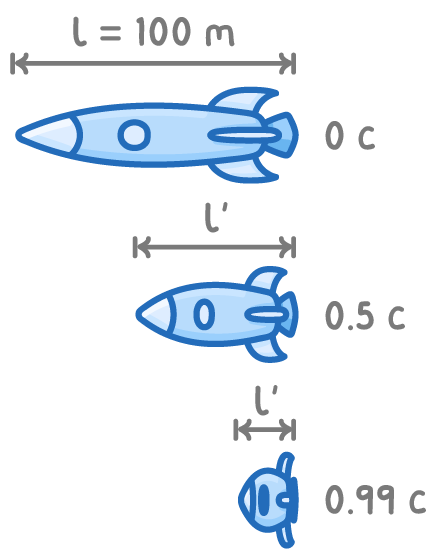
- Proper length (L) - This is the length of an object as measured in its own rest frame (the frame where the object is stationary).
- Observed length (L') - This is the length of the object as measured by an observer in relative motion to the object.
It's important to note that the object itself doesn't shrink; rather, it's the measurement of its length that changes for observers in different reference frames.
Let's calculate the contracted length of a 100-metre spacecraft at different velocities.
At 10% the speed of light (0.1c):
γ ≈ 1.005
L' = $\frac{100}{1.005}$ ≈ 99.5 metres
At 50% the speed of light (0.5c):
γ ≈ 1.155
L' = $\frac{100}{1.155}$ ≈ 86.6 metres
At 99% the speed of light (0.99c):
γ ≈ 7.089
L' = $\frac{100}{7.089}$ ≈ 14.1 metres
As an object's speed approaches the speed of light:
- The Lorentz factor approaches infinity
- The contracted length approaches zero
- From the perspective of a stationary observer, the object appears to become increasingly flat in the direction of motion
These effects contribute to the impossibility of objects with mass reaching or exceeding the speed of light.
Worked example 1 - Length contraction of a fast-moving train
A train has a proper length of 200 metres. If it passes an observer at 95% the speed of light (0.95c), what length does the observer measure for the train?
Step 1: Calculate the Lorentz factor
γ = $\frac{1}{\sqrt{1 - \frac{v^2}{c^2}}}$ = $\frac{1}{\sqrt{1 - \frac{(0.95c)^2}{c^2}}}$ = $\frac{1}{\sqrt{1 - 0.9025}}$ ≈ 3.202
Step 2: Apply the length contraction formula
L' = $\frac{L}{\gamma}$ = $\frac{200}{3.202}$ ≈ 62.5 metres
The observer measures the train to be about 62.5 metres long, less than one-third of its proper length.
Important considerations
- Length contraction only affects dimensions parallel to the direction of motion. Dimensions perpendicular to the motion are unaffected.
- The effect is symmetrical: each observer sees the other's objects as contracted.
- Length contraction and time dilation are closely related phenomena, both derived from the Lorentz transformations in special relativity.