5.7 - Space-Time Diagrams
- 1
Visualising spacetime using Minkowski diagrams
- 2
Understanding worldlines for stationary, moving, and accelerating objects
- 3
Comparing spacetime diagrams for different inertial frames
- 4
The concept of simultaneity in special relativity
- 5
Examining the train carriage thought experiment
Minkowski's spacetime diagrams
In 1908, Hermann Minkowski introduced spacetime diagrams (also known as Minkowski diagrams) to visualise the motion of an object through spacetime.
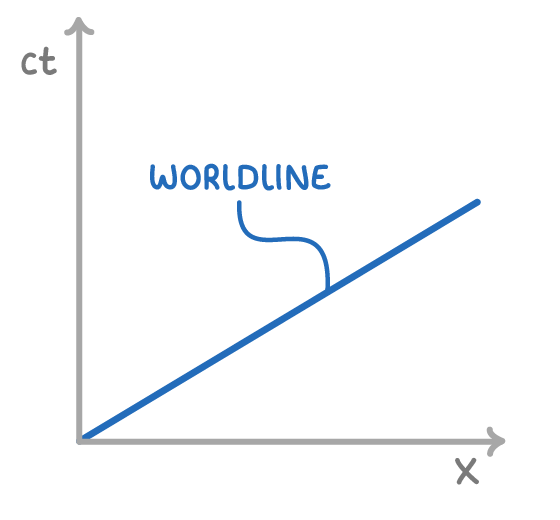
Key features of spacetime diagrams:
- ct is plotted on the y-axis, where c is the speed of light and t is time
- Position x is plotted on the x-axis
- The axes themselves constitute the inertial frame
- Worldlines show the trajectory of particles through spacetime
Worldlines for different motion types
Stationary particles:
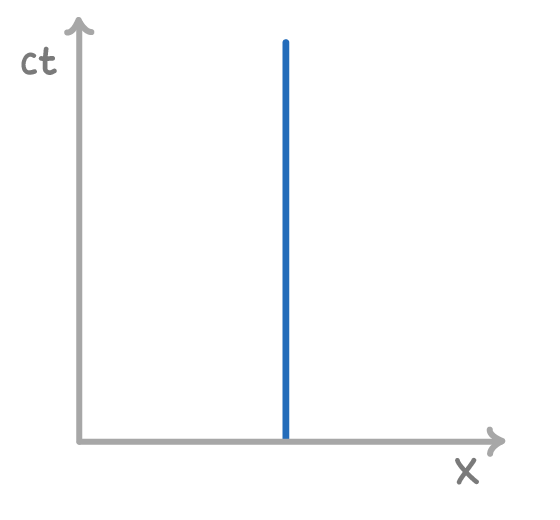
The worldline is a vertical line parallel to the time axis, indicating no change in position over time.
Constant velocity:
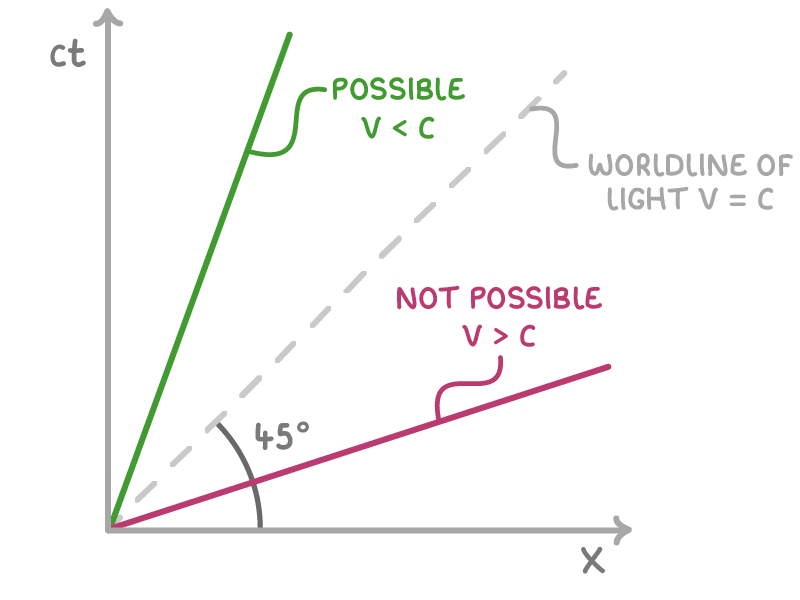
An object travelling at a constant speed forms a straight worldline at an angle to both the x and t axes, with the gradient determined by the particle's velocity.
gradient = $\frac{c\Delta t}{\Delta x}=\frac{c}{v}$
where v =$\frac{\Delta x}{\Delta t}$
An object travelling at the speed of light occurs when the gradient is equal to 1:
gradient = $\frac{c}{v}=\frac{3\times10^8}{3\times10^8}=1$
Key points:
- Gradient = 1 - represents an object travelling at the speed of light. This forms a wordline at 45° to the x axis.
- Gradient < 1 - Not possible. This represents an object travelling faster than light.
- Gradient > 1 - Possible. This represents an object travelling slower than light.
Accelerating particles:
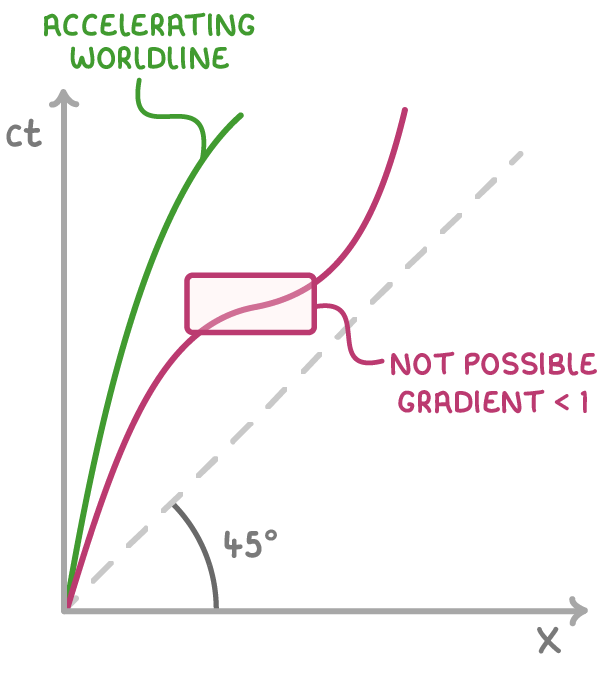
Acclerating object has a curved worldline, showing the change in velocity over time.
Key points:
- Increasing gradient - represents an object slowing down (decelerating).
- decreasing gradients - represents an object speeding up (accelerating).
Comparing inertial frames
Spacetime diagrams can be drawn for different inertial frames moving at constant speed relative to each other. This helps resolve apparent paradoxes in special relativity.
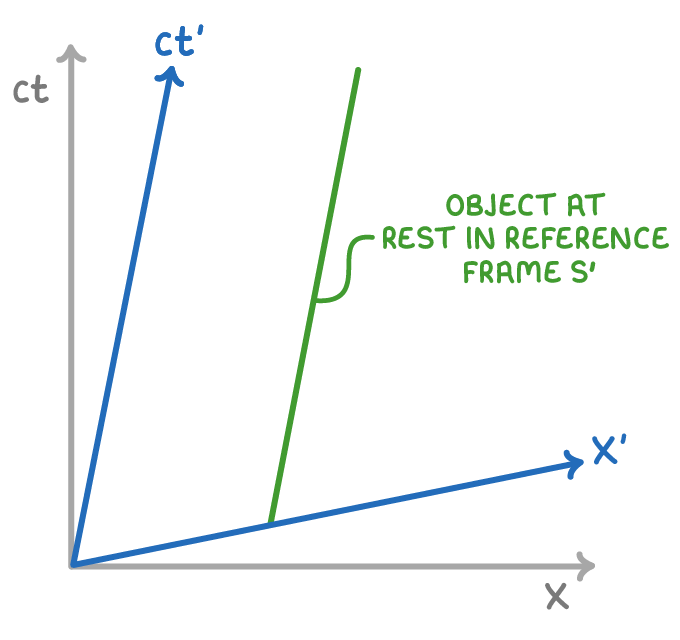
Multiple reference frames can be visualised on one spacetime diagram:
- The axes ct and x rerpesent the stationary reference frame S.
- The axes ct' and x' represent the inertial reference frame S' travelling at constant velocity v, relative to S.
The worldline shown represents a stationary object in reference frame S'. Stationary objects have the same gradient as the time axis in their frame of reference.
Simultaneity in special relativity
In Galilean relativity, time is absolute and independent of the observer. Clocks in different frames keep time at the same rate, allowing for direct comparisons between frames.
However, in Einstein's relativity, the speed of light is always observed to have the same value by observers in different frames. This leads to changes in the perceived order and simultaneity of events.
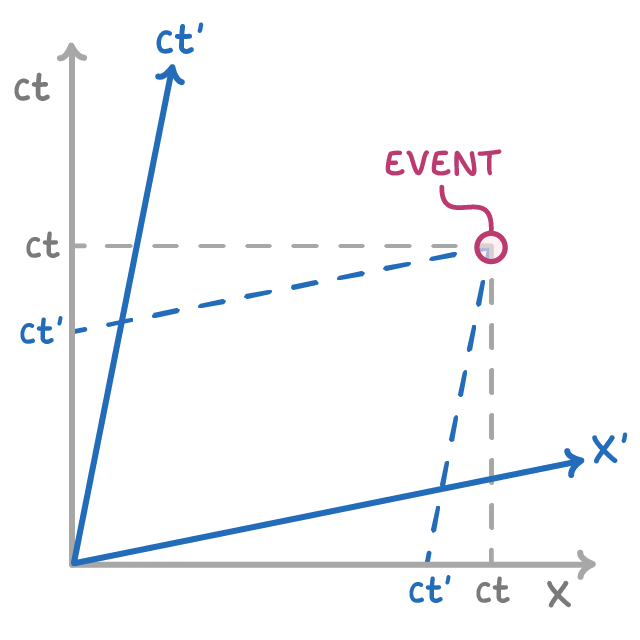
The table below shows the time and position of the event as observed in the stationary reference frame (S) and the moving reference frame (S').
| S | S' | |
|---|---|---|
| Position of event | x | x' |
| Time of event | ct | ct' |
The train carriage thought experiment
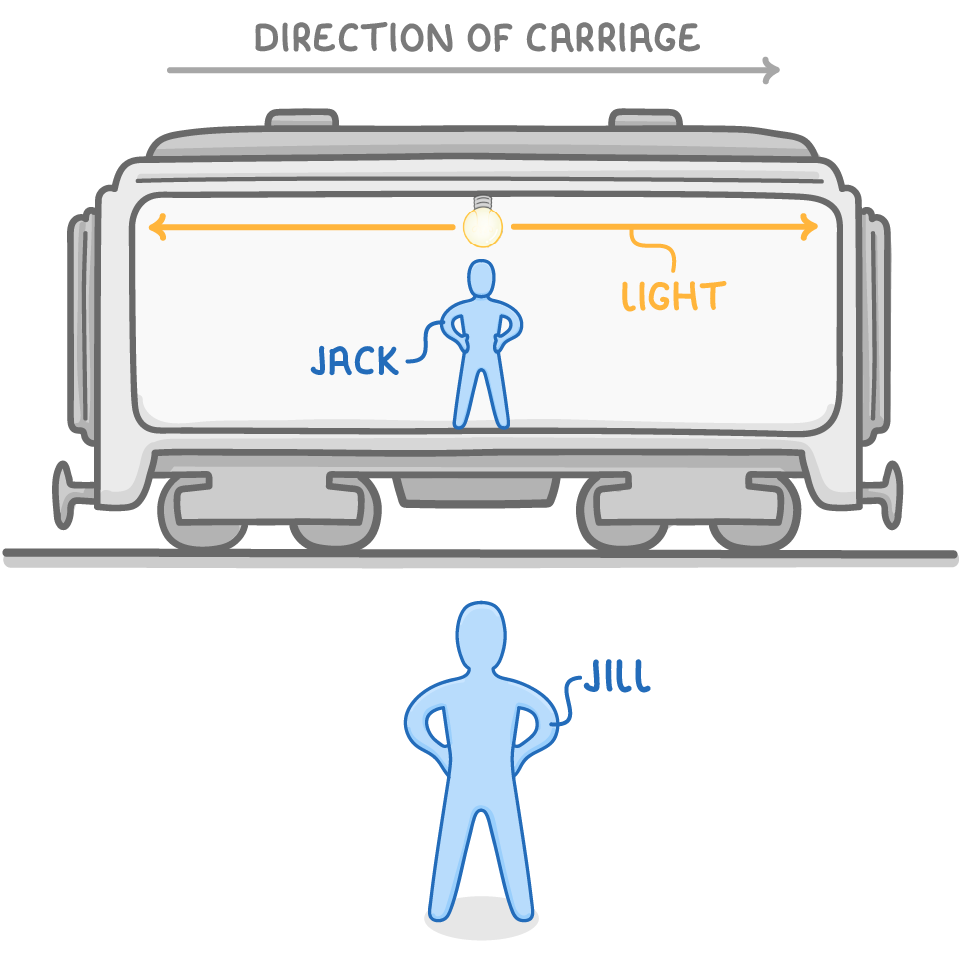
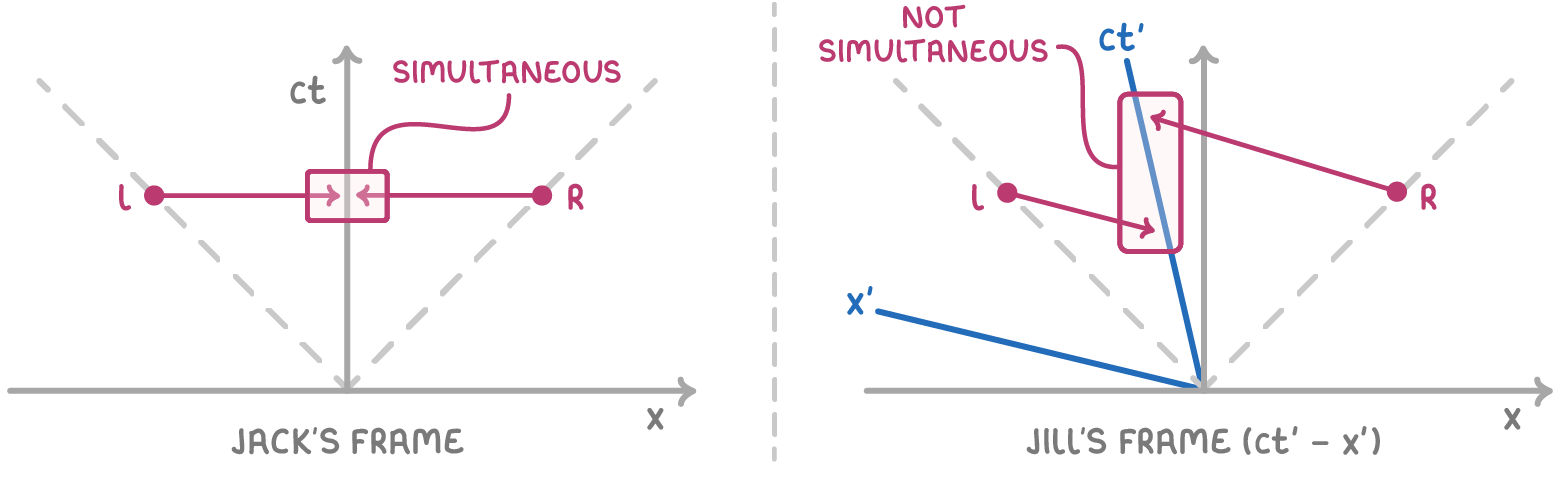
Consider a train carriage moving at constant velocity past an observer (Jill) on a platform. A person in the carriage (Jack) switches on a lamp hanging from the centre of the ceiling.
Observations:
- Jack observes the light reaching both end walls (L and R) simultaneously.
- Jill disagrees, as the left-hand end moves towards the light while the right-hand end moves away. According to Jill, the light hits the left-hand end first (event L) before the right (event R).
Explanation:
- In Jack's frame (x-ct), events R and L occur at the same instant, as they are on a line parallel to the x-axis with the same ct coordinate.
- In Jill's frame (x'-ct'), L occurs before R when considered on the ct' axis.
- This loss of simultaneity is not due to the transmission of information but arises from the relative motion of the frames.