17.5 - Millikan's Oil Drop Experiment
- 1
The purpose and significance of Millikan's oil drop experiment
- 2
The two-step process of the experiment
- 3
The forces acting on the oil drops during the experiment
- 4
How the charge on an electron was determined from the experimental data
Introduction to Millikan's experiment
In 1909, American physicist Robert A. Millikan conducted a groundbreaking experiment to determine the charge of an electron. This experiment, known as Millikan's oil drop experiment, provided strong evidence for the quantisation of electric charge and helped establish the fundamental unit of charge. Millikan was awarded the Nobel Prize in 1923 for this work and his contributions to the photoelectric effect.
The purpose of Millikan's oil drop experiment was to measure the charge of an electron and to demonstrate that electric charge is quantised, meaning it comes in discrete units rather than being continuous. This experiment was crucial in advancing our understanding of the fundamental properties of matter and laid the groundwork for the development of quantum mechanics.
The two-step process of Millikan's experiment
Step 1: Observing the motion of uncharged oil drops
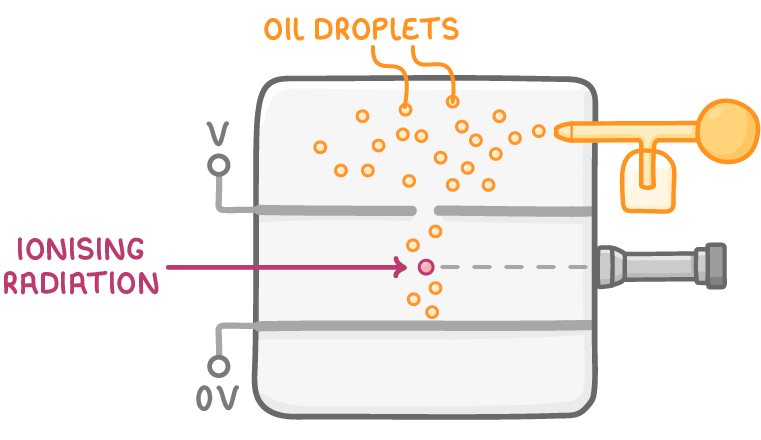
In the first step, a fine mist of oil droplets is introduced into a chamber. These drops become electrically charged, either through exposure to X-rays or beta particles or by friction as they pass through the aperture into the chamber. A single drop is then selected and allowed to fall freely through the air without any applied electric field.
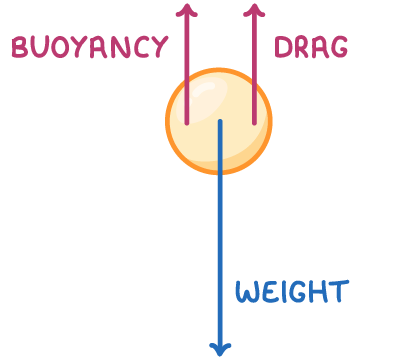
During this free fall, the oil drop experiences three forces:
- Weight (W) - Pulls the drop downward due to the mass of the drop and the acceleration due to gravity
- Buoyancy force (Fb) - Acts upward, opposing gravity, and is caused by the displacement of air by the oil drop
- Drag force (Fd) - Resists the drop's motion through the air and is proportional to the drop's velocity
At terminal velocity, these forces balance each other, resulting in zero net force on the drop. By measuring the terminal speed of the drop and applying Stokes' law, which relates the drag force to the velocity, radius, and viscosity of the medium, the mass and radius of the drop can be calculated.
Step 2: Measuring the charge on the oil drop
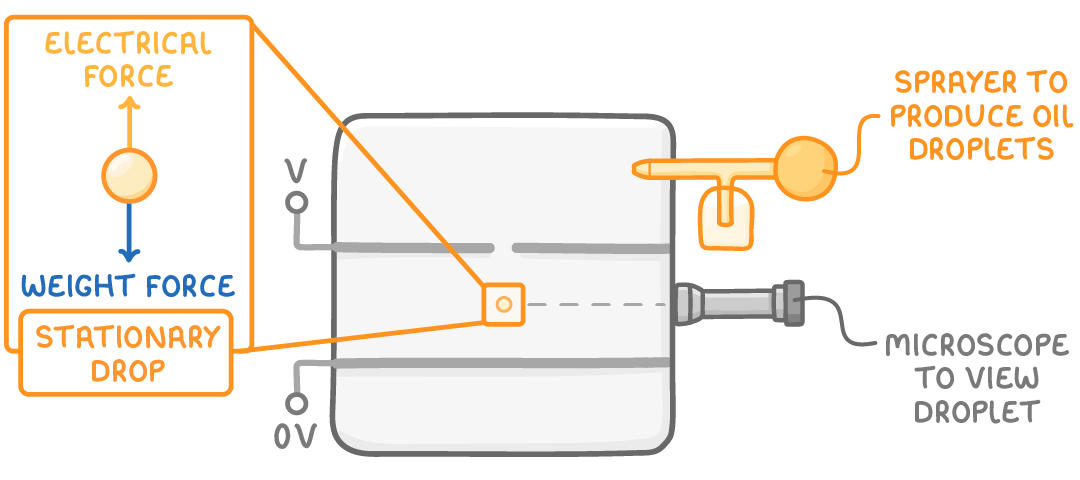
In the second step, the same oil drop is charged and held stationary by applying an upward electric field that exactly counteracts the drop's weight. This allows the electric force (Fe) on the drop to be determined.
The electric force on the drop is given by:
$F_e = qE$
Where:
- q = charge on the oil drop (C)
- E = electric field strength (V m-1)
At equilibrium, the electric force balances the weight of the drop, which is the product of the drop's mass and the acceleration due to gravity:
$F_e = F_g$
$qE = mg$
Where:
- m = mass of the oil drop (kg)
- g = acceleration due to gravity (m s-2)
By measuring the electric field strength required to hold the drop stationary and knowing the mass of the drop from the first step, the charge on the oil drop can be calculated using the equation above.
Worked example - Calculating the charge on an oil drop
An oil drop of mass $1.64 \times 10^{-14}$ kg is held stationary in an electric field of strength $1.92 \times 10^5$ V m$^{-1}$. Calculate the charge on the oil drop.
Step 1: Formula
At equilibrium:
$qE = mg$
Step 2: Rearrange to make q the subject
$q = \frac{mg}{E}$
Step 3: Substitution and correct evaluation
$q = \frac{1.64 \times 10^{-14} \times\text{ } 9.81}{1.92\text{ } \times \text{ }10^5}\text{ = 8.38 x 10}^{-19}\text{ C}$
This charge is approximately 5 times the elementary charge (1.60 × 10$^{-19}$ C), indicating that the oil drop carries an excess of 5 electrons.
Determining the charge on an electron
By combining the measurements from both steps, the excess charge on the oil drop can be estimated. Millikan and his co-worker discovered that this excess charge was always an integer multiple of a fundamental charge, which they attributed to the charge of a single electron.
To determine the value of this fundamental charge, Millikan repeated the experiment with numerous oil drops, each carrying a different amount of excess charge. By finding the highest common factor among these charges, he arrived at an estimate for the charge of an electron.
Millikan's original estimate for the elementary charge was $(1.592 \pm 0.003) \times 10^{-19}$ C. Subsequent experiments have refined this value, and today, the charge of an electron is defined as $1.602176634 \times 10^{-19}$ C exactly.