11.4 - Phase Angle
- 1
Introducing the phase angle (φ) in simple harmonic motion equations
- 2
Understanding the concept of phase difference between two simple harmonic motions
- 3
Interpreting displacement-time graphs for simple harmonic motions with phase differences
- 4
Modelling phase difference using circular motion
- 5
Presenting the complete equations for displacement, velocity, and acceleration in simple harmonic motion
The phase angle (φ)
Previously we focused on motion starting at specific positions, such as the extreme displacements (x = x_0_) or the centre of the motion (x = 0). However, it is possible to derive an equation that allows for any starting point.
The general solution to the second-order differential equation for simple harmonic motion includes an additional term, φ, known as the phase angle:
$x = x_0 \sin(\omega t + \phi)$
The phase angle (φ) determines the starting point of the oscillation:
- When φ = 0, the motion starts at the equilibrium position (x = 0).
- When φ = $\frac{π}{2}$ or 90°, the motion starts at the maximum displacement (x = x_0_).
The phase angle can take any value between 0 and 2π radians (0° to 360°), allowing the motion to start at any point in the cycle.
Worked example - Calculating the displacement in simple harmonic motion
Calculate the displacement of an object undergoing simple harmonic motion with amplitude x_0_ = 0.5 m, angular velocity $\omega$ = 2 rad/s, and phase angle $\phi$ = $\frac{\pi}{4}$ rad at time t = 3 s.
Step 1: Formula
x = x_0_ sin($\omega$ t + $\phi$)
Step 2: Substitution and correct evaluation
x = 0.5 sin$\left(2 \times 3 + \frac{\pi}{4}\right)$
x = 0.5 sin$\left(6 + \frac{\pi}{4}\right)$ = 0.241 m
Understanding phase difference
Phase difference is the difference in the phase angles between two simple harmonic motions. It represents the relative starting points of the two oscillations. A phase difference can be expressed in radians, degrees, or as a fraction of a complete cycle.
Consider the displacement-time graphs for two simple harmonic motions in Figure 16.
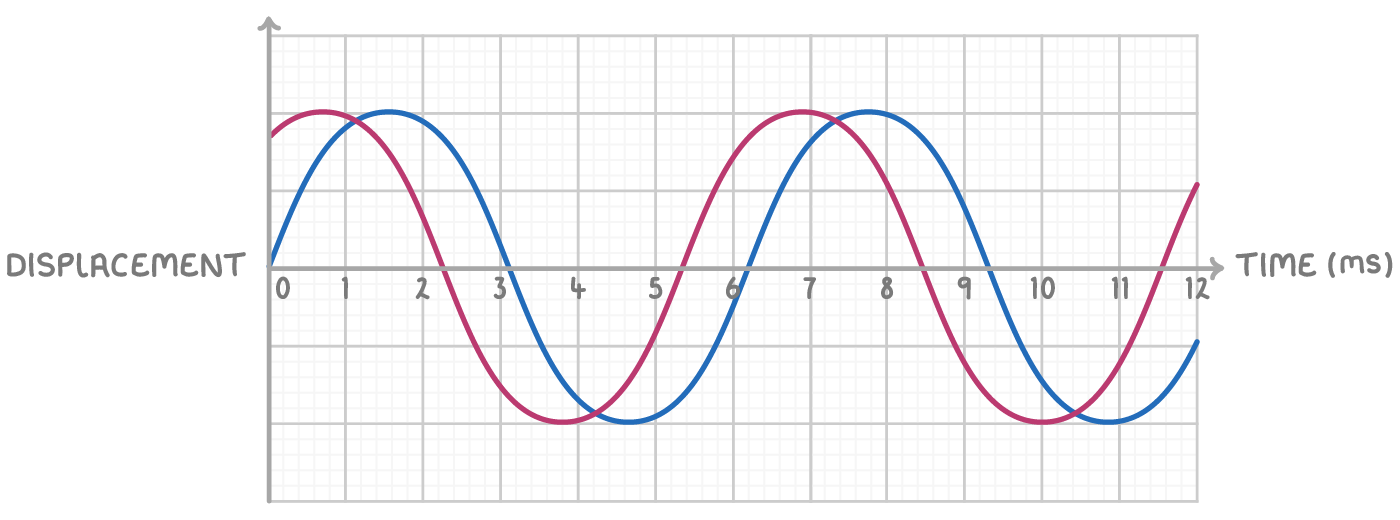
At the beginning of the graph, the blue curve shows a displacement of zero, while the red curve is about to reach its maximum displacement. The red curve is approximately one radian ahead of the blue curve. One cycle corresponds to 2π radians, therefore the red curve leads the blue by:
$\frac{1}{2\pi} = \frac{1}{6.3} = 0.16 \text{ of a cycle}$
If the equation for the blue curve is:
$x = x_0 \sin(\omega t + 0)$
Then the equation for the red curve must be:
$x = x_0 \sin(\omega t + 1.0)$
The phase difference between the two curves is 1.0 radian or approximately 57.3°.
Modelling phase difference with circular motion
The phase difference between curves can be modelled using circular motions for both oscillations.
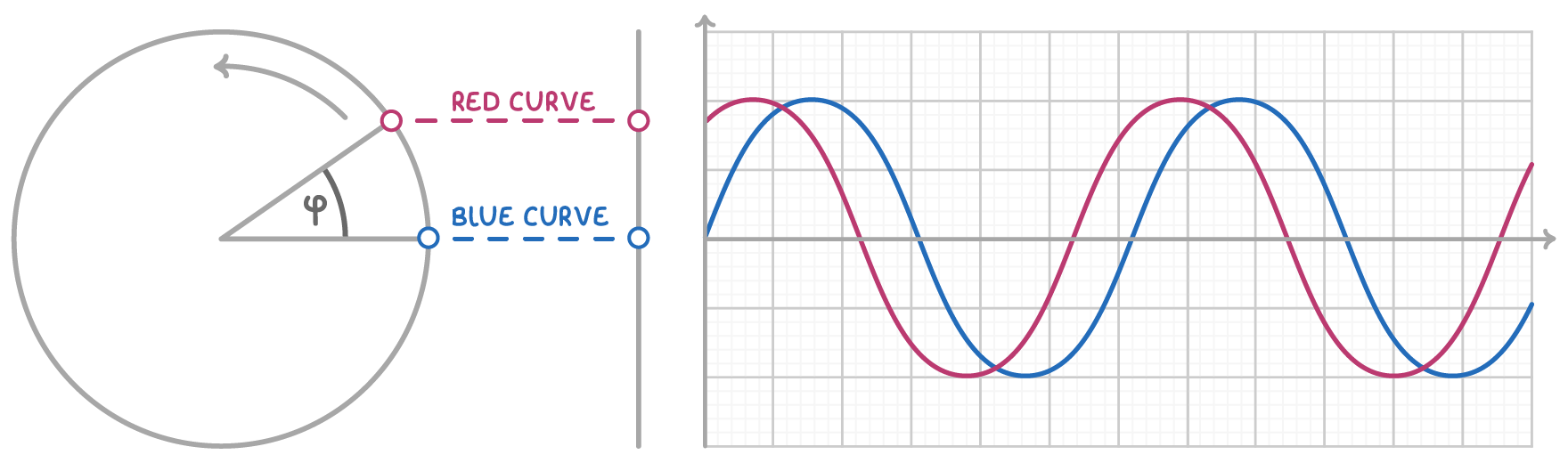
Remember that both oscillations have the same angular velocity (ω) and therefore travel around the circle at the same angular speed. The phase difference is the angle between the radial lines that trace out the simple harmonic motion as the blue point chases the red point around the circle.
The phase difference remains constant throughout the motion, as both points move around the circle at the same angular velocity. This means that the red point will always be one radian ahead of the blue point, maintaining the phase difference between the two oscillations.
Equations for simple harmonic motion
The equations for displacement, velocity, and acceleration in simple harmonic motion, incorporating the phase angle (φ), are as follows:
- $x = x_0 \sin(\omega t + \phi)$
- $v = \omega x_0 \cos(\omega t + \phi)$
The velocity equation is derived by differentiating the displacement equation with respect to time. The cosine function appears due to the phase shift of (π/2) radians between displacement and velocity in simple harmonic motion.
Worked example - Calculating the velocity in simple harmonic motion
Calculate the velocity and acceleration of an object undergoing simple harmonic motion with amplitude x_0_ = 0.5 m, angular velocity $\omega$ = 3 rad/s, and phase angle $\phi$ = $\frac{\pi}{4}$ rad at time t = 3 s.
Step 1: Formula for velocity
v = $\omega$ x_0_ cos($\omega$ t + $\phi$)
Step 2: Substitution and correct evaluation
v = 3 $\times$ 0.5 cos$\left(2 \times3 + \frac{\pi}{4}\right)$
v = 1.5 cos$\left(6 + \frac{\pi}{4}\right)$ = 1.32 m s^-1^
Step 3: Formula for acceleration
$a = -\omega^2 x = -\omega^2 x_0 \sin(\omega t + \phi)$
Step 4: Substitution and correct evaluation
a = - 3^2^ x 0.5 sin$\left(3\times3 +\frac{\pi}{4}\right)$= -1.59 ms^-2^