1.3 - Projectile Motion
- 1
How to analyse projectile motion by separating horizontal and vertical components
- 2
Resolving velocities into horizontal and vertical vectors
- 3
Using equations of motion to determine the path and time of flight
Think about horizontal and vertical motion separately
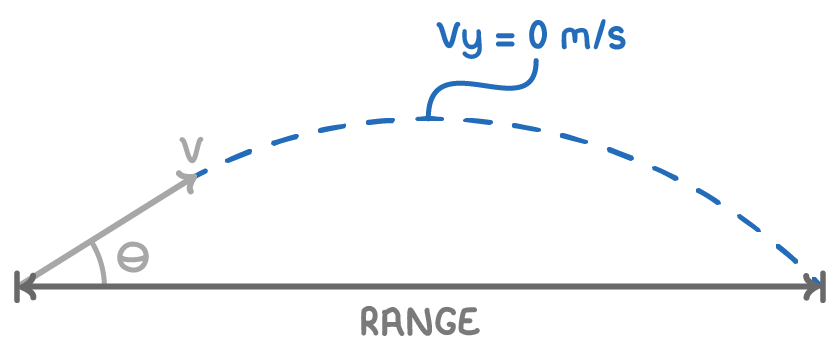
- A projectile is any object with an initial velocity that then moves freely under gravity
- The horizontal and vertical components of a projectile's motion are independent
- The horizontal velocity remains constant while the vertical velocity changes due to gravity
- This causes the curved path typical of projectile motion
- The vertical component of velocity is 0 m/s at the highest point
Worked example - Calculating the range of a projectile
Sharon fires a scale model horizontally from 15 m high with a speed of 100 m/s. Determine the time of flight and horizontal distance traveled, assuming no air resistance.
Step 1: Formula
$\text{s = u t + }\frac{1}{2}\text{a t}^2$
Step 2: Rearrangement
$\text{t = }\sqrt\frac{\text{2 s}}{\text{a}}$
Step 3: Substitution and correct evaluation
s = 15 m
u = 0 m s$^{-1}$
v =
a = 9.81 m s$^{-2}$
t = ?
$\text{t = }\sqrt\frac{2\times15}{9.81}$
t = 1.7487 s
Step 4: Calculate range
range = horizontal velocity x flight time
range = 100 x 1.7487 = 174.9 m
Motion at an angle requires vector resolving
- Forces and velocities can act in any direction
- Motion must be resolved into horizontal and vertical vectors using trigonometry
- The initial velocity determines the time of flight and maximum height
Consider an object moving with velocity R at an angle of $\theta$ to the horizontal.
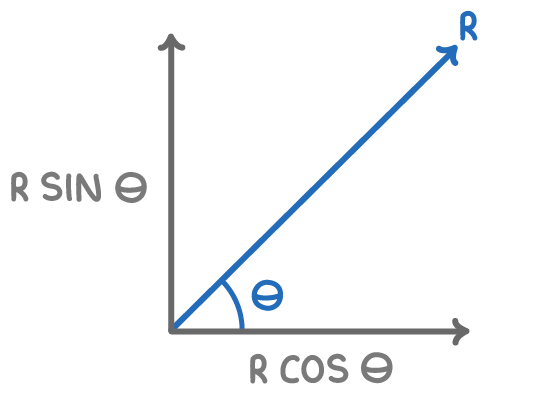
The horizontal and vertical components can be calculated:
- $\text{horizontal component = R} \cos(\theta)$
- $\text{vertical component = R} \sin(\theta)$
Worked example - Javelin throw
A javelin is thrown at a speed of 21 m/s at an angle of 45° to the horizontal. Determine the range of the javelin.
Step 1: Calculate vertical and horizontal components
$u_x = \cos(45°) \times 21 = 14.849 \text{ m s}^{-1}$
$u_y = \sin(45°) \times 21 = 14.849\text{ m s}^{-1}$
Step 2: Calculate time to reach highest point
s = 0 m
uy = 14.849 m s$^{-1}$
vy = 0 m s$^{-1}$
a = - 9.81 m s$^{-2}$
t = ?
$t = \frac{\text{v-u}}{\text{a}}$
$t = \frac{0 - 14.85}{-9.81} = 1.5136 \text{ s}$
Step 3: Calculate total flight time
total flight time = 2 x 1.5136 = 3.027 s
Step 4: Calculate range of javelin
range = horizontal velocity x flight time
range = 14.849 x 3.027 = 44.95 m