6.7 - Convection
- 1
The process of convection
- 2
Demonstrations of convection currents in air and water
- 3
The role of convection in creating sea breezes
- 4
How convection currents in Earth's mantle drive plate tectonics
- 5
The influence of convection on wind patterns
Understanding convection in fluids
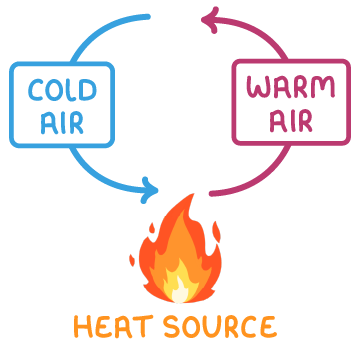
Convection is a type of heat transfer that occurs in fluids (liquids and gases) due to variations in density. Unlike conduction, which involves the microscopic transfer of energy between atoms or molecules, convection is a macroscopic process involving the bulk movement of fluid particles. Convection cannot occur in solids because their particles are fixed in place.
When a fluid is heated, the particles near the heat source gain energy and move apart, decreasing the density of the fluid in that region. The less-dense fluid experiences an upward buoyant force and rises, while cooler, denser fluid sinks to replace it. This creates a continuous circulation known as a convection current.
Demonstrating convection currents in air and water
Convection currents can be demonstrated through various experiments.
Candle in a box:
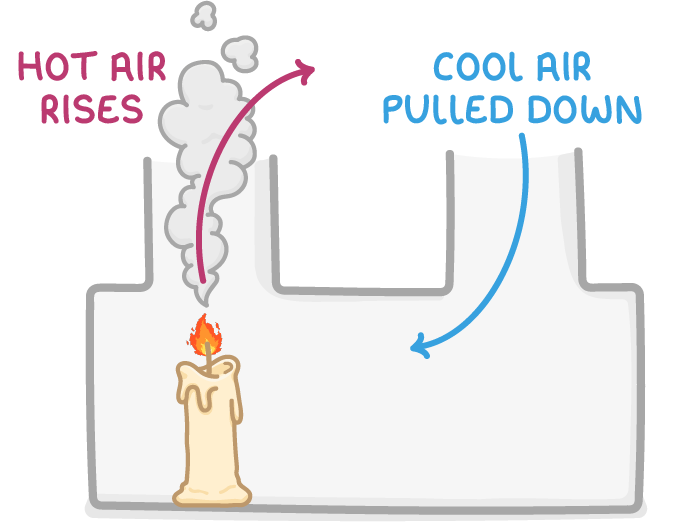
A candle heats the air beneath a vertical chimney inside a box. The heated air becomes less dense and rises through the left chimney, while cooler air is pulled down the right chimney to replace it, creating a continuous convection current.
Potassium permanganate:
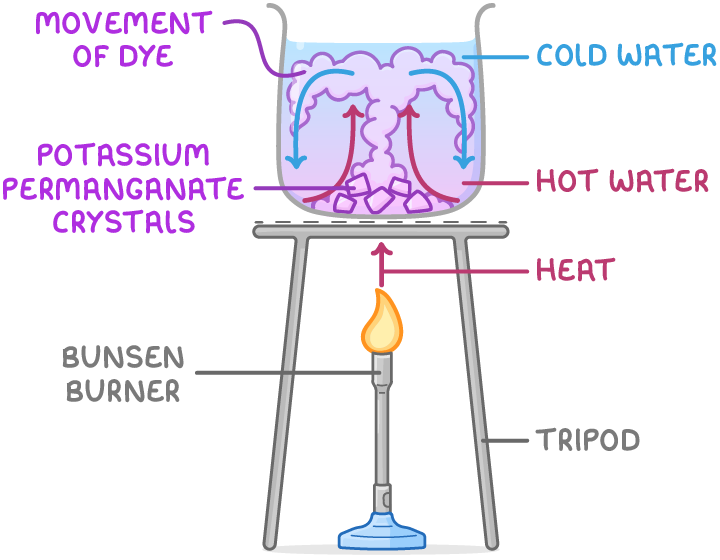
A small crystal of soluble dye (potassium permanganate) is placed at the bottom of a beaker of water. When the base of the beaker is gently heated near the crystal, the water at the base heats up, expands, becomes less dense, and rises, carrying the dye with it and demonstrating the convection current.
Convection and sea breezes
Convection plays a crucial role in the formation of sea breezes, which change direction during a 24-hour period.
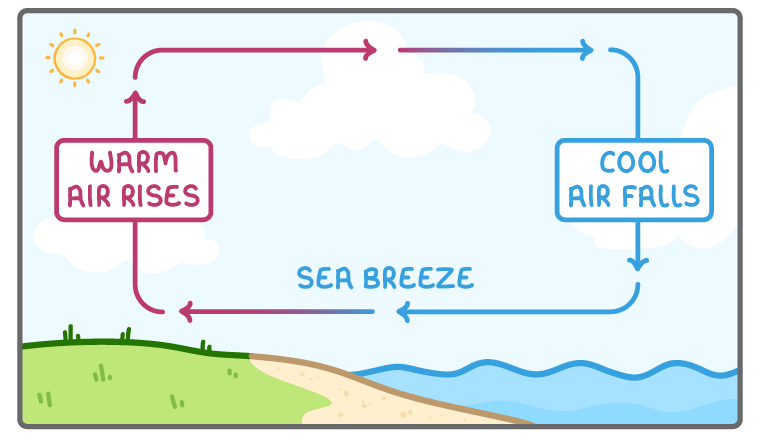
During the day, the land heats up more quickly than the sea. The air above the land expands and becomes less dense than the cooler air above the ocean. This warm air rises over the land, pulling in cooler air from the sea, and creating an onshore breeze.
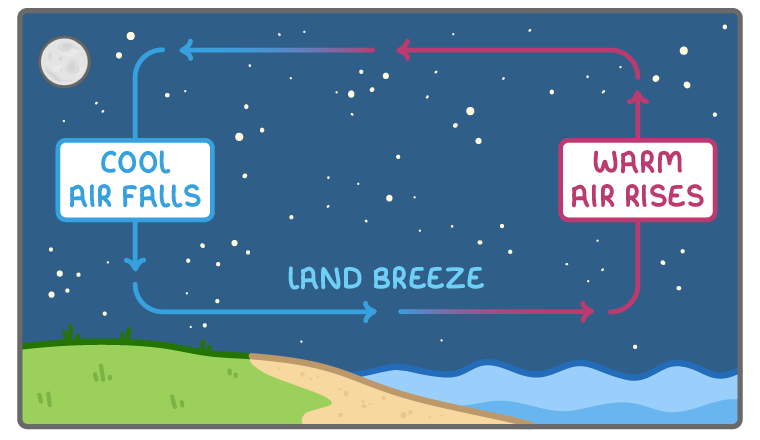
At night, the land cools down much faster than the sea because the sea has a higher specific heat capacity. The warmer air rises from the sea, causing the wind to blow offshore.
The role of convection in wind patterns
Winds are driven by uneven heating of Earth's surface by the Sun, which can be influenced by geographical factors and the presence of clouds.
- Low-pressure areas: Where land or sea heats up, the air above rises, creating an area of low pressure.
- High-pressure areas: Where air is falling, a high-pressure zone is formed.
Air moves from high-pressure to low-pressure areas, creating wind. Earth's rotation also affects wind patterns through the Coriolis force, a centripetal force that causes air masses to rotate:
- In the northern hemisphere, air circulates clockwise around high-pressure regions.
- In the southern hemisphere, air circulates counter-clockwise around high-pressure areas.