5.5 - Time Dilation
- 1
Understanding the concept of proper time interval
- 2
Comparing time intervals in different inertial reference frames
- 3
Calculating time dilation using the Lorentz factor
Proper time interval and time dilation
In special relativity, time intervals can differ between observations made in separate inertial reference frames. A simple thought experiment involving a photon clock illustrates this principle.
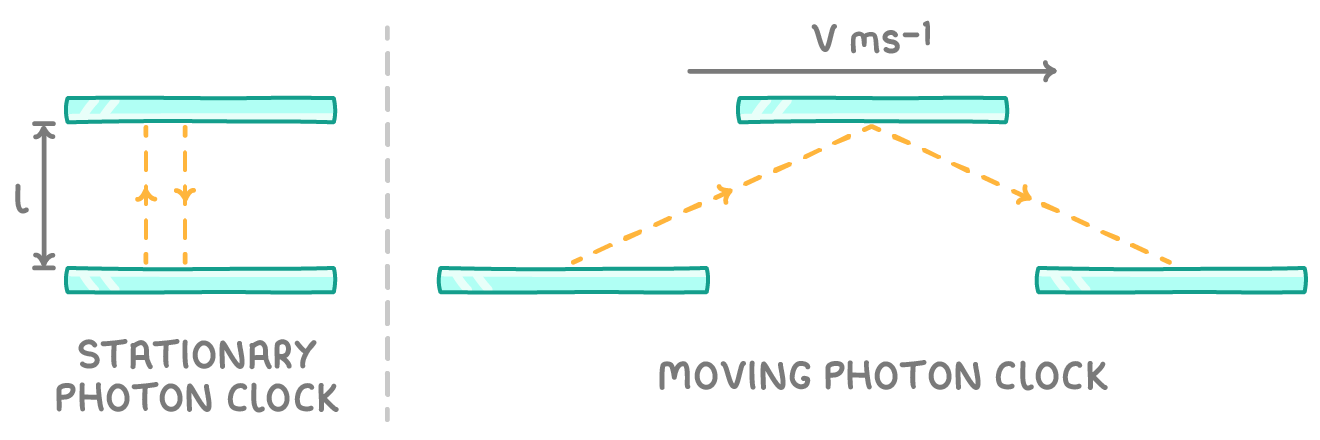
A photon leaves the bottom mirror, is reflected by the top mirror and it travels back towards the bottom mirror. The time interval for light to travel from one stationary mirror to the other and back is:
$\Delta t_0 = \frac{2L}{c}$
Where:
- $\Delta t_0$ = proper time interval (s)
- L = distance between mirrors (m)
- c = speed of light (m s$^{-1}$)
Now consider another light clock moving at constant velocity v. In this frame, the light appears to travel a longer distance (2D) due to the observer's motion.
Using Pythagoras' theorem and the fact that $D = \frac{c \Delta t}{2}$, we can derive:
$\Delta t = \frac{\Delta t_0}{\sqrt{1 - \frac{v^2}{c^2}}} = \gamma \Delta t_0$
Where:
- $\Delta t$ = time interval in the moving frame (s)
- $\gamma = \frac{1}{\sqrt{1 - \frac{v^2}{c^2}}}$ = Lorentz factor
The time interval measured in the frame where the event occurs ($\Delta t_0$) is always the shortest and is called the proper time interval. Time dilation occurs in any other frame, with the observed time interval being longer than the proper time.
Worked example 1 - Calculating proper time interval
A light clock is set up with mirrors 1.5 m apart. Calculate the proper time interval for light to travel from one mirror to the other and back.
Step 1: Formula
$\Delta t_0 = \frac{2L}{c}$
Step 2: Substitution and correct evaluation
$\Delta t_0 = \frac{2 \times 1.5}{3 \times 10^8} = 1 \times 10^{-8} \text{ s}$
Worked example 2 - Calculating time dilation
An observer moves relative to a light clock at 0.6c. Calculate the observed time interval in the moving frame.
Step 1: Formula
$\Delta t = \frac{\Delta t_0}{\sqrt{1 - \frac{v^2}{c^2}}}=\gamma \Delta t_0$
Step 2: Calculate Lorentz factor (γ)
$\gamma = \frac{1}{\sqrt{1 - \left(\frac{0.6c}{c}\right)^2}} = \frac{1}{\sqrt{1 - 0.36}} = \frac{1}{\sqrt{0.64}} = 1.25$
Step 3: Substitution and correct evaluation
$\Delta t_0 = 1 \times 10^{-8} \text{ s}$
$\Delta t = 1.25 \times 1 \times 10^{-8} = 1.25 \times 10^{-8} \text{ s}$