9.4 - Thermodynamic Processes
- 1
Understanding the four common types of changes in a gas: isobaric, isovolumetric, isothermal, and adiabatic
- 2
Exploring the equations of state and the first law of thermodynamics for each type of change
- 3
Visualising these changes using P-V diagrams
- 4
Discussing the practical feasibility of isothermal and adiabatic changes
Thermodynamic processes
In thermodynamics, several processes describe how systems change state under varying conditions. These processes are vital for the understanding of the behaviour of gases.
There are four main processes:
- Isobaric - changes that occur under constant pressure.
- Isovolumetric - changes that occur under constant volume.
- Isothermal - changes that occur at constant temperature.
- Adiabatic - changes that occur when there is no heat transfer in or out of the system.
Isobaric change
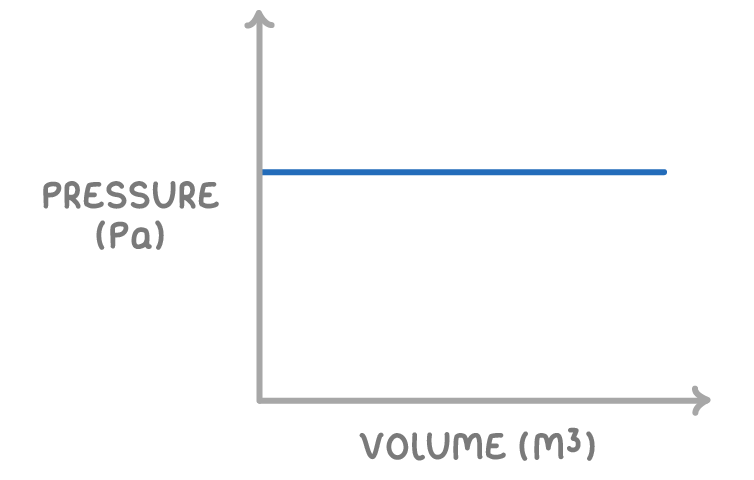
An isobaric change occurs when the pressure remains constant.
For an isobaric change, the first law of thermodynamics is expressed as:
$Q = \Delta U + P\Delta V$
Worked example - Calculating heat energy in an isobaric change
A gas expands isobarically from a volume of $2 \text{ m}^3$ to $5 \text{ m}^3$ under the constant pressure of $100 \text{ kPa}$. The change in internal energy ($\Delta U$) is 1,500 J. Calculate the heat energy (Q) transferred into the gas.
Step 1: Formula
$Q = \Delta U + P\Delta V$
Step 2: Calculate the change in volume (ΔV)
$\Delta V = V_f - V_i = 5 - 2 = 3 \text{ m}^3$
Step 3: Substitution and correct evaluation
$Q = 1,500 + 100 \times 10^3 \times 3 = 1,500 + 300,000 = 301,500 \text{ J}$
Isovolumetric change
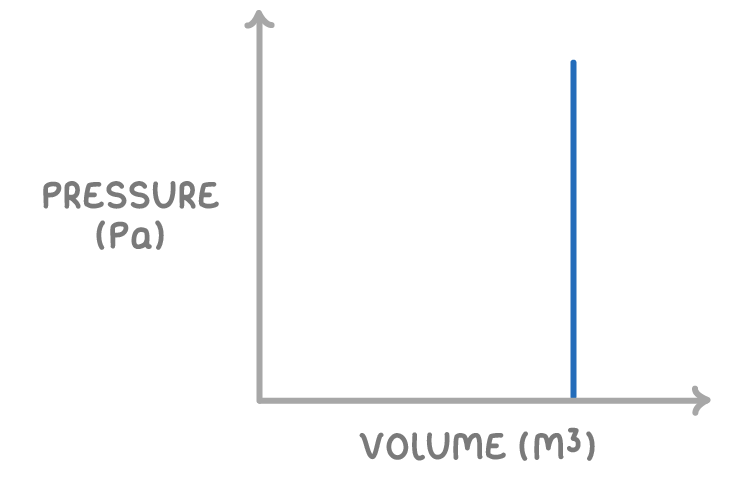
An isovolumetric change happens when the volume of the gas remains constant. In this case, the equation of state is:
$\frac{P}{T} = \text{constant}$
The first law of thermodynamics for an isovolumetric change becomes:
$Q = \Delta U + P\Delta V = \Delta U + P \times 0$
This simplifies to $Q = \Delta U$, meaning that all the heat energy transferred into the system manifests as internal energy.
If Q = -$\Delta$U, this indicates that energy is removed from the system and transferred from the gas's internal energy store.
Worked example - Calculating heat energy in an isovolumetric change
A gas is heated at constant volume, causing its internal energy to increase by 2,000 J. Calculate the heat energy (Q) transferred to the gas.
Step 1: Formula
$Q = \Delta U + W$
W = 0 for isovolumetric changes, so the equation becomes:
Q = $\Delta$U
Step 2: Substitution and correct evaluation
$Q = 2,000 \text{ J}$
Isothermal change
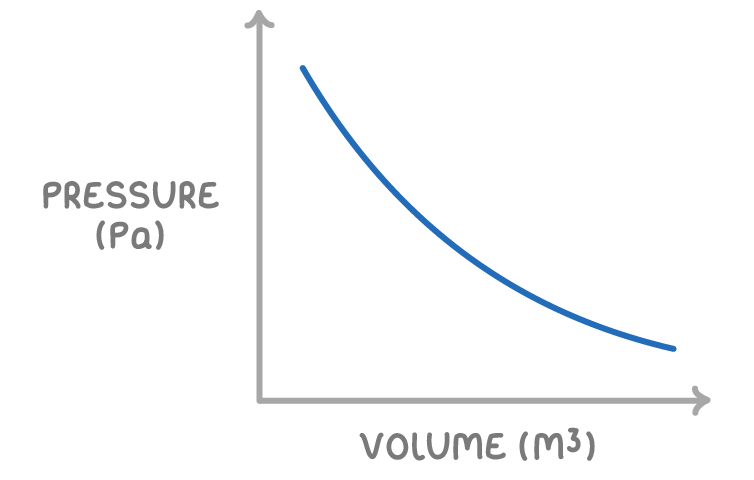
An isothermal change is characterised by two equivalent statements:
- The internal energy of the system remains constant ($\Delta$U = 0).
- The temperature of the system remains unchanged.
For an isothermal change Q = W as the change in internal energy is zero.
All the thermal energy transferred into the system is due to work done by the gas.
- When the gas in its container expands against the atmosphere (surroundings), the work done is positive.
- When energy is transferred away from the gas and work is done by the surroundings to compress the gas, the work done is negative.
It is important to note that an isothermal change is not practically feasible, as it would require an infinitely slow energy transfer through a boundary that is an excellent thermal conductor.
Worked example - Calculating work done in an isothermal change
A gas undergoes an isothermal expansion, performing $500 \text{ J}$ of work on the surroundings at a temperature of 350 K. Calculate the heat energy (Q) transferred into the gas.
Step 1: Formula
$Q = $$\Delta$$U+W$
For an isothermal change, $\Delta$U = 0, so the equation becomes:
Q = W
Step 2: Substitution and correct evaluation
$Q = 500 \text{ J}$
Adiabatic change
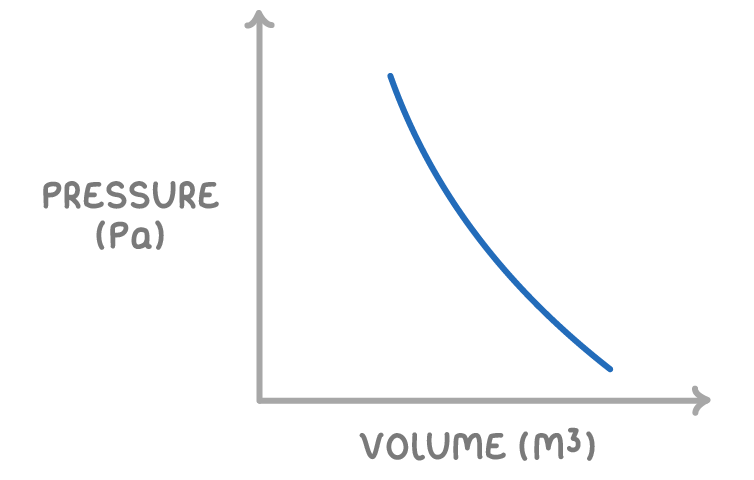
An adiabatic change occurs when no energy is transferred between the surroundings and the system, typically achieved by having an insulating boundary between them.
According to the first law of thermodynamics, for adiabatic conditions, $Q = 0$.
Therefore, the equation becomes:
$0 = \Delta U + W$
$\Delta U = -W$ (work done on the system with an increase in internal energy)
Sign convention for work done:
- Work done is positive when the gas expands as work is done by the gas on the surroundings.
- Work done is negative when the gas is compressed as work is done by the surroundings on the gas.
Like an isothermal change, an adiabatic change is not strictly possible in practice. There must be no opportunity for energy transfer between the system and the surroundings, and the change in the system's internal energy must be equal to the work being done.
Worked example - Calculating work done in an adiabatic change
A gas undergoes an adiabatic compression, with $700 \text{ J}$ of work done on the gas. Calculate the change in internal energy ($\Delta U$) of the gas.
Step 1: Formula
$\Delta U = -W$
Step 2: Substitution and correct evaluation
W = -700 J because work is done by the surroundings to compress the gas.
$\Delta U = -(-700) = 700 \text{ J}$