5.8 - Muon Decay Experiments
- 1
The creation of muons in the upper atmosphere
- 2
The mean lifetime and expected travel distance of muons
- 3
The discrepancy between expected and observed muon counts at Earth's surface
- 4
The role of time dilation and length contraction in explaining muon observations
- 5
Calculating the relativistic factor (γ) for muons travelling at 0.98c
- 6
Applying time dilation and length contraction to the muon decay scenario
Muon creation and properties
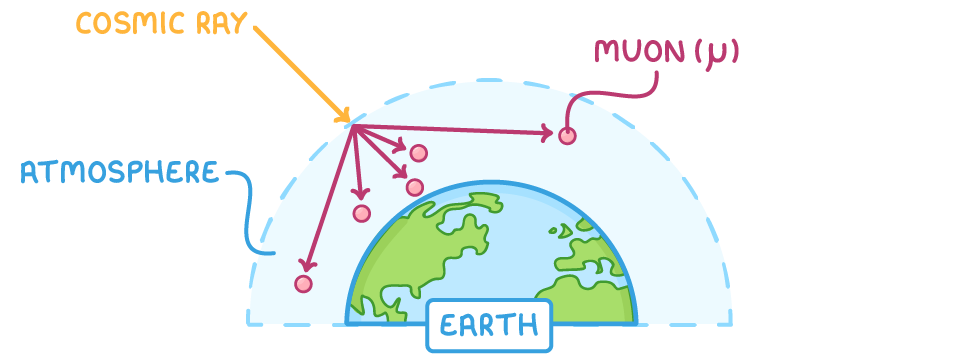
Muons are subatomic particles that can be generated in two ways:
- In high-energy particle accelerators
- When cosmic rays collide with air molecules in the upper atmosphere, approximately 10 km above Earth's surface
These muons have a short mean lifetime of around 2.2 μs. At a speed of 0.98c, a muon would be expected to travel about 660 m before decaying.
Muons are created in the upper atmosphere at a height of approximately 10 km above the Earth's surface.
Muon detection at the Earth's surface
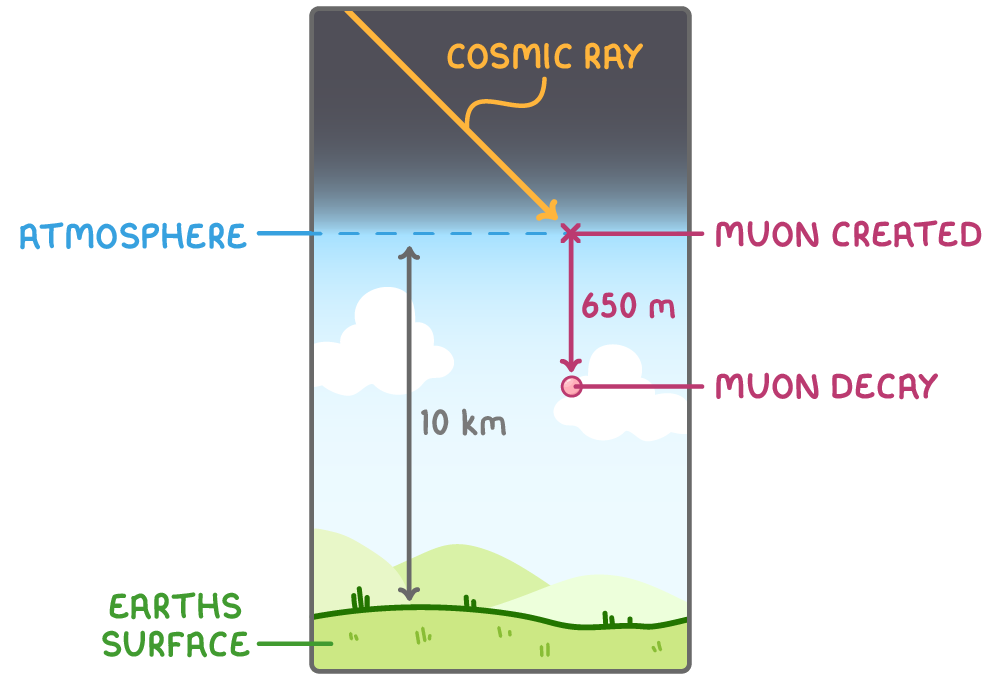
Key points:
- Muons created in the atmosphere travel at approximately 98% of the speed of light (c).
- The average lifetime of a muon is 2.2 $\mu$s.
- Muons are created in the atmosphere at a height of 10 km above the Earth's surface.
The distance travelled by these muons using Newtonian mechanics is given by:
distance = speed x time
distance = 0.98 x 3 x 10^8^ x 2.2 x 10^-6^ $\approx$ 650 m
As 650 m << 10,000 m, very few muons should reach the Earth's surface. This does not match experimental observations which detect many muons at the Earth's surface.
Explanation from Earth's reference frame
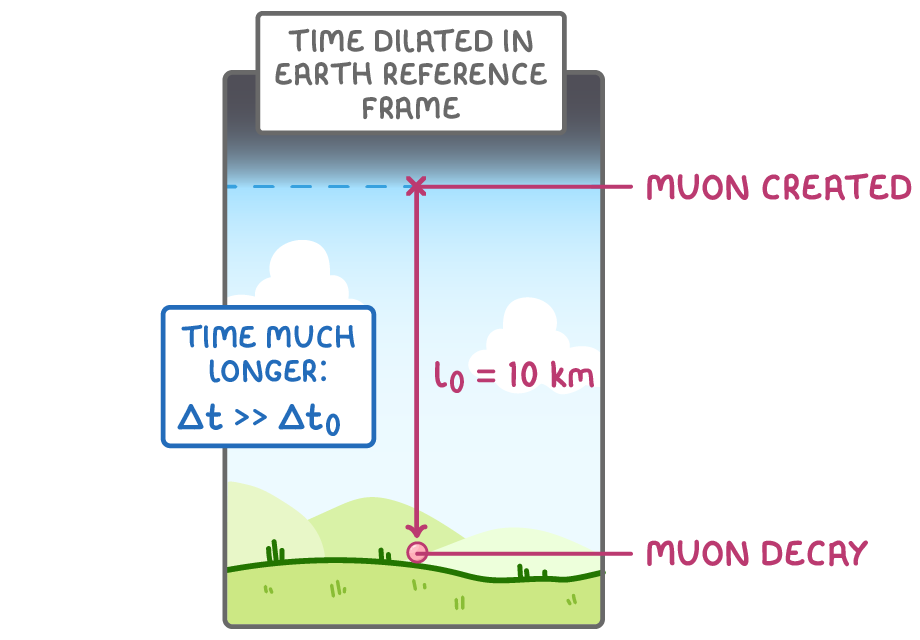
From the muon's reference frame, it experiences an average lifetime of 2.2 $\mu$s. To a stationary observer on Earth, this time is much longer due to time dilation.
The relativistic factor (γ) for muons travelling at 0.98c, is given by:
$\gamma = \frac{1}{\sqrt{1 - \frac{v^2}{c^2}}}$
Where:
- $\gamma$ = relativistic factor
- v = muon speed (m s^-1^)
- c = speed of light (m s^-1^)
$\gamma = \frac{1}{\sqrt{1 - \frac{(0.98c)^2}{c^2}}} = \frac{1}{\sqrt{1 - 0.9604}} = \frac{1}{\sqrt{0.0396}} = 5.0$
The time observed by an observer on Earth is given by:
$\Delta$t = $\gamma \Delta$t$_0$
Where:
- $\Delta$t = observed time in Earth's reference frame (s)
- $\gamma$ = relativistic factor
- $\Delta$t$_0$ = proper time-period in the muons reference frame (s)
The observer time period on Earth is therefore:
$\Delta$t = 5 x 2.2 $\mu$s = 11 $\mu$s
As 11 $\mu$s >> 2.2 $\mu$s, many more muons can reach the surface of the Earth's surface. Muons travelling faster than 0.98c are even more likely to reach the Earth's surface as shown by the table below.
| muon speed (ms^-1^) | dilated time (s) | distance travelled (m) |
|---|---|---|
| 0.98c | 11 | 3,200 |
| 0.995c | 22 | 6,600 |
| 0.998c | 35 | 10,400 |
Explanation from the muon reference frame
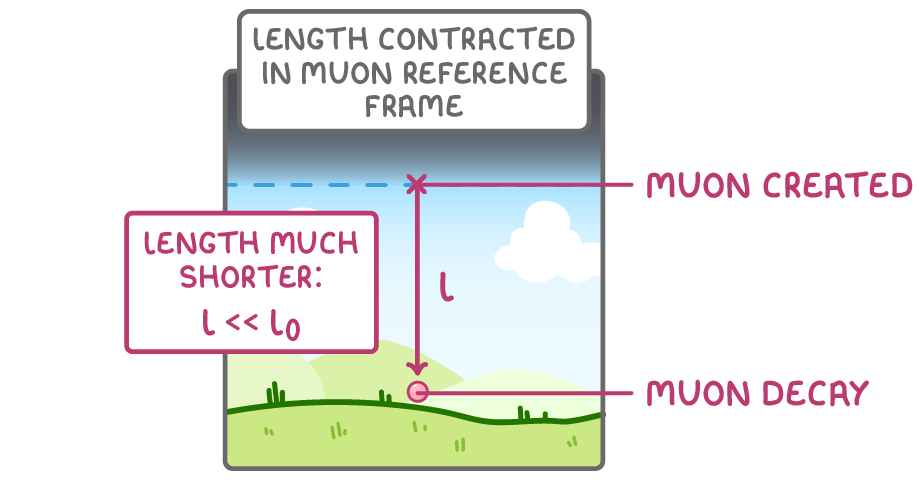
To a stationary observer on the Earth's surface, the distance travelled by a muon is 10 km. To a muon, this distance is much shorter due to length contraction at speeds close to the speed of light.
The length observed by the muon (L) is related to the relativistic factor ($\gamma$) and the proper length (L_0_) as given by:
L = $\frac{L_0}{\gamma}$
At a speed of 0.98c, the relativistic factor $\gamma$ = 5. The length observed by the muon is:
L = $\frac{10}{5}$ = 2 km
In the muon's reference frame, this reduced distance of 2.0 km corresponds to a travel time of approximately 3 mean lifetimes, allowing many more muons to survive the journey.