4.2 - Angular Displacement, Angular Velocity & Angular Acceleration
- 1
Understanding angular velocity as a measure of rotational speed
- 2
Defining angular acceleration and its relationship with changes in angular velocity
- 3
Deriving the rotational equations of motion for constant angular acceleration
- 4
Interpreting graphical representations of angular velocity and angular displacement
Angular velocity
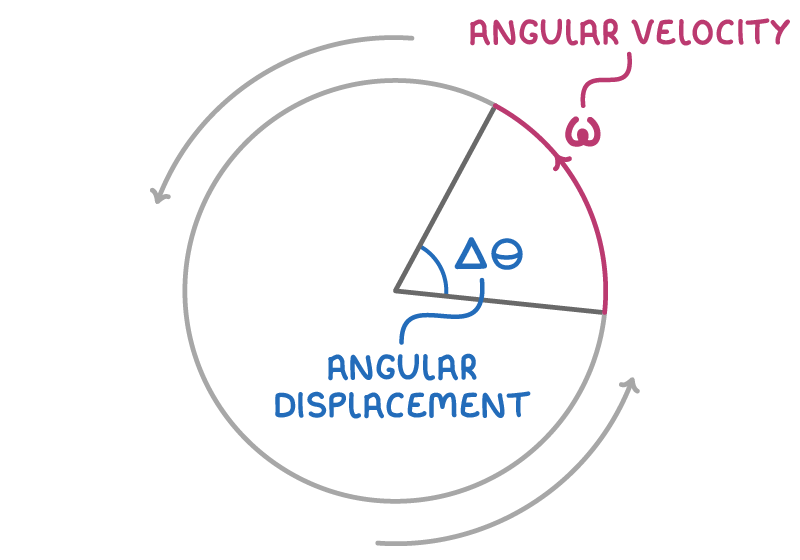
We are used to describing velocity as the rate of change of displacement. In rotational motion, we replace displacement with angular displacement. One full revolution represents an angular displacement of 2$\pi$.
Angular velocity (ω) is a measure of how quickly an object rotates or changes its angle over time. It describes the rotational speed of an object and is defined as:
$\omega = \frac{\Delta\theta}{\Delta \text{t}}$
Where:
- ω = angular velocity (rad s-1)
- Δθ = change in angle (rad)
- Δt = change in time (s)
Worked example 1 - Calculating angular velocity
Calculate the angular velocity of a Ferris wheel that rotates 4 times in 3 minutes.
Step 1: Formula
$\omega = \frac{\Delta \theta}{\Delta \text{t}}$
Step 2: Calculate change in angle (Δθ)
$\Delta \theta = 4 \times 2\pi\text{ = }8\pi \text{ radians}$
Step 3: Convert minutes to seconds (Δt)
to convert from minutes to seconds, multiply by 60
3 minutes = 180 seconds
Step 4: Substitution and correct evaluation
$\omega = \frac{8\pi}{180} = 0.14 \text{ rad s}^{-1}$
Angular acceleration
Just as linear motion can involve speeding up or slowing down, rotational motion can also experience changes in angular velocity. This change in angular velocity over time is known as angular acceleration (α).
The formula for angular acceleration is:
$\alpha \text{ = }\frac{\Delta\omega}{\Delta \text{t}}\text{ = }\frac{\omega_2\text{ - }\omega_1}{\text{t}_2\text{ - }\text{t}_1}$
Where:
- α = angular acceleration (rad s-2)
- Δω = change in angular velocity (rad s-1)
- Δt = change in time (s)
- ω₁ = initial angular velocity at time t₁ (rad s-1)
- ω₂ = final angular velocity at time t₂ (rad s-1)
Worked example 2 - Calculating angular acceleration
A spinning disk slows down from an angular velocity of 10 rad s-1 to 2 rad s-1 in 4 seconds. Calculate the angular acceleration.
Step 1: Formula
$\alpha \text{ = }\frac{\Delta\omega}{\Delta \text{t}}\text{ = }\frac{\omega_2\text{ - }\omega_1}{\text{t}_2 \text{ - t}_1}$
Step 2: Substitution and correct evaluation
$\alpha\text{ = }\frac{2 - 10}{4} = \frac{-8}{4} = -2 \text{ rad s}^{-2}$
Rotational equations of motion
The definitions of angular displacement (θ), angular velocity (ω), and angular acceleration (α) directly correspond to linear displacement (s), velocity (v), and acceleration (a), respectively.
The table below summarises the linear and rotational quantities used in equations of motion.
| Linear symbol | Quantity | Rotational symbol | Quantity |
|---|---|---|---|
| s | displacement (m) | θ | Angular displacement (rad) |
| u | Initial velocity (m s^-1^) | ω₁ | Initial angular velocity (rad s-1) |
| v | Final velocity (m s^-1^) | ω₂ | Final angular velocity (rad s-1) |
| a | Acceleration (m s^-2^) | α | Angular acceleration (rad s-2) |
| t | Time (s) | t | Time (s) |
The table compares the linear equations of motion to their equivalent rotational equations of motion.
| Linear equation of motion | Rotational equation of motion |
|---|---|
| v = u + a t | |
| s = u t + | |
| v = u + 2 a s | \omega_2$$^2$$\text{ = }\omega_1$$^2\text{ + }2\alpha\Delta\theta ParseError: Can't use function '$' in math mode at position 9: \omega_2$̲$^2$$\text{ = }… |
Worked example 3 - Using rotational equations of motion
A wheel starts from rest and accelerates uniformly to an angular velocity of 12 rad s^-1^ in 6 seconds.
Calculate the angular displacement.
Step 1: Formula
$\Delta\theta = \left(\frac{\omega_1 + \omega_2}{2}\right)\text{t}$
Step 4: Substitution and correct evaluation
$\Delta\theta = \left(\frac{\omega_1 + \omega_2}{2}\right)\text{t = }\frac{0+12}{2}\times\text{ 6 = 36 rad}$
Worked example 4 - Using rotational equations of motion
A wheel with an initial angular velocity of 5 rad s-1 decelerates uniformly at 1 rad s-2 until it stops.
Calculate the time taken to stop.
Step 1: Formula
$\omega_2 = \omega_1 + \alpha \text{ t}$
Step 2: Rearrangement
$\text{t = }\frac{\omega_2 - \omega_1}{\alpha}$
Step 3: Substitution and correct evaluation
$\omega_2 = 0$, so the equation becomes:
$\text{t = } \frac{0 - 5}{-1} = \frac{-5}{-1} = 5 \text{ seconds}$
Graphical representation of rotational motion
The relationship between angular displacement, velocity, and acceleration can be visualised through graphs, similar to their linear equivalents.
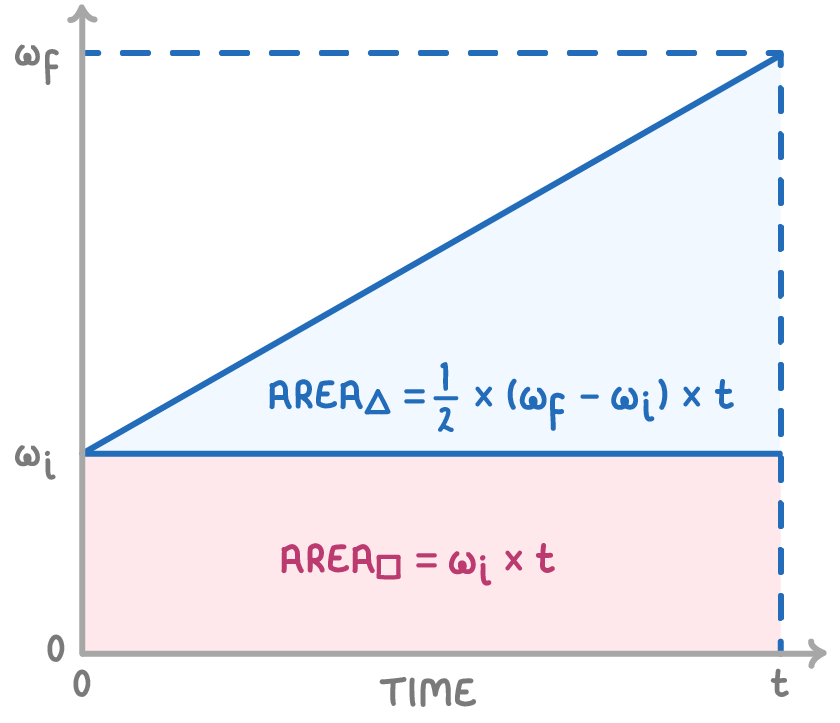
The angular displacement (θ) equals the total area under the angular velocity-time graph. This area can be divided into two parts:
Area of rectangle = $\omega_\text{i}\times\text{ t}$
Area of triangle = $\frac{1}{2}\times\left(\omega_\text{f}-\omega_\text{i}\right)\times\text{ t}$
Therefore, the angular displacement can be expressed as:
$\theta = \text{ Area A + Area B} = \omega_\text{i}\text{ t + }\frac{1}{2}\alpha \text{ t}^2$