4.3 - Inertia
- 1
Understanding the concept of moment of inertia and its importance in rotational mechanics
- 2
Calculating the moment of inertia for a single point mass rotating in a circle
- 3
Determining the moment of inertia for objects with multiple masses or distributed mass
- 4
Examining the equations for moments of inertia of common shapes
Introduction to moment of inertia
In rotational mechanics, the moment of inertia plays a role similar to mass in linear mechanics. It is a measure of an object's resistance to changes in its rotational motion. The moment of inertia depends not only on the mass of the object but also on how that mass is distributed around the axis of rotation.
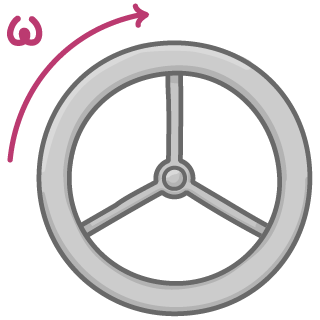
Flywheels, for example, are designed to store rotational kinetic energy in machines. They have a large mass, and this mass is placed as far from the axis of rotation as possible. This high moment of inertia makes it difficult to change the rotational speed of the flywheel.
Moment of inertia for a single point mass
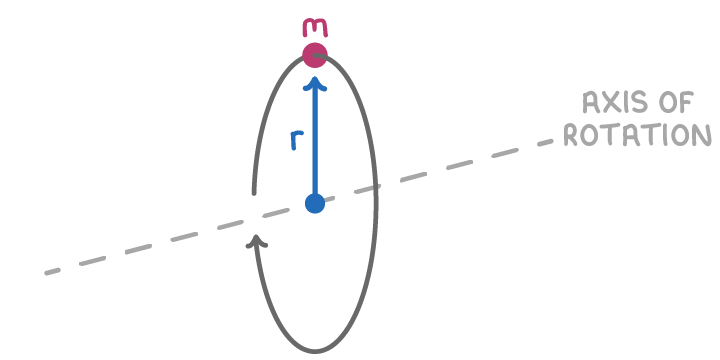
For a single point mass rotating in a circle of radius r, the moment of inertia I is given by:
I = m r2
Where:
- I = moment of inertia (kg m²)
- m = mass (kg)
- r = radius of rotation (m)
Moment of inertia for multiple masses or distributed mass
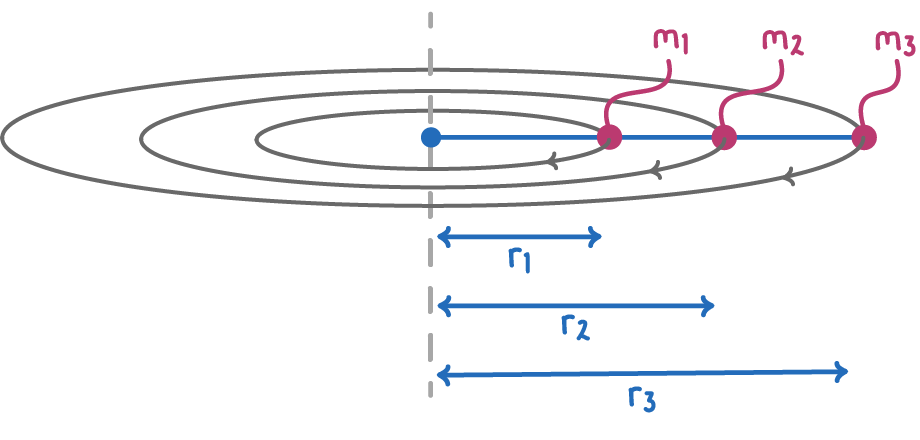
In practice, objects often have more than one mass or a mass that is distributed in space. For multiple point masses, the total moment of inertia is calculated by summing the individual moments of inertia:
$\text{I = }\sum \text{m r}^2$
Here, $\sum$ means "sum of every mass m, multiplied by the square of its distance r from the axis of rotation".
For example, if there are three masses m_1_, m_2_, and m_3_ at distances r_1_, r_2_ and r_3_ from the axis, respectively, then:
$\text{I = m}_1\text{r}_1^2\text{ + m}_2\text{r}_2^2\text{ + m}_3\text{r}_3^2$
Moments of inertia for common shapes
The table below provides the equations for the moments of inertia of some common shapes, assuming uniform density.
| Shape and rotation axis | Moment of inertia |
|---|---|
| Sphere of radius R rotating around a diameter | |
| Disc of radius R rotating about an axis perpendicular to and through the centre | |
| Rod of length L rotating about its centre perpendicular to the length | |
| Rod of length L rotating about one end perpendicular to the length | |
| Hoop of radius R rotating about its central axis |
Worked example 1 - Calculating the moment of inertia for a rod rotating about its end
Calculate the moment of inertia of a rod of length $2 \text{ m}$ and mass $5 \text{ kg}$, rotating about one end perpendicular to its length.
Step 1: Formula
$I = \frac{1}{3}\text{ m L}^2$
Step 2: Substitution and correct evaluation
$I = \frac{1}{3} \times 5 \times 2^2$
$I = \frac{20}{3}$
$I = 6.67 \text{ kg m}^2$
Worked example 2 - Calculating the moment of inertia for a disc rotating about its centre
Calculate the moment of inertia of a disc of radius $0.5 \text{ m}$ and mass $10 \text{ kg}$, rotating about an axis perpendicular to and through its centre.
Step 1: Formula
$I = \frac{1}{2}\text{ m R}^2$
Step 2: Substitution and correct evaluation
$I = \frac{1}{2} \times 10 \times 0.5^2$
$I = 5 \times 0.25$
$I = 1.25 \text{ kg m}^2$