2.5 - Viscous Drag & Buoyancy
- 1
Examining the forces acting on a falling sphere
- 2
Stokes' law and its assumptions
- 3
Calculating the drag force on a sphere moving through a fluid
- 4
Deriving the expression for terminal velocity
Forces acting on a falling sphere
When a sphere falls through a fluid under the influence of gravity, three forces act on it.
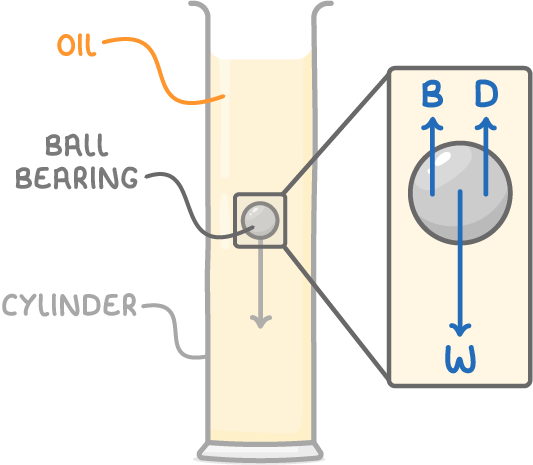
- Weight (W) - Downwards force due to gravity acting on the mass of the sphere.
- Viscous Drag force (D) - Upwards resistive force due to the motion through the fluid.
- Buoyancy force (B) - Upwards force equal to the weight of the displaced fluid.
Fluid viscosity
The dynamic viscosity ($\eta$) is a measure of a fluid's resistance to deformation.
Fluids with high viscosity, like honey, have a higher resistance to flow compared to more runny, low-viscosity fluids like water.
The table below summarises the viscosity of some common substances.
| Substance | Viscosity (mPa s) |
|---|---|
| Whole milk | 2.12 |
| Water | 1.00 |
| Honey | 2,000+ |
| Olive Oil | 56.2 |
Stokes' law for viscous drag
In 1851, George Stokes derived a theory for the viscous drag force acting on a small sphere moving through a viscous fluid. This law, known as Stokes' law, applies to both gases and liquids. However, Stokes made the following assumptions:
- The fluid flow is laminar, meaning layers flow smoothly without mixing.
- The moving particles are smooth spheres.
- The fluid is homogeneous (uniform in composition).
- The particles do not interact with each other.
Calculating viscous drag
According to Stokes' law, the drag force (Fd) on a sphere of radius r moving with speed v through a fluid with dynamic viscosity $\eta$ is given by:
$\text{F}_\text{d}\text{ = 6 }\pi\eta \text{ r v}$
Where:
- Fd = viscous drag force (N)
- $\eta$ = dynamic viscosity of the fluid (Pa s)
- r = radius of the sphere (m)
- v = speed of the sphere (m s-1)
Worked example 1 - Calculating drag force on a sphere
A small steel ball with a radius of 1.5 mm moves through oil with a dynamic viscosity of 0.1 Pa s at a speed of 0.2 m s-1. Calculate the drag force acting on the ball.
Step 1: Formula
$F_d = 6\pi\eta rv$
Step 2: Identify known quantities
r = 1.5 mm = 1.5 × 10⁻³ m
$\eta$ = 0.1 Pa s
v = 0.2 m s^-1^
Step 3: Substitution and correct evaluation
$\text{F}_\text{d}\text{ = 6 }\pi \times 0.1 \times 1.5 \times 10^{-3} \times 0.2$
$\text{F}_\text{d}\text{ = }5.66 \times 10^{-4} \text{ N}$
Calculating buoyancy force
When an object is immersed in a fluid, it experiences an upward buoyant force. The buoyancy force is equal to the weight of the displaced fluid as given by:
$\text{B = }\rho_\text{f}\text{ g V}$
Where:
- B = buoyancy force (N)
- $\rho_\text{f}$ = density of the fluid (kg m-3)
- g = acceleration due to gravity (m s-2)
- V = volume of the object (m3)
In the case of a spherical object of radius r, the volume is:
$\text{V}\text{ = }\frac{4}{3}\pi \text{ r}^3$
The buoyancy force opposes the weight force acting downwards, reducing the net downward force and increasing the terminal velocity compared to if buoyancy was neglected.
Worked example 2 - Calculating buoyancy force
Calculate the buoyancy force acting on a spherical steel ball of radius 5 cm immersed in water at 20°C. The density of steel is 7800 kg/m³. The density of water at 20°C is 998 kg m-3.
Step 1: Identify known quantities
r = 5 cm = 0.05 m
$\rho_f$ = 998 kg m-3 (density of water at 20°C)
g = 9.81 m s-2
Step 2: Calculate the volume of the sphere
$V = \frac{4}{3}\pi r^3 = \frac{4}{3}\pi (0.05)^3 = 5.24 \times 10^{-4}$ m³
Step 3: Calculate the buoyancy force
$B = \rho_f gV = 998 \times 9.81 \times 5.24 \times 10^{-4} = 5.13$ N
Terminal velocity derivation
As the sphere falls, the drag force increases due to its increasing speed. Eventually, the sum of the buoyancy (B) and drag forces (D) equals the weight (W), resulting in a constant terminal velocity ($v_t$). At this point the net force = 0.
Setting the net force to zero and rearranging, we obtain the expression for terminal velocity:
W - B - D = 0
V$\rho_s$g - V$\rho_f$g - 6$\pi\eta$rv = 0
Vg$\left(\rho_s-\rho_f\right)$ = 6$\pi\eta\text{r v}_\text{t}$
$\text{v}_\text{t} = \frac{(\rho_\text{s} - \rho_\text{f})\text{ g V}}{6\pi\eta \text{r}}$
Where:
- v_t_ = terminal velocity (m s^-1^)
- $\rho_s$ is the density of the sphere (kg m-3)
- $\rho_f$ is the density of the fluid (kg m-3)
- $g$ is the acceleration due to gravity (m s-2)
- $V$ is the volume of the sphere (m3)
- $\eta$ is the dynamic viscosity of the fluid (Pa s)
- $r$ is the radius of the sphere (m)
Worked example 3 - Calculating terminal velocity
A spherical raindrop with a radius of 0.2 mm falls through air at 20°C. Given that the density of water is 1000 kg m-3 and the dynamic viscosity of air at 20°C is 1.8 × 10^-5^ Pa s, calculate the terminal velocity of the raindrop.
Step 1: Identify known quantities
r = 0.2 mm = 2 × 10⁻⁴ m
$\rho_s$ = 1000 kg m-3 (density of water)
$\rho_f$ = 1.2 kg m-3 (density of air at 20°C)
$\eta$ = 1.8 × 10^-5^ Pa s (for air at 20°C)
$g$ = 9.81 m s-2
Step 2: Calculate the volume of the sphere
$V = \frac{4}{3}\pi r^3 = \frac{4}{3}\pi (2 \times 10^{-4})^3 = 3.35 \times 10^{-11} \text{ m}^3$
Step 3: Substitute values into the terminal velocity equation
$\text{v}_\text{t}\text{ = }\frac{(\rho_\text{s} - \rho_\text{f})\text{ g V}}{6\pi\eta \text{r}}$
$\text{v}_\text{t}\text{ = }\frac{(1000 - 1.2) \times 9.81 \times 3.35 \times 10^{-11}}{6\pi \times 1.8 \times 10^{-5} \times 2 \times 10^{-4}}\text{ = 4.84 m s}^{-1}$