9.5 - Heat Engines
- 1
The concept of a heat engine and its role in converting internal energy into useful work
- 2
The principle behind heat engine operation and the role of temperature differences
- 3
Defining thermal efficiency and its mathematical representation
- 4
Introducing the Carnot cycle and its four distinct processes
- 5
Understanding reversibility in thermodynamic processes
What is a heat engine?
A heat engine is a device that continuously converts thermal energy (heat) into mechanical energy (useful work). It operates on the principle that energy ($Q_H$) is transferred into the engine at a high temperature ($T_H$), and some energy ($Q_C$) is rejected by the engine at a lower temperature ($T_C$). The difference between these energies ($Q_H - Q_C$) represents the useful work output.
W = Q_H_ - Q_C_
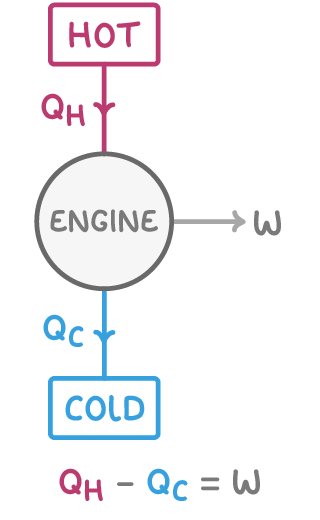
For a heat engine to operate continuously, it must return to its initial state after completing a cycle. This cyclical process allows the engine to be used repeatedly without the need for resetting or replacing components.
Thermal efficiency of a heat engine
The thermal efficiency ($\eta$) of a heat engine is defined as the ratio of the useful work output to the input energy. It quantifies how effectively the engine converts the input heat into useful work:
$\eta = \frac{\text{useful work output}}{\text{input energy}} = \frac{Q_H - Q_C}{Q_H}=\frac{T_H-T_C}{T_C}$
Where:
- $\eta$ = thermal efficiency
- $Q_H$ = energy input at high temperature (J)
- $Q_C$ = energy output at low temperature (J)
- T_H_ = Temperature of the hot reservoir (K)
- T_C_ = Temperature of the cold reservoir (K)
This equation suggests that to increase the efficiency of a Carnot cycle (and, in principle, any heat engine), $T_H$ should be as high as possible, and $T_C$ should be as low as possible. However, practical limitations, such as material properties and the availability of suitable heat reservoirs, restrict the achievable efficiency of real heat engines.
It is important to note that for irreversible processes, some energy is lost to non-useful processes like friction or turbulence, and the difference $Q_H - Q_C$ will not entirely constitute useful work output. As a result, the efficiency of real heat engines is always lower than the theoretical maximum efficiency of a Carnot cycle operating between the same temperature reservoirs.
Worked example - Calculating useful work output of a Carnot engine
A Carnot engine absorbs $1,000\text{ J}$ of energy from a high-temperature reservoir at $500\text{ K}$ and rejects $600\text{ J}$ to a low-temperature reservoir at $300\text{ K}$. Calculate the useful work output.
Step 1: Formula
W = $Q_H - Q_C$
Step 2: Substitution and correct evaluation
Useful work output = $1000\text{ J} - 600\text{ J}$
Useful work output = $400\text{ J}$
Worked example - Calculating the energy rejected by a Carnot engine
A Carnot engine with a thermal efficiency of $40\%$ absorbs $1,500\text{ J}$ of energy from the high-temperature reservoir. Calculate the energy rejected to the low-temperature reservoir.
Step 1: Formula
$\eta_{\text{Carnot}} = \frac{Q_H - Q_C}{Q_H}$
Step 2: Rearrangement
$Q_C = Q_H - \eta_{\text{Carnot}} \times Q_H$
Step 3: Substitution and correct evaluation
$Q_C = 1500 - 0.4 \times 1,500$
$Q_C = 1500 - 600 = 900 \text{ J}$
Worked example - Calculating the thermal efficiency of a Carnot cycle
A Carnot engine operates between a high-temperature reservoir at $600\text{ K}$ and a low-temperature reservoir at $300\text{ K}$. Calculate the thermal efficiency of this Carnot engine.
Step 1: Formula
$\eta_{\text{Carnot}} = \frac{T_H - T_C}{T_H}$
Step 2: Substitution and correct evaluation
$\eta_{\text{Carnot}} = \frac{600 - 300}{600}\text{ = 0.5 or 50}$%
The Carnot cycle
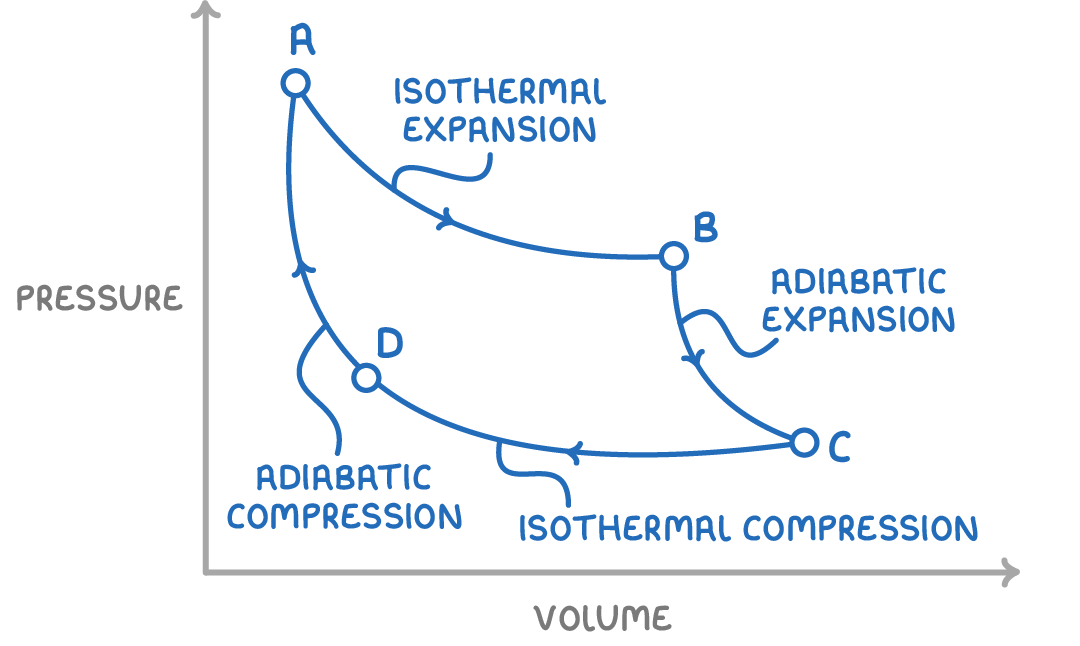
The Carnot cycle, proposed by French engineer and physicist Nicolas Léonard Sadi Carnot in 1824, is a theoretical ideal cycle for a heat engine. It consists of four processes that an ideal gas undergoes in sequence: two isothermal (constant temperature) and two adiabatic (no heat exchange with the surroundings).
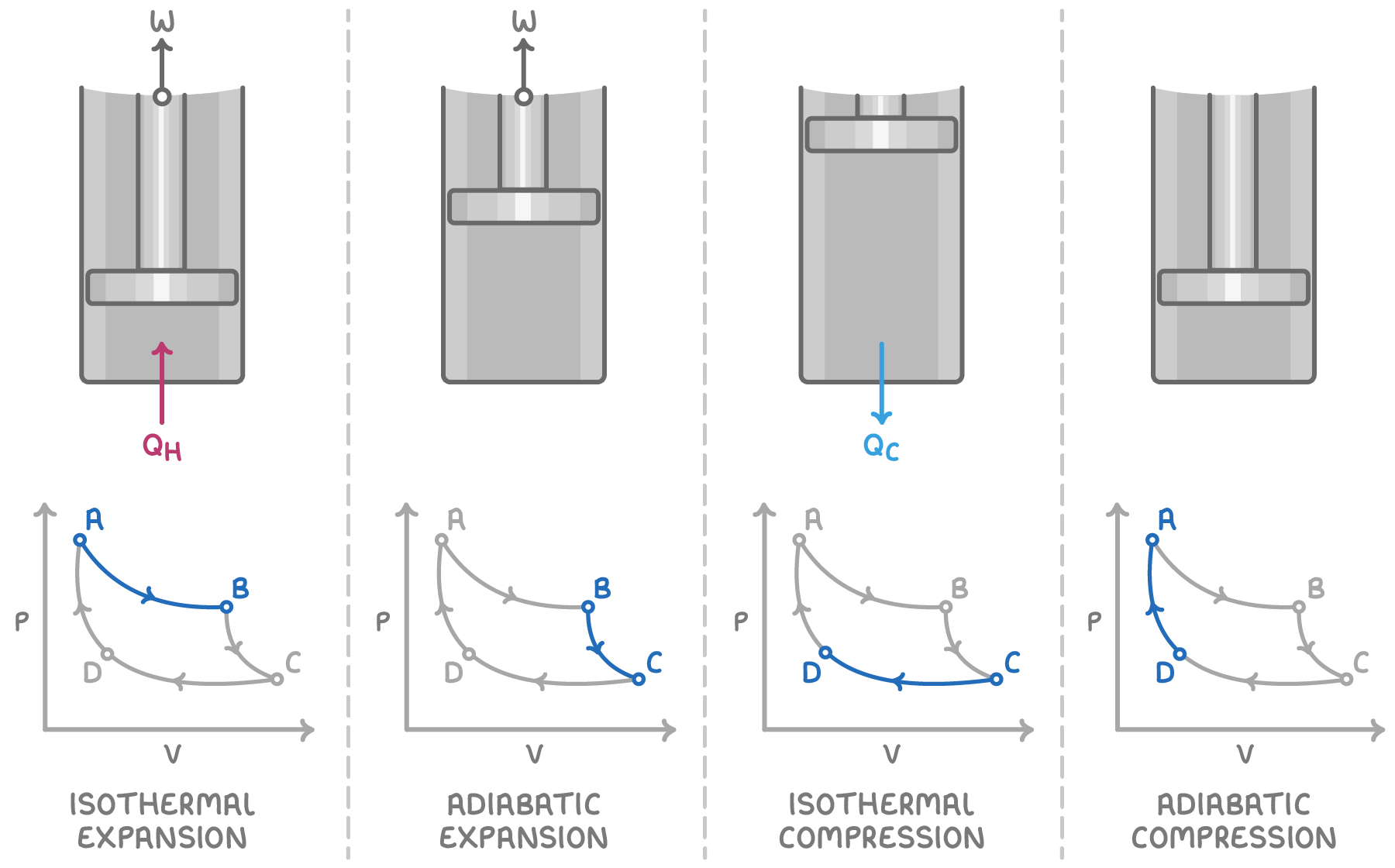
The four steps of the Carnot cycle are:
- Isothermal expansion (A→B) - The gas expands at constant temperature $T_H$ as energy $Q_H$ is supplied. The internal energy remains constant, and all the absorbed energy performs work on the surroundings.
- Adiabatic expansion (B→C): The gas expands without exchanging energy with the surroundings ($Q=0$). The internal energy decreases, causing the temperature to drop to $T_C$. The gas performs work on the surroundings equal to the decrease in internal energy: $-\Delta U = W$.
- Isothermal compression (C→D): The gas is compressed at constant temperature $T_C$, rejecting energy $Q_C$ to the surroundings. The internal energy remains constant, and the compression work is entirely supplied by the surroundings.
- Adiabatic compression (D→A): The gas is further compressed without exchanging energy with the surroundings. The work done on the gas increases its internal energy and temperature back to $T_H$.
Reversibility in thermodynamic processes
A reversible process is one in which a system can return to its previous state with a negligible change to the properties of the system or its surroundings. In a reversible process, the system and its surroundings are always in thermodynamic equilibrium, meaning there are no net changes in the system's properties over time.
For a process to be reversible, it must be carried out infinitely slowly, allowing the system to maintain equilibrium at each step and return to its exact initial state at the end of the cycle. In reality, all processes are irreversible to some extent due to factors such as friction, turbulence, and heat transfer across finite temperature differences.