2.3 - Friction
- 1
Understanding the concept of static friction and dynamic friction
- 2
Defining the coefficients of static and dynamic friction
- 3
Exploring the relationship between frictional force, normal reaction force, and the coefficients of friction
What is friction?
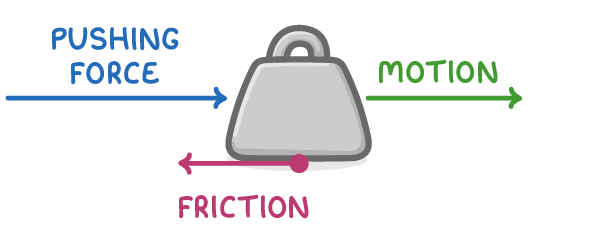
Friction is a force that opposes the relative motion of two surfaces in contact.
This phenomenon plays a crucial role in our daily lives, from walking on the ground to gripping objects.
Illustrating static and dynamic friction
To understand the concepts of static and dynamic friction, let's consider an experiment.
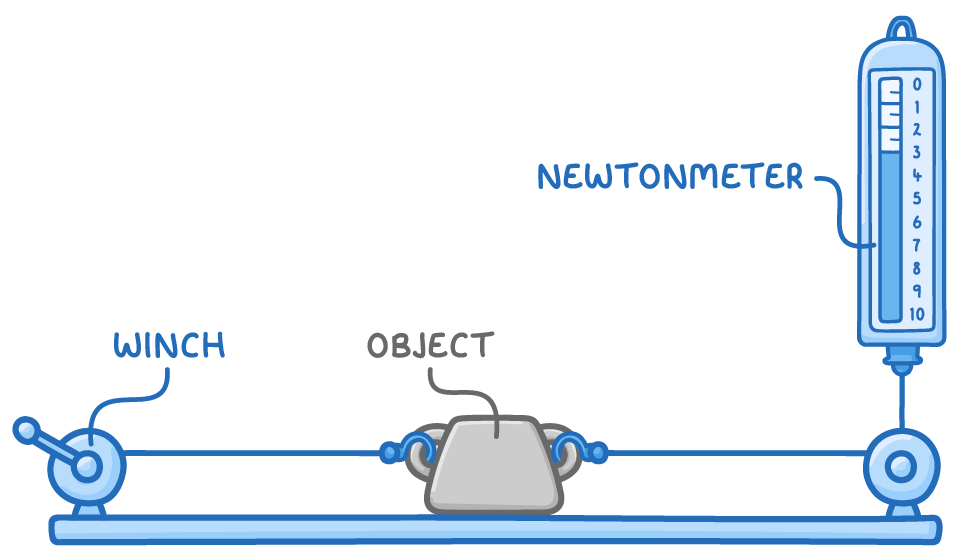
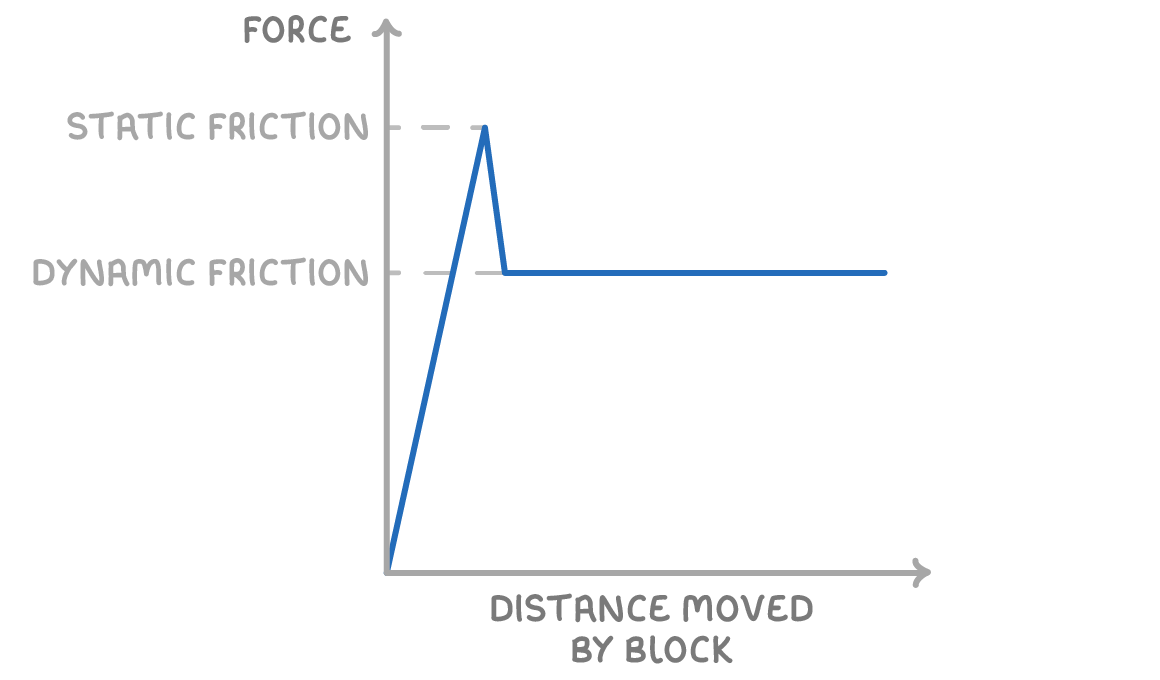
- Initially, when the winch is turned, the tension in the newtonmeter increases, but there is no relative movement between the metal object and the wooden platform due to static friction.
- Eventually, the tension reaches a point where the metal object starts to slide over the wood, indicating that the static friction has been overcome.
- At this instant, the reading on the newtonmeter decreases, reflecting the transition to a lower dynamic friction force.
Static friction and the coefficient of static friction
When two surfaces are in contact and no relative motion occurs, static friction resists the initiation of motion.
The static frictional force (Ff) is given by:
$\text{F}_\text{f}\text{ } \leq \mu_\text{s}\text{ } \text{F}_\text{N}$
Where:
- $\mu_\text{s}$ = coefficient of static friction (a dimensionless quantity)
- $\text{F}_\text{N}$ = normal reaction force (N)
The static frictional force can vary from zero to a maximum value, represented by the inequality sign (≤). If the applied force exceeds this maximum value, the object begins to move.
Worked example 1 - Calculating static frictional force
A crate weighing 250 N is being pulled across a concrete floor with a coefficient of static friction ($\mu_\text{s}$) of 0.6.
Calculate the force required to initiate motion.
Step 1: Identify the normal reaction force ($F_N$)
$F_N$ is equal to the weight of the crate = 250 N
Step 2: Formula
$\text{F}_\text{f}\text{ } \leq \text{ }\mu_\text{s}\text{ } \text{F}_\text{N}$
Step 3: Substitution and correct evaluation
$\text{F}_\text{f}\text{ } \leq 0.6 \times 250 \text{ N}$
$\text{F}_\text{f } \leq 150 \text{ N}$
Dynamic friction and the coefficient of dynamic friction
After the object starts sliding, dynamic friction comes into play. The dynamic frictional force is given by:
$\text{F}_\text{f}\text{ = }\mu_\text{d} \text{ F}_\text{N}$
Where:
- $\mu_\text{d}$ = coefficient of dynamic friction (a dimensionless quantity)
- $\text{F}_\text{N}$ = the normal reaction force (N)
Dynamic friction remains constant, independent of the relative speed between the surfaces.
Worked example 2 - Calculating dynamic frictional force
A box weighing 150 N is being pulled across a concrete floor with a coefficient of dynamic friction ($\mu_\text{d}$) of 0.3.
Calculate the dynamic frictional force acting on the box.
Step 1: Identify the normal reaction force ($\text{F}_\text{N}$)
$\text{F}_\text{N}$ is equal to the weight of the crate = 150 N
Step 2: Formula
$\text{F}_\text{f}\text{ } = \text{ }\mu_\text{d}\text{ } \text{F}_\text{N}$
Step 3: Substitution and correct evaluation
$\text{F}_\text{f}\text{ } = 0.3 \times 150$
$\text{F}_\text{f } = 45 \text{ N}$
Typical coefficients of friction
The coefficients of static and dynamic friction vary greatly depending on the pair of surfaces involved and their conditions (e.g., lubricated or dry). The table below provides some typical values:
| Surface Pair | Coefficient of Static Friction () | Coefficient of Dynamic Friction () |
|---|---|---|
| Steel on Steel (dry) | 0.6 | 0.4 |
| Aluminium on Steel (dry) | 0.5 | 0.4 |
| Wood on Wood (dry) | 0.4 | 0.3 |
| Rubber on Concrete (dry) | 0.8 | 0.6 |