5.2 - Galilean Relativity
- 1
The ways to move between inertial frames of reference
- 2
The principle of relativity and its implications
- 3
Transformations between inertial frames for position and velocity
Moving between inertial frames
In the universe, there are countless inertial frames of reference. We can move between these frames in distinct ways:
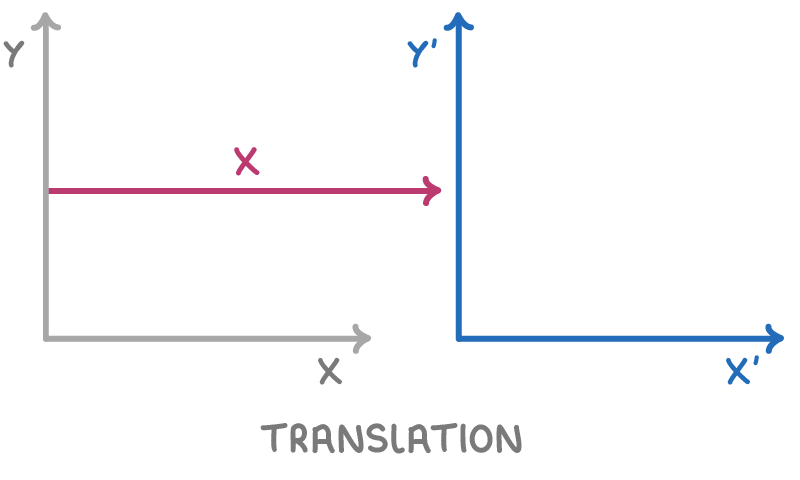
Translation - Moving from one frame to another by a constant distance.
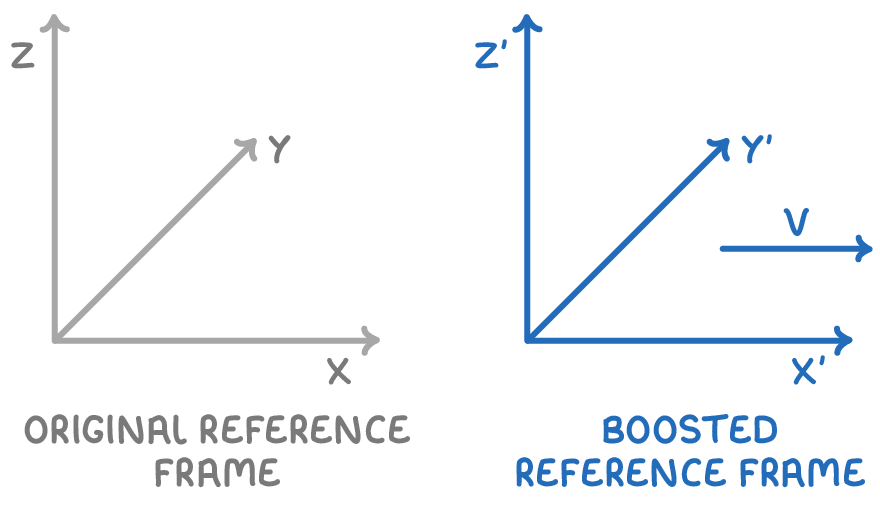
Boost - Shifting from one frame to another that has a constant relative velocity.
When an object moves with constant velocity in one frame, it will also have a constant (though possibly different) velocity in the other frame under any of these conditions.
The principle of relativity
The principle of relativity reveals fundamental aspects of our universe:
- The translation rule implies that there is no special position; position is relative.
- The boost rule suggests that there is no special velocity; being at rest is not an absolute state.
- The rotation rule indicates that there is no special direction; direction is relative.
Transformations between inertial frames
Translated frame
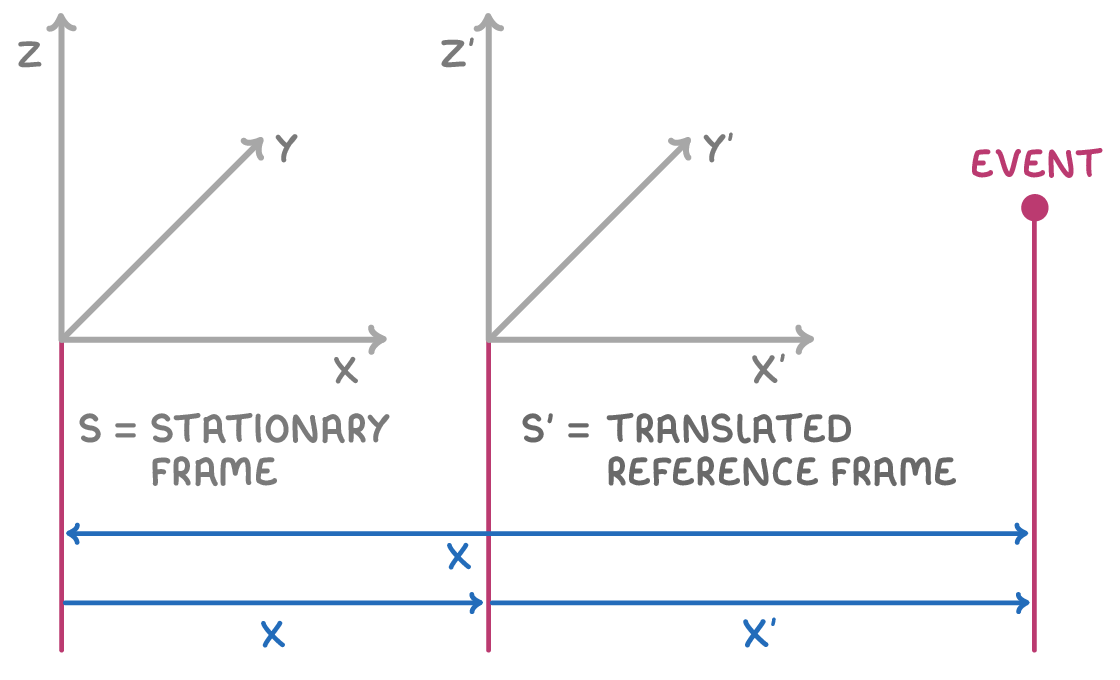
For a translation, to convert a position from frame (x, y, z) to frame (x', y', z'), subtract the offset distance X from x:
x' = x - X
x = x' + X
Boosted Frames
In a boost, when one frame moves relative to another with constant velocity v along the x-axis, the distance between their origins changes by v every second. This distance is $vt$, where t is the time since the frames coincided.
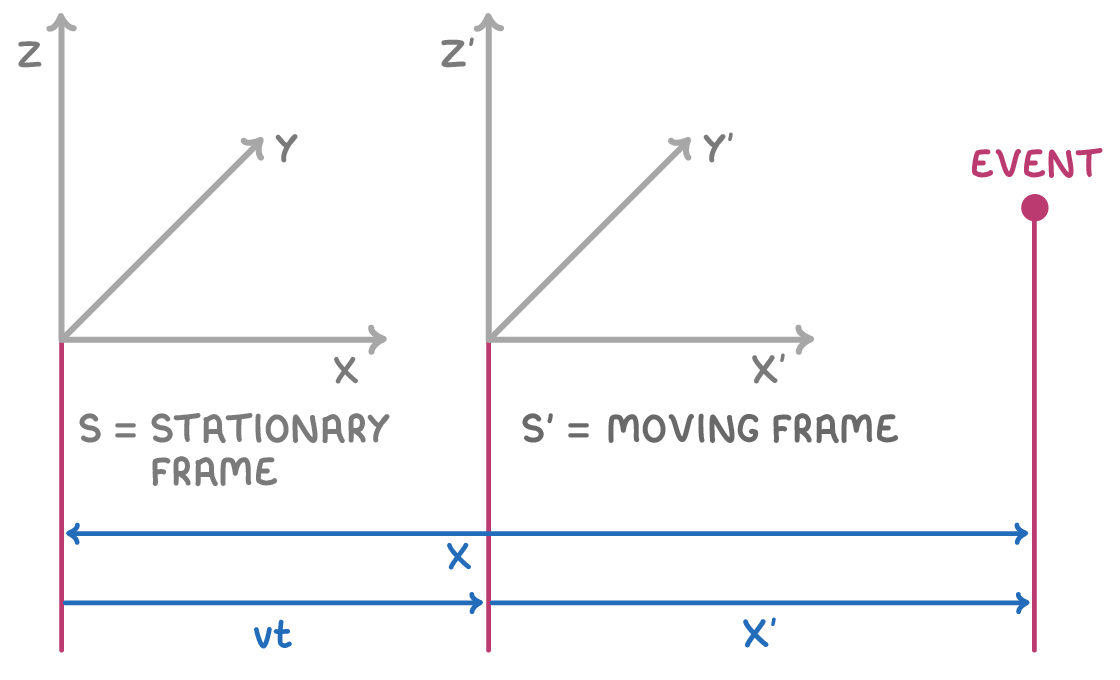
Suppose the origins of frames S and S' coincided at time $t = 0$, with clocks synchronised so that $x = x'$ at this moment. Later, at time t, the origins will be separated by vt. Thus, a position x in frame (x, y) relates to position x' in (x', y') as:
$x' = x - vt$
$x = x' + vt$
The velocities u and u' of an object in the two frames are related by:
$u' = u - v$
When u and v are not in the same direction, they must be subtracted as vectors. Alternatively, treat them as scalar components in the direction of the frames' relative motion.