9.3 - Second Law Of Thermodynamics
- 1
Clausius's statement of the second law
- 2
The Kelvin-Planck statement of the second law
- 3
Efficiency limitations for heat engines
Clausius's Statement of the Second Law
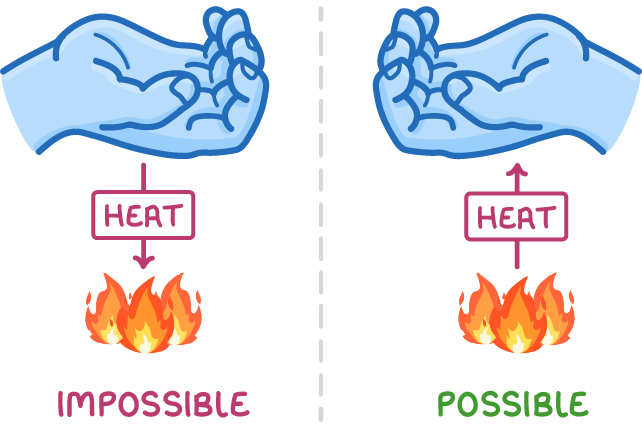
According to Clausius, the second law of thermodynamics states:
Energy cannot be transferred from a body at a lower temperature to a body at a greater temperature unless work is done on the system.
In other words, energy will not spontaneously move from a low-temperature object to a high-temperature object. Consider a cup of hot drink placed in a room with a lower temperature than the drink. The drink can't become hotter at the expense of the room's internal energy, which would then decrease.
Domestic refrigerators, which are heat engines, can warm a room by cooling their interior. However, this requires an input of energy to the compressor.
The Kelvin-Planck Statement of the Second Law
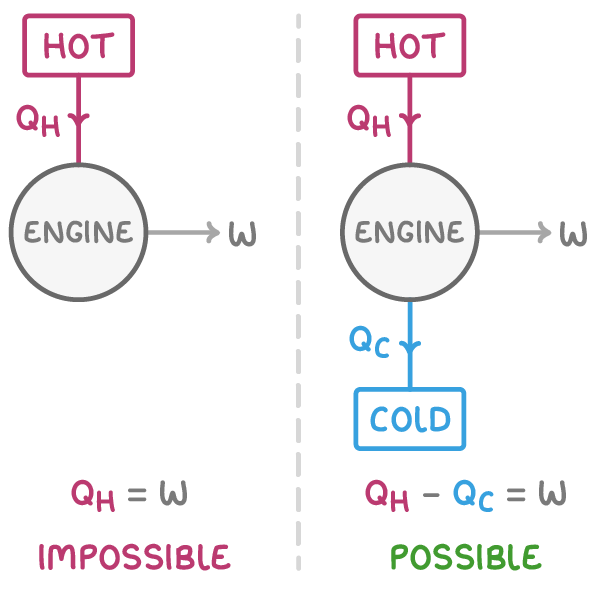
The Kelvin-Planck statement of the second law asserts:
Energy cannot be extracted from a hot object and transferred entirely into work.
This implies that the rejected energy, denoted as Qc, can never be zero for a heat engine. The efficiency of a heat engine is given by:
$\eta = \frac{Q_h - Q_c}{Q_h}$
Where:
- $\eta$ = efficiency
- Q_h_ = heat removed from the hot reservoir (J)
- Q_c_ = heat supplied to the cold reservoir (J)
The efficiency of a real heat engine can never equal 1. A heat engine must always have an efficiency below 100% because some energy (Qc) must be rejected to the sink at the lower temperature Tc.
Efficiency limitations for heat engines
The second law of thermodynamics imposes fundamental limitations on the efficiency of heat engines. No heat engine can achieve 100% efficiency, as some energy must always be rejected to the sink at a lower temperature.
The maximum theoretical efficiency of a heat engine operating between two temperatures, Th (hot reservoir) and Tc (cold reservoir), is given by the Carnot efficiency:
$\eta_\text{Carnot} = 1 - \frac{T_c}{T_h}$
Where:
- $\eta_{carnot}$ = maximum theoretical (carnot) efficiency
- Th = Temperature of the hot source (K)
- Tc = Temperature of the cold sink (K)
Worked example - Calculating the efficiency of a heat engine
A heat engine operates between a hot reservoir at 600 K and a cold reservoir at 300 K. Calculate the maximum theoretical efficiency of this heat engine.
Step 1: Formula
$\eta_\text{Carnot} = 1 - \frac{T_c}{T_h}$
Step 2: Substitution and correct evaluation
$\eta_\text{Carnot} = 1 - \frac{300}{600} = 1 - 0.5 = 0.5$
Maximum theoretical efficiency = 0.5 or 50%
This equation shows that the efficiency of a heat engine depends on the temperature difference between the hot and cold reservoirs. A larger temperature difference leads to higher efficiency.
In practice, the actual efficiency of heat engines is always lower than the Carnot efficiency due to various factors such as friction, heat loss, and mechanical limitations.