20.6 - Bohr Model
- 1
Bohr's four key assumptions about the structure of the hydrogen atom
- 2
The concept of stationary states and their relation to energy levels
- 3
The role of electron transitions in producing emission spectra
- 4
The quantisation of energy levels and the principal quantum number (n)
- 5
The mathematical formulation of the Bohr model and its connection to empirical data
- 6
The quantisation of angular momentum and its implications for electron orbitals
Bohr's four assumptions
Niels Bohr developed a model of the hydrogen atom that explained the observed emission spectra. His model was based on four crucial assumptions:
- Electrons orbit the nucleus in specific, circular paths called stationary states.
- Atoms do not emit or absorb radiation while in a stationary state.
- Atoms gain or lose energy only when electrons transition between stationary states.
- The angular momentum of an electron in a stationary state is quantised in integer multiples of $\frac{h}{2\pi}$.
Although we now know that electrons do not orbit the nucleus in the classical sense, Bohr's model provides a useful starting point for understanding the quantum nature of the hydrogen atom. It introduces the idea that electrons can only exist in specific, discrete energy levels within an atom.
Energy levels and electron transitions
Bohr's model explains the observed emission spectra of hydrogen by associating each spectral line with a specific electron transition between energy levels.
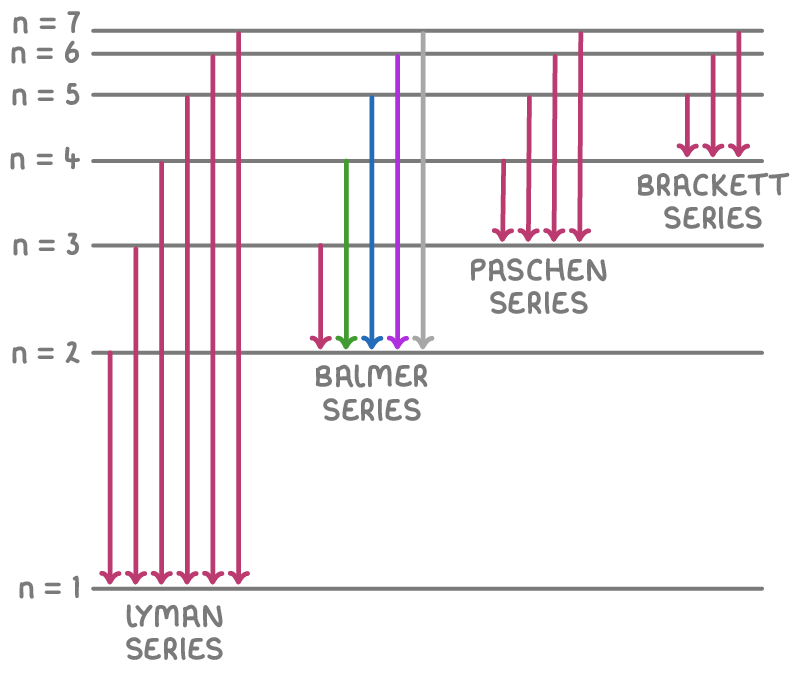
The lowest energy level (n=1) is called the ground state, while higher energy levels (n=2, 3, 4...) are called excited states. The energy required to completely remove the electron from the atom is called the ionisation energy.
Electrons can only transition between these discrete energy levels, absorbing or emitting photons with energies matching the difference between the levels. When an electron absorbs a photon, it gains energy and moves to a higher energy level. Conversely, when an electron drops to a lower energy level, it releases a photon with energy equal to the difference between the levels. These transitions give rise to the distinct spectral lines observed in hydrogen's emission spectrum.
Quantisation of energy levels
A key feature of Bohr's model is the quantisation of energy levels, represented by the principal quantum number (n). The energy of an electron in the nth energy level is given by:
$E_n = -\frac{13.6}{n^2}$
Where:
- E_n_ = energy level of the n^th^ level (eV)
- n = quantum number (1,2,3,etc)
This formula shows that the energy of an electron is inversely proportional to the square of the principal quantum number. As n increases, the energy levels become more closely spaced, converging to the ionisation energy at the limit of n approaching infinity.
Worked example - Electron transition energies
Let's calculate the energy change when an electron transitions from the ground state (n=1) to the first excited state (n=2) in a hydrogen atom.
Step 1: Calculate the energy of the ground state (n=1)
$E_1 = -\frac{13.6}{1^2} = -13.6 \text{ eV}$
Step 2: Calculate the energy of the first excited state (n=2)
$E_2 = -\frac{13.6}{2^2} = -3.4 \text{ eV}$
Step 3: Calculate the energy change during the transition
$\Delta E = E_2 - E_1 = -3.4 \text{ eV} - (-13.6 \text{ eV}) = 10.2 \text{ eV}$
This energy change corresponds to the absorption of a photon with a wavelength of approximately 122 nm, which falls in the ultraviolet region of the electromagnetic spectrum. When the electron transitions back to the ground state, it will emit a photon with the same energy, wavelength, and frequency.
Angular momentum quantisation
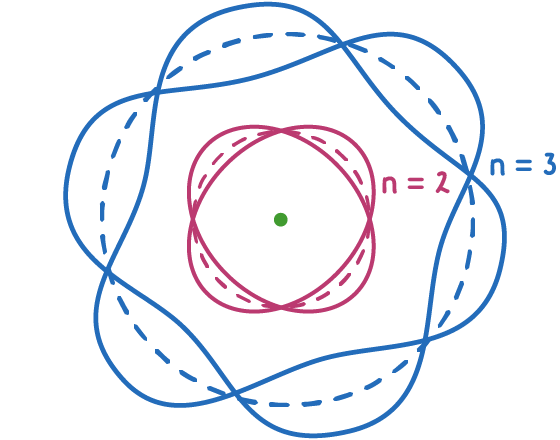
Bohr's fourth assumption states that the angular momentum of an electron in a stationary state is quantised in integer multiples of $\frac{h}{2\pi}$. This assumption is related to the wave-particle duality of electrons, as described by de Broglie's wavelength:
$\lambda = \frac{h}{mv}$
Where:
- $\lambda$ = wavelength (m)
- $h$ =Planck's constant
- $m$ = electron mass (kg)
- $v$ = electron velocity (m s^-1^)
For an electron to remain in a stable orbit, its de Broglie wavelength must fit an integer number of times around the orbital circumference. This condition leads to the quantisation of angular momentum:
$mvr = \frac{nh}{2\pi}$
where $r$ is the orbital radius and $n$ is the principal quantum number.
This quantisation of angular momentum supports the idea of electron orbitals as standing waves and reinforces the quantisation of energy levels in the Bohr model. It shows that electrons can only exist in specific, allowed orbitals that correspond to integer multiples of the fundamental unit of angular momentum.