4.4 - Angular Momentum
- 1
Definition of angular momentum and its vector nature
- 2
The conservation of angular momentum
- 3
Rotational kinetic energy in terms of angular momentum
- 4
Applications of angular momentum conservation in sports
Understanding angular momentum
Angular momentum (L) is the rotational equivalent of linear momentum. It is defined as the product of an object's
The mathematical expression for angular momentum is:
L = I $\omega$
Where:
- L = Angular momentum (kg m2 rad-1)
- I = inertia (kg m2)
- $\omega$ = angular velocity (rad s-1)
Worked example 1 - Calculating the angular momentum of a rotating object
Calculate the angular momentum of a rotating object with a moment of inertia of 5 kg m² and an angular velocity of 10 rad s⁻¹.
Step 1: Formula
$\text{L = I } \omega$
Step 2: Substitution and correct evaluation
$L = 5 \times 10 = 50 \text{ kg m² rad⁻¹}$
Conservation of angular momentum
Just as linear momentum is conserved in a system with no external forces, angular momentum is conserved in a system with no external torques. This principle is known as the conservation of angular momentum.
In mathematical terms, using the summation symbol (∑):
$\sum (I_\text{initial} \omega_\text{initial}) = \sum (I_\text{final} \omega_\text{final})$
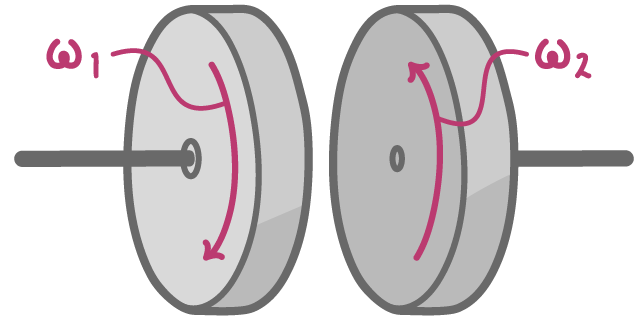
Consider two co-axial flywheels rotating in opposite directions at different initial angular velocities ($\omega_1$and $\omega_2$) and with different moments of inertia ($I_1$and $I_2$). When these flywheels are suddenly clamped together, they must rotate at the same final angular velocity ($\omega$). The conservation of the angular momentum equation for this scenario is:
$I_1 \omega_1 - I_2 \omega_2 = (I_1 + I_2) \omega$
The negative sign on the left-hand side accounts for the opposite rotational directions. The sign of $\omega$ indicates the final rotational direction of the combined flywheels.
Worked example 2 - Conservation of angular momentum for two clamped flywheels
Two flywheels, one with a moment of inertia of 3 kg m² rotating at 4 rad s⁻¹ and the other with a moment of inertia of 2 kg m² rotating at -6 rad s⁻¹, are clamped together. Calculate their final angular velocity.
Step 1: Formula
$I_1 \omega_1 - I_2 \omega_2 = (I_1 + I_2) \omega$
Step 2: Substitution and correct evaluation
$3 \times 4 - 2 \times (-6) = (3 + 2) \omega$
$12 + 12 = 5 \omega$
$24 = 5 \omega$
$\omega = \frac{24}{5} = 4.8 \text{ rad s⁻¹}$
Applications in sports
Conservation of angular momentum is crucial in many sports. For example, an ice skater can increase their angular velocity about a vertical axis by pulling their arms tightly into their body.
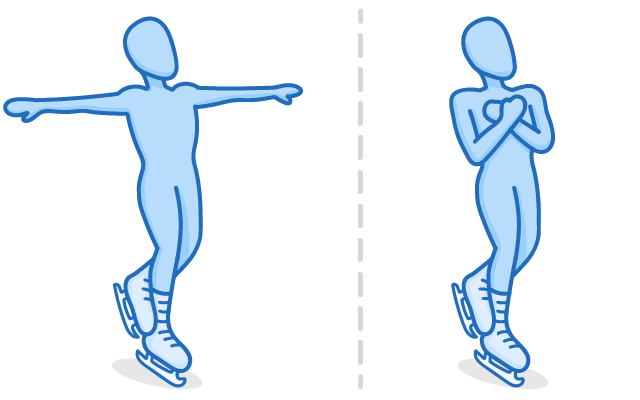
By reducing their moment of inertia (I) while conserving angular momentum (L), the skater's angular velocity (ω) must increase, as per the relationship:
$\text{L = I } \omega$
This principle applies to various rotational motions in sports, such as diving, gymnastics, and figure skating.