9.2 - Entropy
- 1
Understanding entropy from a macroscopic perspective
- 2
The entropy formulation of the second law of thermodynamics
- 3
Interpreting entropy on a microscopic scale
- 4
The relationship between entropy and the number of possible microstates
- 5
Exploring the concept of macrostates and microstates through an example
Entropy - A macroscopic interpretation
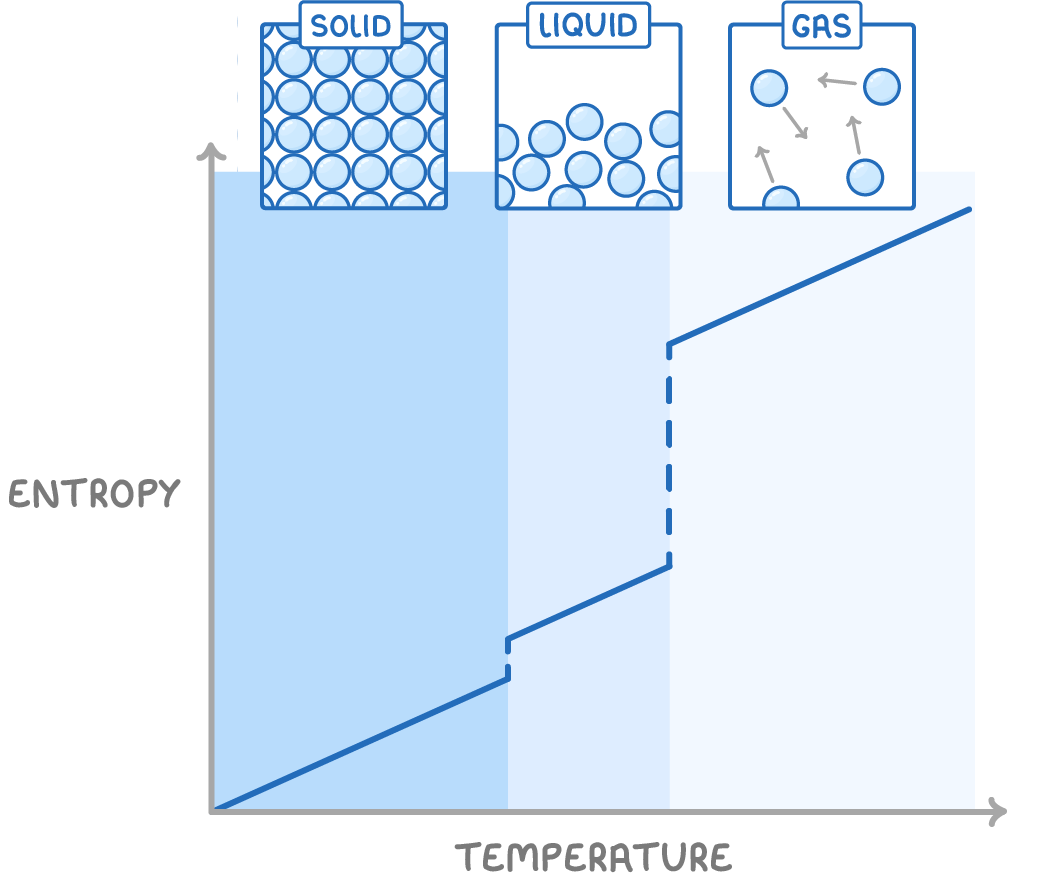
Entropy is a property that relates to the degree of order or disorder in a system. In general, cool objects are more ordered, while hot objects are more disordered. This concept leads us to another way of expressing the second law of thermodynamics.
For a reversible change, the change in entropy ($\Delta S$) is defined as:
$\Delta S = \frac{\Delta Q}{T}$
Where:
- $\Delta S$ = change in entropy (J K$^{-1}$)
- $\Delta Q$ = energy transferred into the system (J)
- $T$ = temperature at which the transfer occurs (K)
Entropy, like temperature and internal energy, is a property of a system. It is a scalar quantity measured in joules per kelvin (J K$^{-1}$).
In a reversible process, there is no change in the entropy of the system ($\Delta S = 0$).
Entropy formulation of the second law of thermodynamics
The second law of thermodynamics can be expressed in terms of entropy:
The entropy of the universe always increases during an irreversible change.
This means that for an irreversible process, the change in entropy of the universe (system + surroundings) is always positive.
Entropy - A microscopic interpretation
On a microscopic scale, entropy relates to the number of possible arrangements (microstates) available to the molecules in a system. When there are $\Omega$ different arrangements for a group of molecules, the entropy ($S$) is defined as:
$S = k_B \ln \Omega$
Where:
- $S$ = entropy (J K$^{-1}$)
- $k_B$ = Boltzmann constant (1.38 × 10$^{-23}$ J K$^{-1}$)
- $\Omega$ = number of microstates
Each microstate is equally likely to be observed, and the more microstates available, the higher the entropy.
The removal of an atom from a perfect lattice increases the number of microstates from 1 to a large number, thus increasing the entropy. This change in entropy can also be viewed in terms of the energy required to remove the atom ($\Delta Q$) at a given temperature ($T$):
$\Delta S = \frac{\Delta Q}{T}$
Exploring macrostates and microstates through an example
To understand the relationship between entropy and randomness, consider an example with 4 coins on a table. The coins can either be heads or tails. Initially, all 4 coins display heads.

Each coin is flipped and the result of the 4 coins is recorded. The table below records all possible outcomes.
| Number of Heads | States | Count of states |
|---|---|---|
| 0 | TTTT | 1 |
| 1 | HTTT THTT TTHT TTTH | 4 |
| 2 | HHTT HTHT HTTH THHT THTH TTHH | 6 |
| 3 | HHHT HHTH HTHH THHH | 4 |
| 4 | HHHH | 1 |
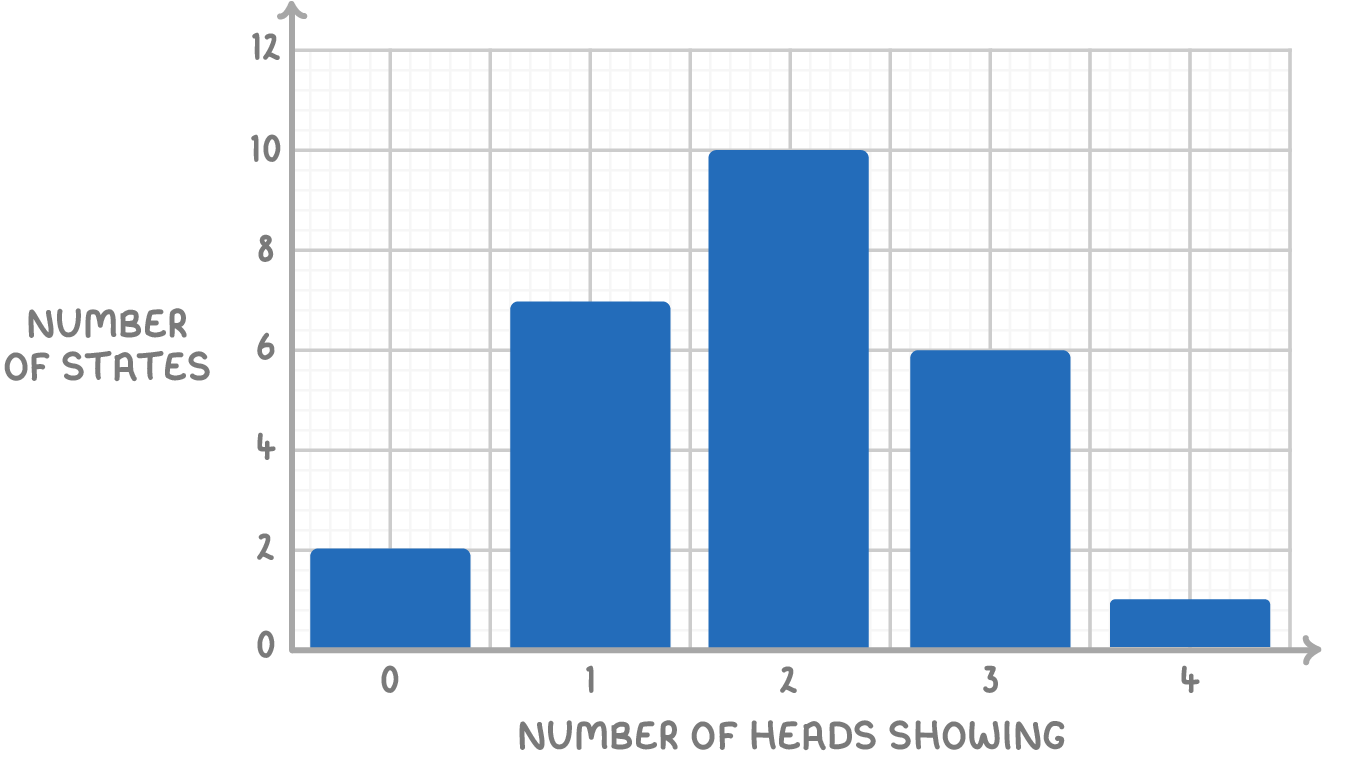
The coins are flipped repeatedly and the number of heads shown are recorded. Over time, the average number of coins showing heads will equal two as this represents the most likely outcome with 6 possible ways of achieving this configuration.
The total number of possible arrangements (microstates) in this system is $2^4 = 16$, as each coin can land on heads or tails, independently of the other coins.
The configuration with two coins showing heads is one of 5 macrostates for this system. There are 6 different ways (microstates) to achieve this particular macrostate, making it the most common among the 5 possible macrostate arrangements.