4.5 - Kinetic Energy Of Rotational Motion
- 1
Distinguishing between rolling and sliding motion
- 2
The role of friction in rolling motion
- 3
Analysing the components of rolling motion
- 4
Understanding the energy considerations in rolling and slipping
- 5
Applying the principle of conservation of energy to solve problems related to rolling motion
Rolling vs sliding
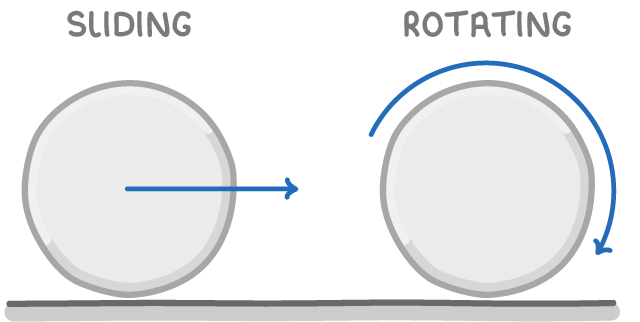
It's crucial to differentiate between rolling and sliding motions. Rolling involves an object rotating about an axis as it moves across a surface. In contrast, sliding describes an object moving smoothly along a surface without rotation.
- Sliding on frictionless surfaces - When an object moves on a perfectly frictionless surface, it can only slide, not roll.
- Rolling with friction - Friction between the surface and the object allows for rolling motion. In this case, the point of contact between the object and the surface is instantaneously at rest.
When calculating forces in rolling motion, always use the coefficient of static friction ($\mu_s$).
Components of rolling motion
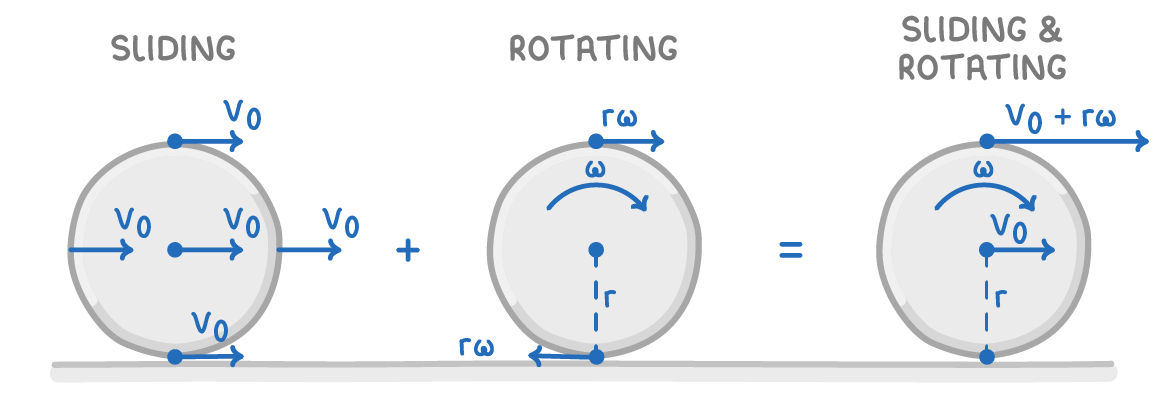
Consider a disc with radius r rolling at a linear velocity v0 and an angular velocity $\omega$.
The disc's motion can be divided into two components:
- Translational motion - The disc moves linearly with velocity $v_0$.
- Rotational motion - The disc rotates with an angular velocity $\omega$.
When the point of contact between the disc and the ground is instantaneously stationary (i.e., no slipping), $v_0$ equals $r\omega$, which is the tangential velocity of each point on the disc's edge.
At the top of the disc, the speed is $v_0 + r\omega$, or $2v_0$.
Energy considerations in rolling and slipping
For a body with mass $m$ and moment of inertia $I$ rolling without slipping at a linear speed $v$ and angular velocity $\omega$, the total kinetic energy is:
$\text{Total KE} = \frac{1}{2}mv^2 + \frac{1}{2}I\omega^2$
When this body rolls down a slope with a vertical height change of $\Delta h$, it loses gravitational potential energy equal to $mg\Delta h$.
Applying the principle of conservation of energy:
$mg\Delta h = \frac{1}{2}mv^2 + \frac{1}{2}I\omega^2$
Worked example 1 - Calculating the velocity of a rolling cylinder
A solid cylinder of mass 10 kg and radius 0.5 m rolls down a slope of vertical height 2 m without slipping. Calculate the velocity of the cylinder at the bottom of the slope.
Step 1: Equation for conservation of energy
$\text{mg}\Delta\text{h} = \frac{1}{2}\text{mv}^2\text{ + }\frac{1}{2}\text{I}\omega^2$
Step 2: Moment of inertia for a solid cylinder
For a solid cylinder, $\text{I} = \frac{1}{2}\text{mr}^2$
Substituting this into the energy equation:
$\text{mg}\Delta\text{h} = \frac{1}{2}\text{mv}^2\text{ + }\frac{1}{2}\times\frac{1}{2}\text{mr}^2\omega^2$
Step 3: Relationship between v and ω
For rolling without slipping, $\text{v = } \text{r }\omega$
Substituting this into the energy equation:
$\text{mg}\Delta\text{h} = \frac{1}{2}\text{mv}^2\text{ + }\frac{1}{4}\text{mv}^2 = \frac{3}{4}\text{mv}^2$
Step 4: Rearrange to make v the subject
$\text{v}^2 = \frac{4}{3}\text{g}\Delta\text{h}$
$\text{v} = \sqrt{\frac{4}{3}\text{g}\Delta\text{h}}$
Step 5: Substitute values and evaluate
$\text{v} = \sqrt{\frac{4}{3} \times 9.81 \times 2} = 5.1\text{ m s}^{-1}$