4.3 - Quotas
The definition and concept of quotas
A quota acts as a limit set by a government on the amount of a specific good that can enter a country from abroad. This tool helps protect local industries by controlling the flow of foreign products.
Key features of quotas
- Quantitative limit - It sets a maximum volume or number of units that can be imported over a certain period, such as restricting steel imports to 4 million tonnes annually from a particular nation.
- Purpose - Governments use quotas to shield domestic producers from overseas competition, support local jobs, or address trade imbalances.
- Implementation - Quotas are often applied to specific countries or products, and exceeding the limit can result in penalties or bans.
The market effects of quotas
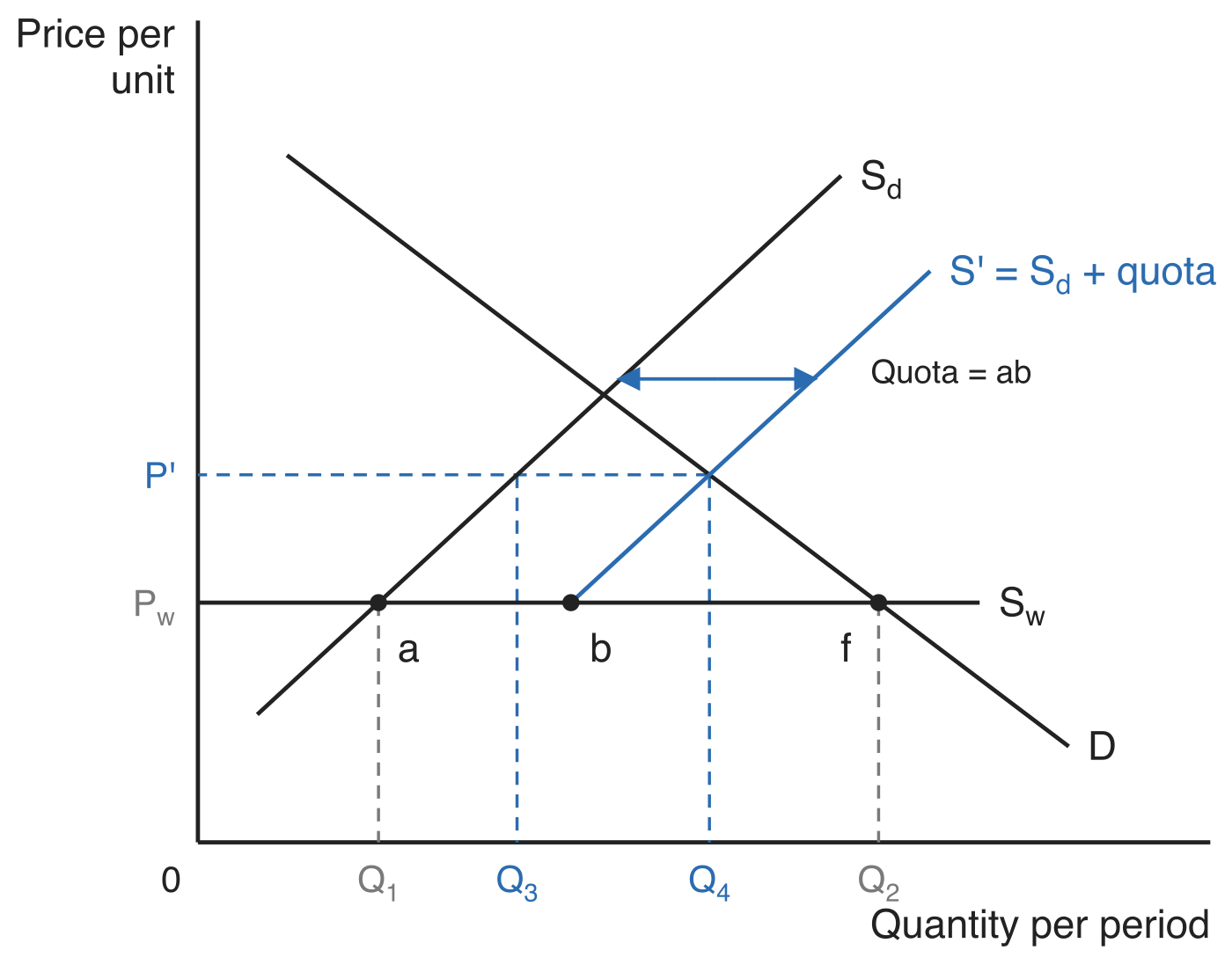
Imposing a quota disrupts the balance between supply and demand in the domestic market, leading to changes in prices and quantities. Domestic supply is Sd and domestic demand is D. Without a quota the country can buy as much as it likes at the world price Pw, so world supply is the horizontal line Sw drawn at that price and the market operates there. The quota removes that unlimited supply, and the restriction creates excess demand at Pw that drives up costs for buyers. The diagram below shows the effect.
Changes in supply and price due to quotas
- At the global price (Pw), local firms supply Q1 at point a, while buyers demand more, Q2 at point f, with the difference met by imports.
- A quota reduces imports to a fixed, smaller amount, shifting the overall supply curve inwards (from Sw to S', combining domestic supply and the quota limit). S' runs parallel to Sd from point b, a fixed horizontal distance to its right at every price, and that distance is the quota, ab.
- Only ab units may now be imported at Pw, so supply reaches b while buyers still want f. This excess demand bf pushes the domestic price up to a new level (P'), where D crosses S'.
- As a result, local production rises (to Q3) because higher prices encourage more output, while overall consumption falls (to Q4) due to the increased cost. Imports are now the gap Q3Q4, which is exactly the quota.
Revenue and expenditure effects of quotas
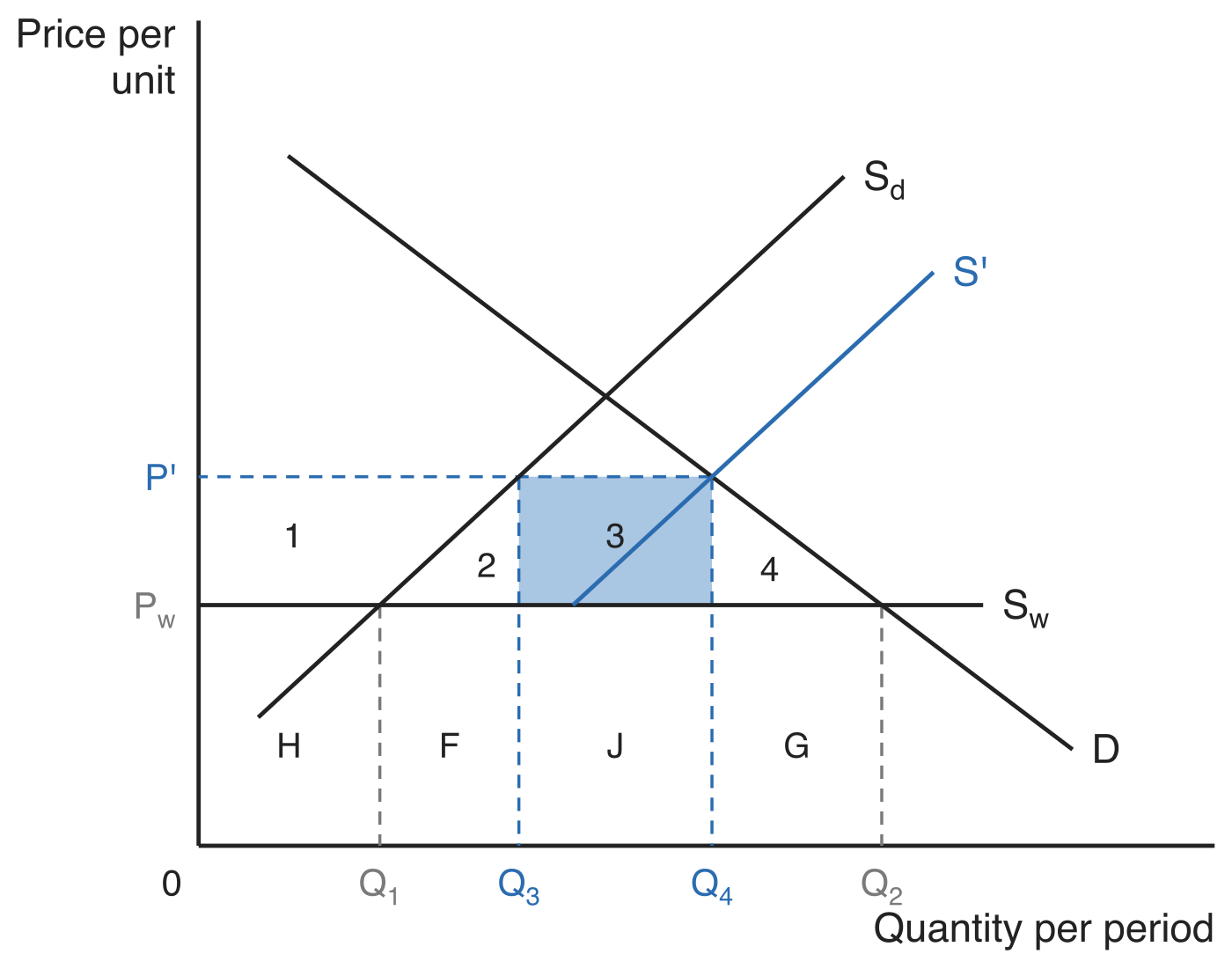
Quotas alter the financial flows in the market, affecting how much money producers earn and consumers spend. These changes can be analysed by comparing situations before and after the quota is applied. The diagram below is the same market again, with domestic supply Sd, domestic demand D, world supply Sw at the world price Pw, and the restricted supply S' giving the higher price P'. Below Pw the market splits into the four areas H, F, J and G, and the strip between Pw and P' splits into areas 1, 2, 3 and 4, so each total below can be read off the diagram as a set of areas.
Revenue for domestic producers
- Without a quota, revenue equals the world price (Pw) multiplied by the quantity supplied (Q1), which is area H.
- With a quota, revenue increases to the higher domestic price (P') multiplied by the expanded quantity (Q3), which is area (H + F + 1 + 2), adding extra income from both higher prices and more sales.
Expenditure by consumers
- Before the quota, total spending is Pw multiplied by consumption (Q2), which is area (H + F + J + G), including costs for both domestic and imported goods.
- After the quota, spending is P' multiplied by the reduced consumption (Q4), which is area (H + F + J + 1 + 2 + 3). Buyers face elevated prices on lower overall purchases, so whether the total rises or falls depends on the price elasticity of demand.
Import-related expenditure
- Initially, spending on imports covers Pw multiplied by the import quantity (Q2 - Q1), which is area (F + J + G).
- The quota caps imports at Q3Q4, but they are now bought at P' rather than Pw, so import spending becomes area (J + 3). Area 3 is the premium foreign sellers collect, which shifts some financial benefits away from consumers.
Area 4 plays no part in these totals, because it is surplus lost rather than money anyone spends.
Welfare analysis of quotas
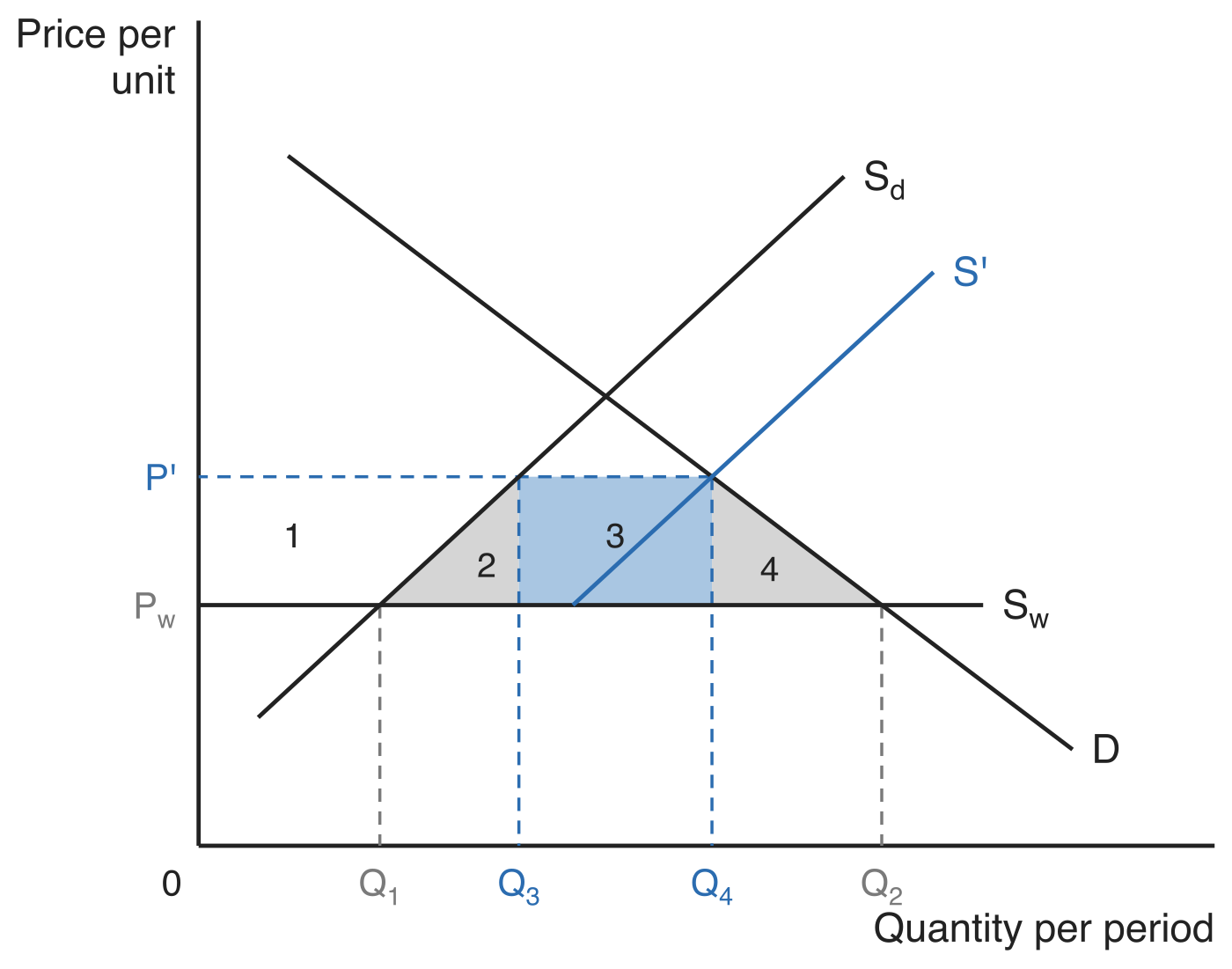
Welfare analysis examines the overall economic well-being, focusing on gains and losses for different groups. Quotas often lead to net losses for society due to inefficiencies in production and consumption. The diagram below shows the same market once more: the quota shifts supply from Sw to S', so the price rises from Pw to P', production rises along Sd from Q1 to Q3, and consumption falls along D from Q2 to Q4. The strip between the two prices divides into areas 1, 2, 3 and 4, and each welfare effect is one or more of those areas.
Impact on consumer and producer surplus
- Consumer surplus - This decreases by areas 1 + 2 + 3 + 4, the whole strip out to D, because buyers pay P' instead of Pw and consume only Q4.
- Producer surplus - This increases by area 1, the part of the strip lying to the left of Sd, because domestic firms sell Q3 at the higher price P'.
Quota rents and inefficiencies
- Quota rents - Area 3, the price rise multiplied by the permitted imports Q3Q4. These extra earnings are captured by those holding import rights, often foreign sellers who charge more under the restriction (typically not benefiting the domestic government unless licences are sold).
- Production inefficiency - Area 2. Resources are misallocated as less efficient local producers expand output from Q1 to Q3, rather than cheaper imports being used.
- Consumption inefficiency - Area 4. Buyers consume Q4 rather than Q2, distorting choices and reducing overall welfare.
Overall, quotas create a deadweight loss of areas 2 + 4, and because area 3 usually leaves the country as quota rents the loss to the domestic economy is bigger still, reducing economic efficiency compared to free trade.
Comparison between quotas and tariffs
Quotas and tariffs both protect domestic markets but differ in their mechanisms and outcomes. A tariff is a tax on imports, while a quota is a direct quantity limit, leading to distinct effects on revenue and welfare.
Similarities between quotas and tariffs
- Both raise the domestic price to a similar level (P') and reduce imports.
- They increase local production and decrease consumption, shifting surplus from consumers to producers.
Key differences between quotas and tariffs
| Difference | Tariff | Quota |
|---|---|---|
| Revenue collection | The government collects the tariff on every unit imported. | The same sum becomes quota rents for whoever holds the import rights, usually foreign exporters, unless the government auctions the licences. |
| Welfare impact | The net loss is the production and consumption inefficiencies. | Usually a larger net loss, because the rents leave the country as well, making a quota less efficient than an equivalent tariff. |
| Preferences | Directly benefits the importing country's government. | Foreign suppliers may favour quotas, since capturing the rents can leave them earning more than under free trade. |
| Flexibility | Import volumes still adjust with demand. | The quantity is fixed, so a rise in demand pushes the domestic price up further. |