3.20 - Fiscal Policy
The definition and components of fiscal policy
Fiscal policy involves adjustments to government spending and taxation levels to influence the overall level of economic activity. It operates by altering government expenditure (G) or direct taxes (T), with the goal of stabilising the economy during periods of boom or downturn.
Government expenditure and revenue sources
Government expenditure and revenue form the core of fiscal policy, enabling the state to fund public services and influence economic conditions.
Government expenditure
Categories of government expenditure:
- Capital expenditure - Investments in long-term infrastructure, such as building roads, hospitals, or transport networks.
- Current expenditure - Day-to-day spending on items like public sector wages, office supplies, and debt interest.
- Transfer payments - Funds distributed to individuals without exchange for goods or services, including pensions, jobseeker's allowances, and welfare benefits. These are excluded from gross domestic product (GDP) calculations.
Government revenue
Sources of government revenue:
- Taxes - The main source, divided into direct taxes (e.g., income tax) and indirect taxes (e.g., value-added tax).
- Asset sales - Income from selling off government-owned businesses or properties.
- State enterprise profits - Earnings generated by publicly owned companies.
Budget positions and their implications
The government's budget position reflects the balance between its income and spending, with significant effects on national debt and economic policy.
Types of budget positions:
- Budget deficit - Occurs when government spending exceeds tax revenue (G > T), requiring borrowing to cover the shortfall.
- Budget surplus - Happens when tax revenue is greater than spending (T > G), allowing debt reduction or savings.
- Balanced budget - Achieved when spending equals revenue (G = T), maintaining a neutral fiscal stance.
Deficits are typically financed by issuing government bonds to borrow funds. Persistent deficits contribute to rising public debt, while surpluses help reduce it.
Goals of fiscal policy
Fiscal policy serves multiple macroeconomic objectives, focusing on stability and equity.
Key objectives of fiscal policy:
- Stimulate recovery during economic slumps.
- Reduce unemployment caused by business cycles.
- Control rising prices to maintain low inflation.
- Foster a stable environment that supports long-term growth.
- Smooth out fluctuations in the economic cycle.
- Narrow gaps in income distribution.
- Address imbalances in international trade.
Types of fiscal policy and perspectives
Fiscal policy can be expansionary or contractionary, depending on the economic context. Different economic theories offer contrasting views on its effectiveness.
Expansionary fiscal policy
This approach boosts aggregate demand to revive a sluggish economy and close gaps where output is below potential:
- Methods - Raise government spending (G) or cut taxes (T).
- Mechanism - Increased G directly raises aggregate demand (AD), shifting the AD curve rightwards. Lower T boosts disposable income (Yd), leading to higher consumption (C) and thus AD.
- Effects - Raises real GDP, lowers unemployment, but may increase inflation.
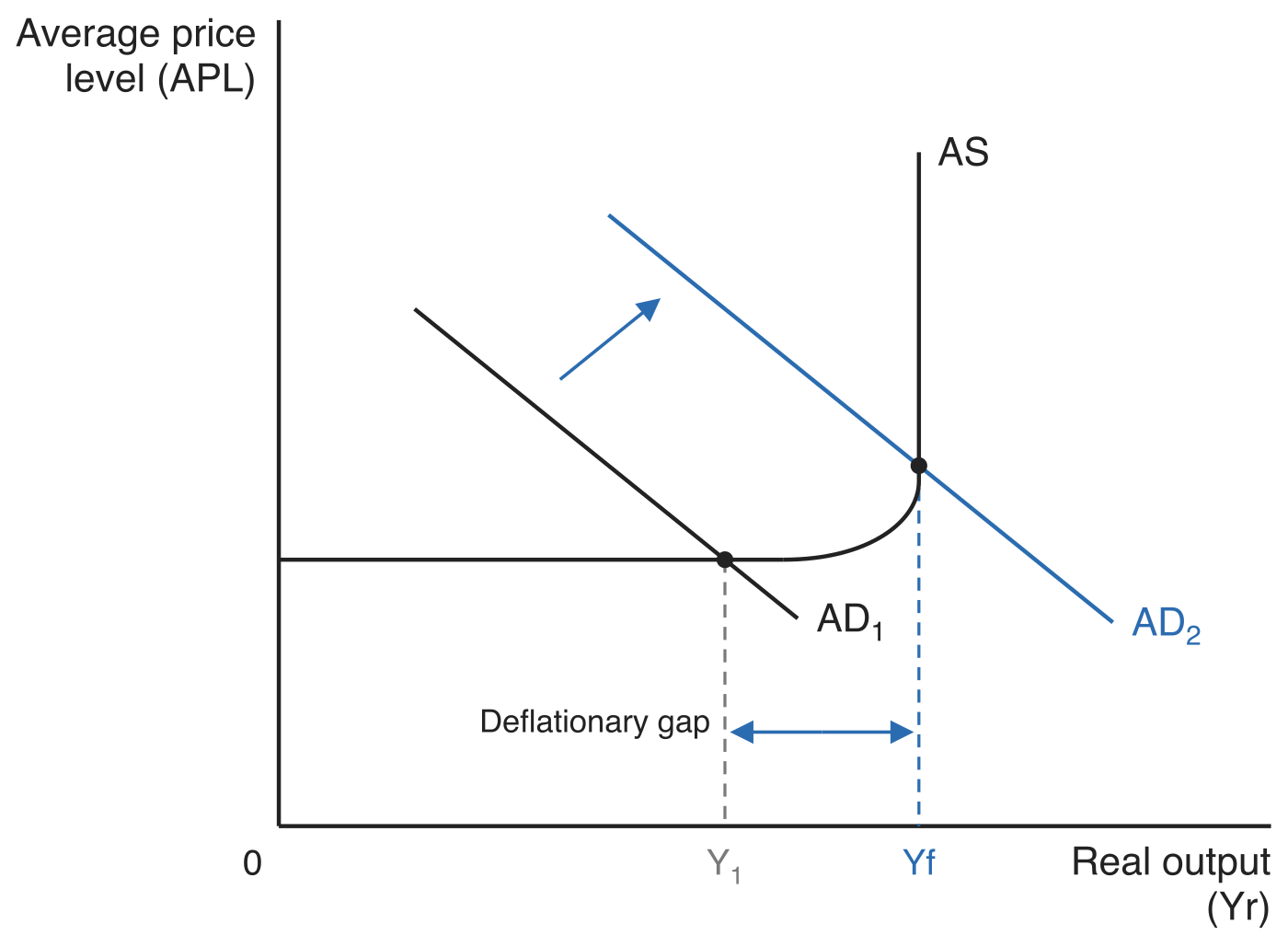
The diagram below shows this on a Keynesian aggregate supply curve. Aggregate demand shifts rightwards from AD1 to AD2, so equilibrium real output (Yr) rises from Y1 to the full-employment level Yf and the deflationary gap between them closes. Where AD1 cuts AS on its flat section there is spare capacity, so output can expand with almost no rise in the average price level (APL); as the economy nears Yf and AS turns vertical, extra demand raises the APL instead of output.
Contractionary fiscal policy
This policy reduces aggregate demand to curb overheating and close gaps where inflation is rising:
- Methods - Cut government spending (G) or raise taxes (T).
- Mechanism - Reduced G directly lowers AD, shifting the AD curve leftwards. Higher T decreases disposable income (Yd), reducing consumption (C) and AD.
- Effects - Lowers inflation, but may raise cyclical unemployment.
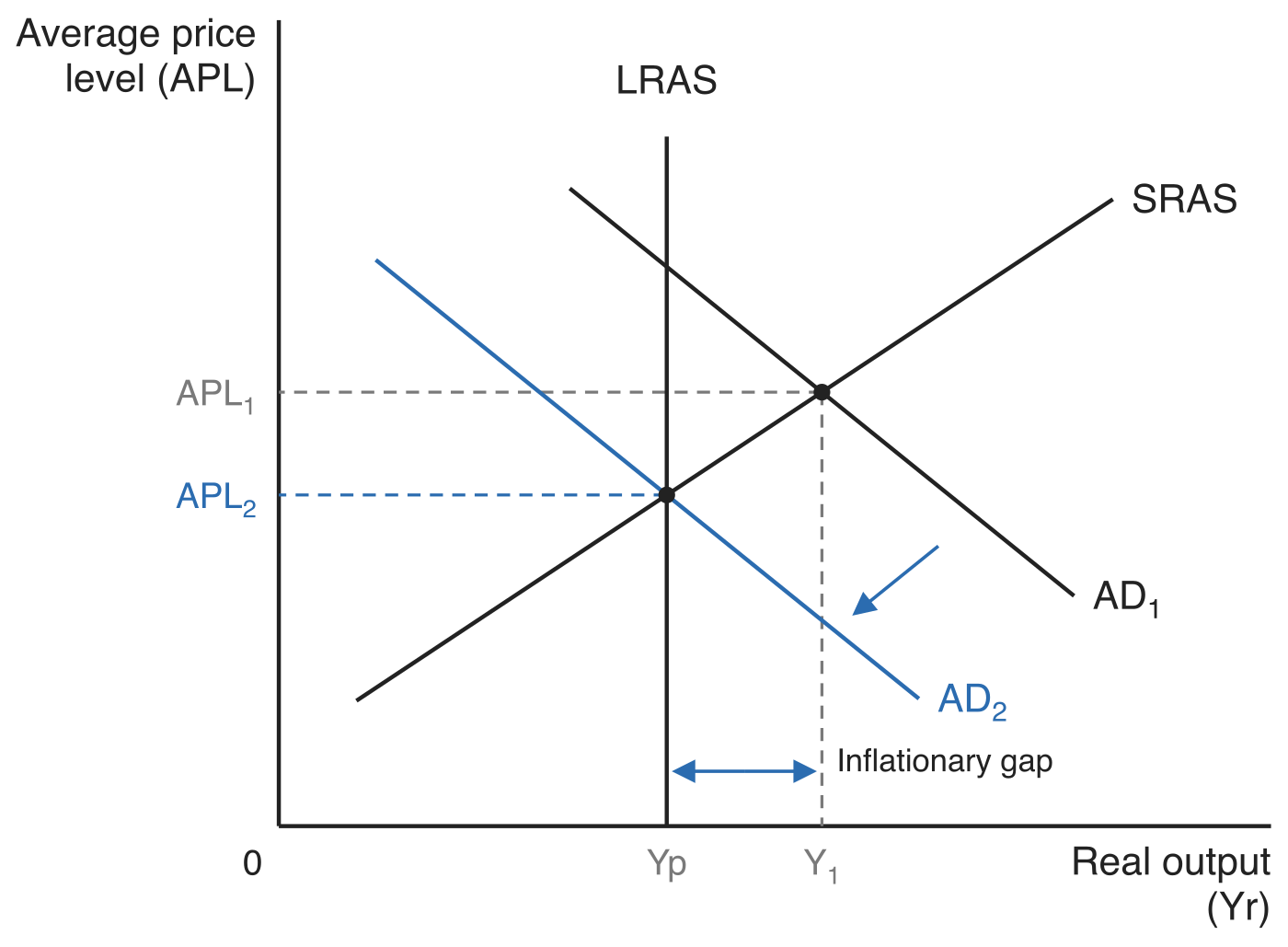
The diagram below shows this in a Monetarist or new classical framework, where the vertical LRAS curve fixes potential output at Yp. Aggregate demand starts at AD1, giving real output Y1 beyond Yp at an average price level of APL1, so an inflationary gap of Yp to Y1 exists. Cutting G or raising T shifts demand leftwards to AD2, and the economy slides back down SRAS to Yp, where the average price level has fallen to APL2. The inflationary gap closes and unemployment rises back towards its natural rate.
Theoretical perspectives on fiscal policy
- Keynesian view - Advocates active government intervention to achieve full employment.
- Monetarist or new classical view - Emphasises that markets will eventually adjust through flexible wages and prices in the long run, making fiscal intervention less necessary.
Practical considerations in implementing fiscal policy
- Tax increases for contractionary policy are politically challenging.
- Businesses and individuals benefit from predictable tax rates for effective planning.
- The concept of expansionary fiscal contraction suggests that reducing spending (without tax hikes) might boost confidence and growth, though this is debated.