4.17 - Sustainable Development
Definition and principles of sustainable development
Sustainable development focuses on creating progress that supports current populations while ensuring resources remain available for those in the future.
Sustainable development
Sustainable development is defined as development that meets the needs of the present without compromising the ability of future generations to meet their own needs. This concept, established by the World Commission on Environment and Development in 1987, highlights the importance of balancing immediate requirements with long-term viability.
Core principles of sustainable development
- Promoting human well-being without environmental harm - Actions should improve quality of life but avoid damaging natural systems.
- Considering future generations - Today's decisions must account for the needs of people yet to come, ensuring they inherit a viable world.
- Meeting basic needs for all - Essential requirements, such as access to food, water, and shelter, should be fulfilled for everyone alive today.
- Reducing global inequality - Efforts should aim to narrow gaps in opportunities and resources between different groups and regions.
Three major aspects of sustainable development
Sustainable development involves integrating three interconnected elements to achieve lasting progress.
The three aspects of sustainable development:
- Economic development - Involves growing economies through activities like job creation and trade, while avoiding resource overuse.
- Social progress - Focuses on improving living standards, including better access to healthcare, education, and equal opportunities for all.
- Environmental protection - Emphasises preserving natural resources, reducing pollution, and maintaining ecosystems for ongoing human benefit.
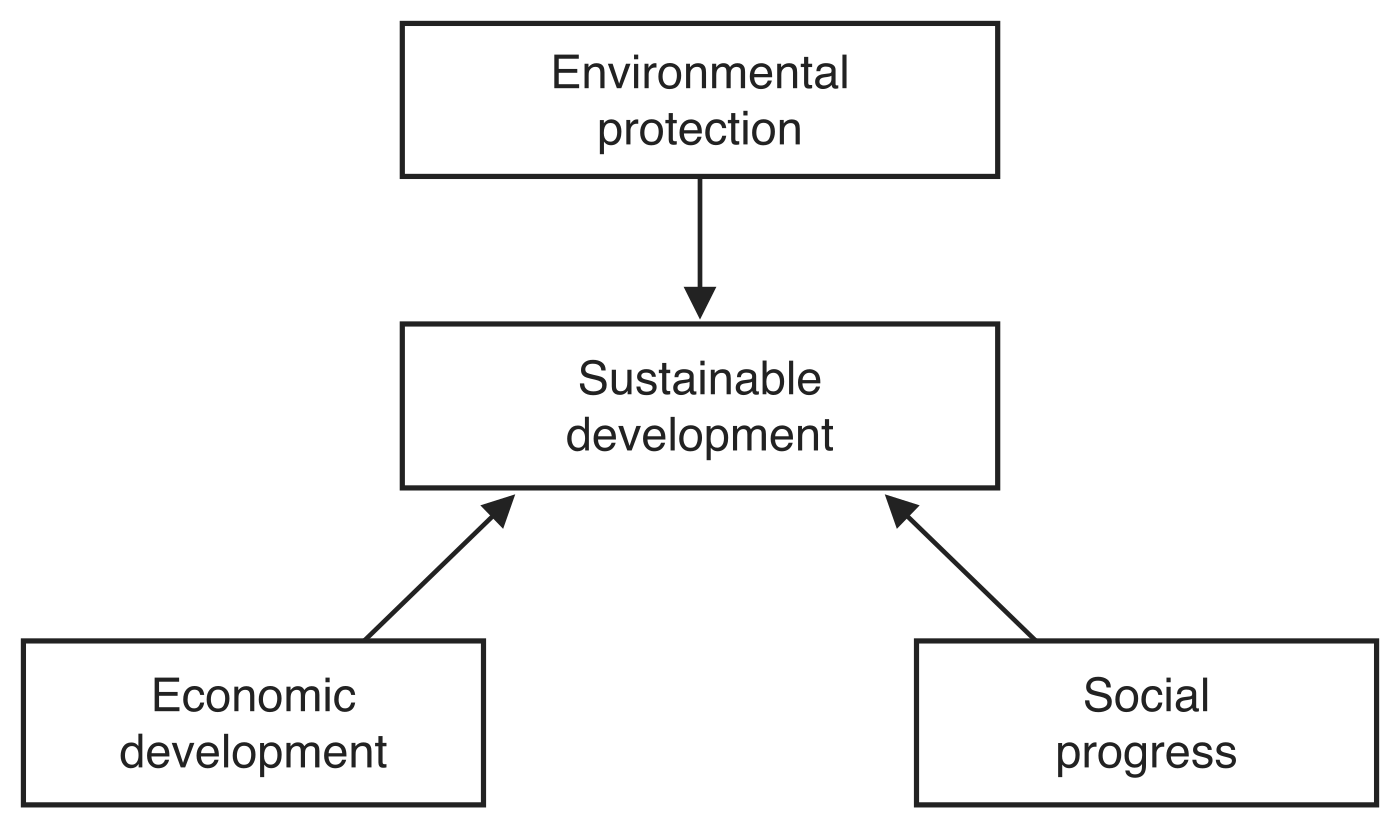
Achieving a balance among these aspects is essential. None of the three delivers sustainable development on its own: the diagram below shows economic development, social progress and environmental protection all feeding into sustainable development, which is reached only where the three are held in balance.
Resource sustainability and global inequality
Sustainable development requires careful resource management to ensure availability across generations, alongside efforts to address disparities in living standards worldwide.
Requirements for resource sustainability
- Avoiding depletion - Natural resources must not be used up faster than they can regenerate.
- Intergenerational availability - Resources should remain accessible from one generation to the next, preventing shortages.
- Impact of resource loss - For example, overusing forests could limit future access to materials needed for building and energy.
Areas of global inequality addressed
Sustainable development targets key disparities to promote fairness:
- Income and wealth - Reducing gaps between rich and poor individuals and nations.
- Basic social goods - Improving access to essentials like health services and education.
- Material goods - Ensuring availability of fundamental items such as food and housing.
The overall goal is to foster enduring stability across economic, social, and environmental domains.
The Sustainable Development Goals (SDGs)
The Sustainable Development Goals represent a global framework for addressing pressing challenges. Established by the United Nations General Assembly in 2015, these goals target achievement by 2030 and apply to all countries, regardless of their wealth.
Key features of the SDGs
- Number and purpose - There are 17 goals designed to promote prosperity while safeguarding the planet.
- Build on previous efforts - They expand upon the earlier Millennium Development Goals (MDGs).
- Universal application - Relevant to both developed and developing nations, encouraging collective action.
The 17 Sustainable Development Goals
- No poverty
- Zero hunger
- Good health and well-being
- Quality education
- Gender equality
- Clean water and sanitation
- Affordable and clean energy
- Decent work and economic growth
- Industry, innovation and infrastructure
- Reducing inequality
- Sustainable cities and communities
- Responsible consumption and production
- Climate action
- Life below water
- Life on land
- Peace, justice and strong institutions
- Partnerships for the goals
Comparison between SDGs and MDGs
The SDGs build on and expand the MDGs, which were set earlier to tackle global issues.
Progress under the MDGs
- Poverty reduction - Efforts accelerated the decline in poverty levels worldwide.
- Disease control - Improvements in managing and preventing diseases were evident.
- Access to education and infrastructure - More people gained schooling and basic facilities, with significant advances in the poorest countries, particularly in Africa.
Scope of SDGs compared to MDGs
- Scale and difficulty - The SDGs are more extensive and challenging to achieve than the MDGs.
- Continuation and integration - They carry forward MDG priorities while combining them with new objectives.
- Added focuses - Greater emphasis on social inclusion, such as equality for all groups, and environmental sustainability, like protecting ecosystems and addressing climate change.