2.13 - Maximum & Minimum Prices
The concept and effects of price ceilings
A price ceiling, also known as a maximum price, is a government-imposed limit on how high a price can be charged for a good or service. It is typically set below the market equilibrium price to prevent prices from becoming excessively high.
Price ceilings are often introduced to protect low-income consumers by making essential items more affordable. Common examples include controls on staple foods, fuel for vehicles or heating, and rental accommodation.
Short-term effects of price ceilings
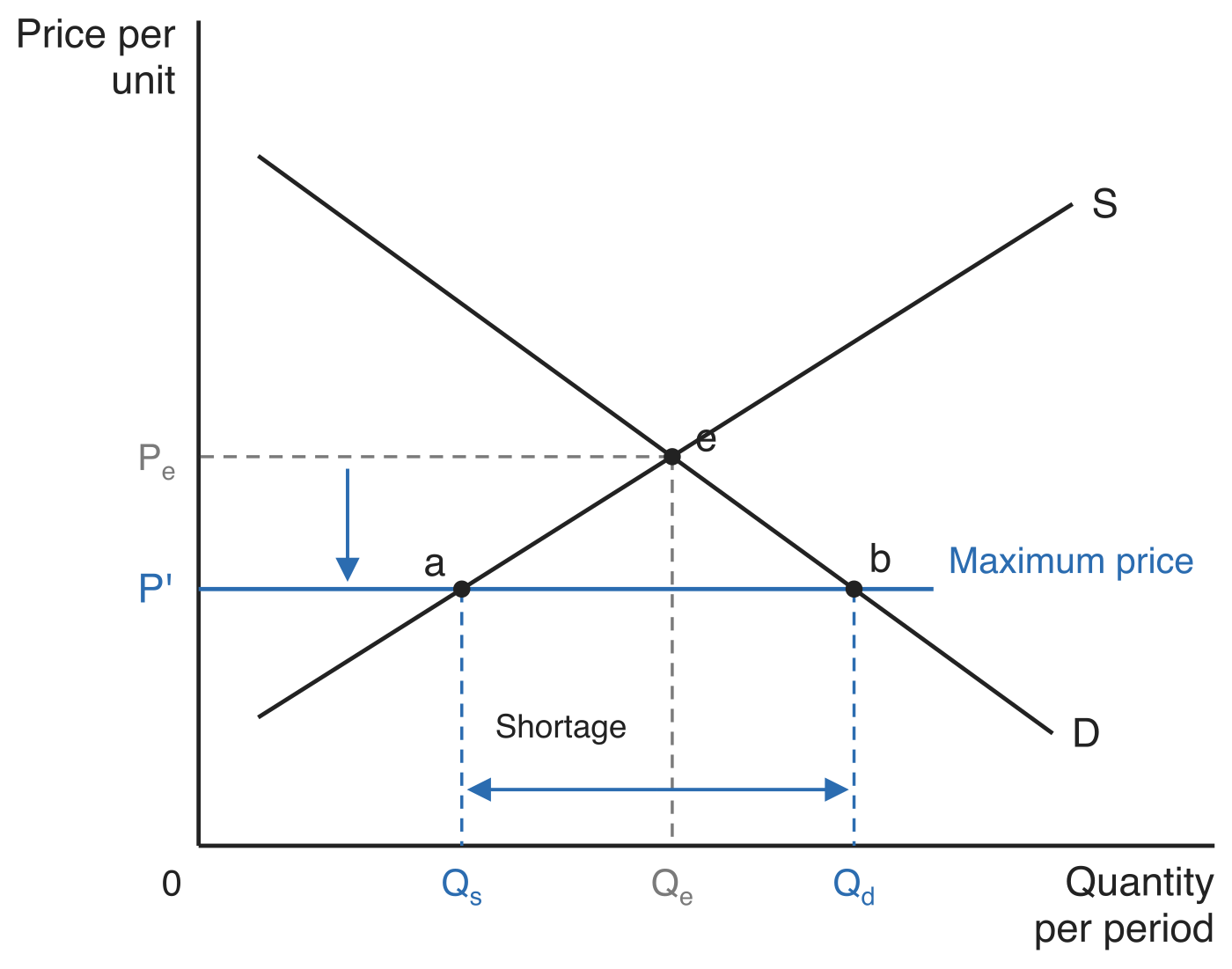
When a price ceiling is fixed below the equilibrium, it disrupts the market balance. In the diagram below, demand D and supply S meet at the free-market equilibrium e, giving the equilibrium price Pe and quantity Qe. The maximum price P' is set below Pe, so P' becomes the highest price sellers may legally charge.
Creation of shortages:
- The quantity supplied falls to Qs, at point a on the supply curve, because producers find it less profitable to supply at the lower price.
- Quantity demanded rises to Qd, at point b on the demand curve, due to the reduced cost.
- This results in demand exceeding supply: the shortage is the distance ab, or Qs to Qd on the quantity axis.
Non-price rationing methods: With prices unable to allocate goods, alternative systems emerge:
- First-come, first-served distribution, leading to queues.
- Seller preferences, where suppliers choose buyers selectively, potentially risking discrimination.
- Random allocation, such as lotteries or waiting lists.
Development of parallel markets: Unofficial markets may form to bypass the ceiling, involving:
- Hidden payments or bribes.
- Inflated deposits or extra fees added to the official price.
Long-term consequences of price ceilings
Over time, price ceilings can lead to broader market distortions:
- Decline in quality - Suppliers have reduced incentives to maintain or improve products, as they cannot charge higher prices to cover costs. For example, landlords might neglect property upkeep in rent-controlled housing.
- Reduced supply - Some producers may leave the market altogether, further decreasing availability and exacerbating shortages.
Gentrification in the context of housing markets
Gentrification refers to the transformation of run-down urban areas through the arrival of wealthier residents. This process increases demand for housing in these neighbourhoods, driving up property values and rents.
Key features and impacts of gentrification
- Causes - Affluent individuals or families move into previously affordable areas, often attracted by lower initial costs or cultural appeal, leading to renovation and investment.
- Effects on local communities - Rising prices can displace lower-income households who can no longer afford to live there, altering the neighbourhood's character and potentially reducing diversity.
- Link to price controls - In markets with rent ceilings, gentrification can intensify shortages, as controlled prices limit new supply while demand surges from incoming residents.
The concept and effects of price floors
A price floor, or minimum price, is a government-set lower limit on the price of a good or service, positioned above the market equilibrium to ensure prices do not fall too low.
Price floors are commonly used in agriculture to stabilise farmers' incomes, shield them from volatile market prices, and support employment in rural areas.
Short-term effects of price floors
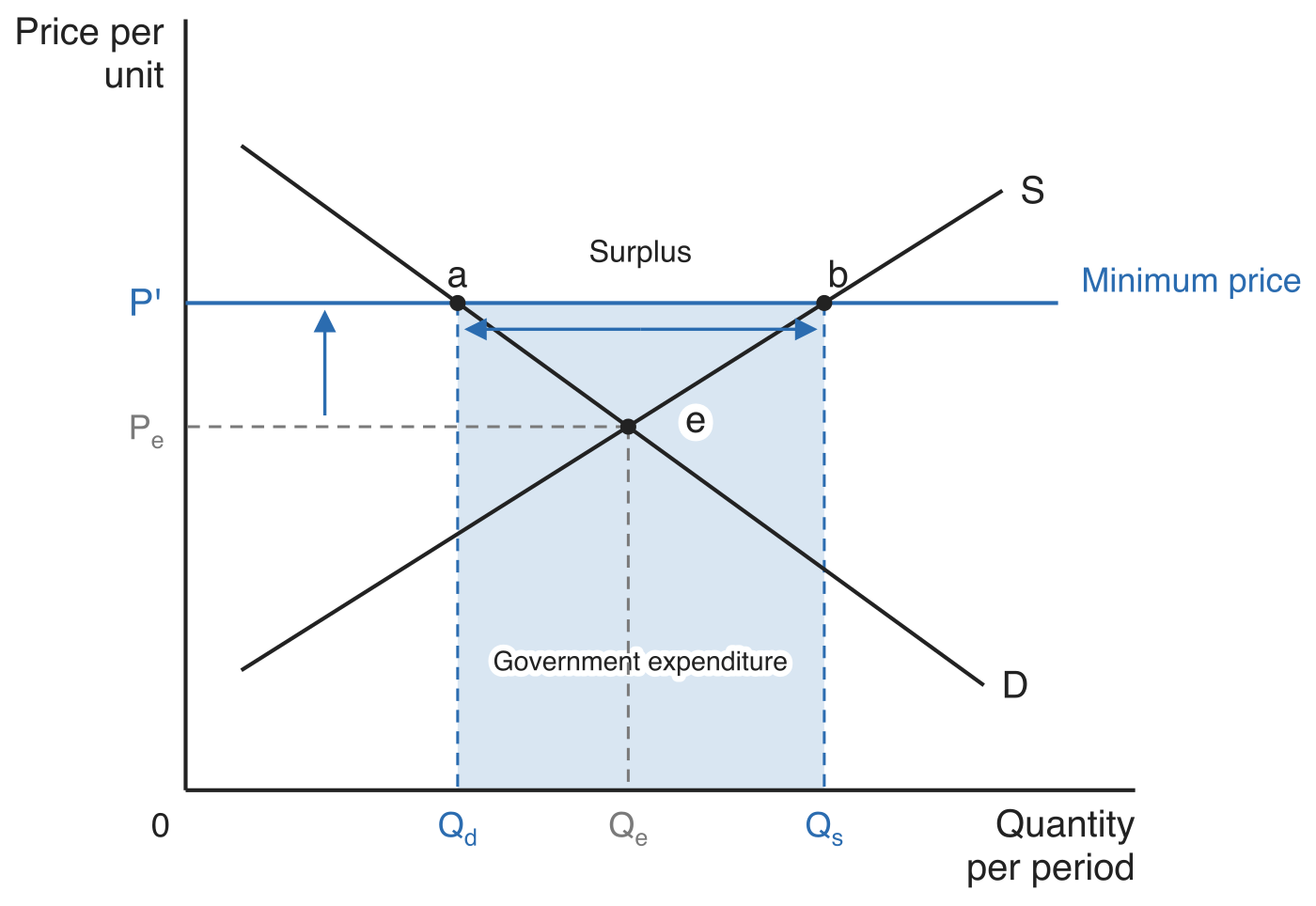
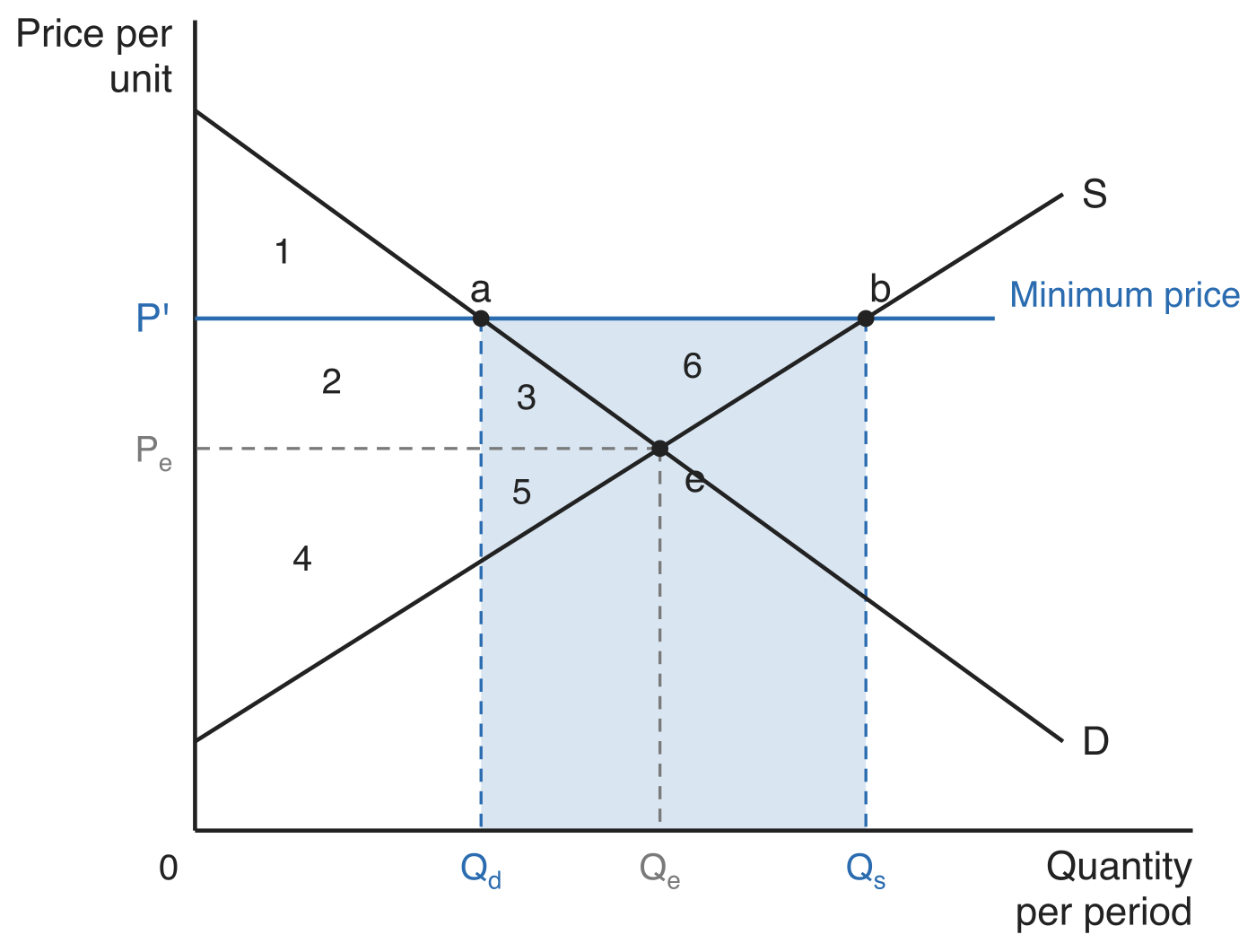
Setting a floor above equilibrium creates market imbalances. In the diagram below, demand D and supply S meet at the equilibrium e, with price Pe and quantity Qe, and the minimum price P' is set above Pe.
Creation of surpluses:
- Quantity supplied increases to Qs, at point b on the supply curve, as producers are encouraged by the higher price.
- Quantity demanded decreases to Qd, at point a on the demand curve, leading to excess supply that cannot be sold at the floor price: the surplus is the distance ab, or Qd to Qs on the quantity axis.
Government intervention in surpluses: To maintain the floor, authorities often step in with measures such as:
- Purchasing and storing the excess for later release, which costs the shaded government expenditure rectangle: the minimum price P' multiplied by the surplus ab.
- Destroying the surplus, which is inefficient and wasteful.
- Exporting it to other countries at discounted prices, known as dumping.
Long-term consequences of price floors
Persistent floors can distort markets over time:
- Overproduction - Resources are allocated inefficiently, with too much production in supported sectors, potentially at the expense of other areas.
- Government costs - Ongoing purchases or subsidies burden public finances, which may lead to higher taxes or reduced spending elsewhere.
Minimum wage as a price floor in labour markets
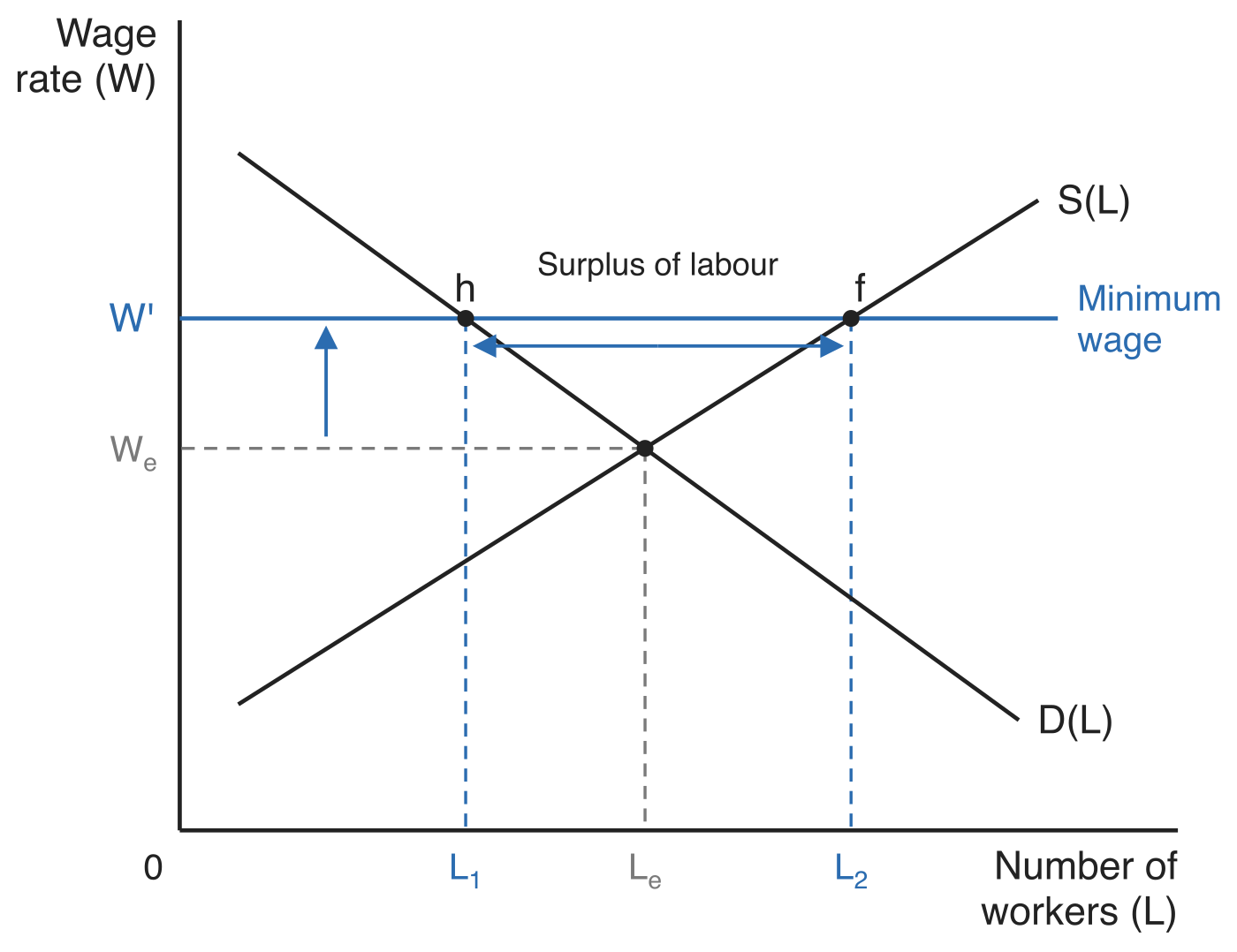
The minimum wage acts as a price floor in the labour market, establishing a legal minimum hourly rate to ensure workers receive a fair income, particularly benefiting low-skilled or entry-level employees. In the diagram below, the demand for labour D(L) and the supply of labour S(L) meet at the competitive wage We, where Le workers are employed, and the minimum wage W' is set above We.
Effects of minimum wage on employment and the economy
- Potential for unemployment - If set above equilibrium, it can create a surplus of labour (more workers seeking jobs than available positions): at W' firms want only L1 workers, at point h, while L2 workers offer their labour, at point f, so the distance hf, or L1 to L2, measures the surplus. This leads to higher unemployment among low-skilled groups.
- Empirical observations - Research indicates that small increases in minimum wage often do not significantly raise unemployment because:
- The cost rise is minor compared to total business expenses.
- Higher wages can boost workers' spending power, increasing overall demand and potentially creating more jobs.
Welfare effects of price controls
Price controls, whether ceilings or floors, generally lead to economic inefficiencies by interfering with market signals, though they may achieve social goals like income protection.
Welfare impacts of price ceilings
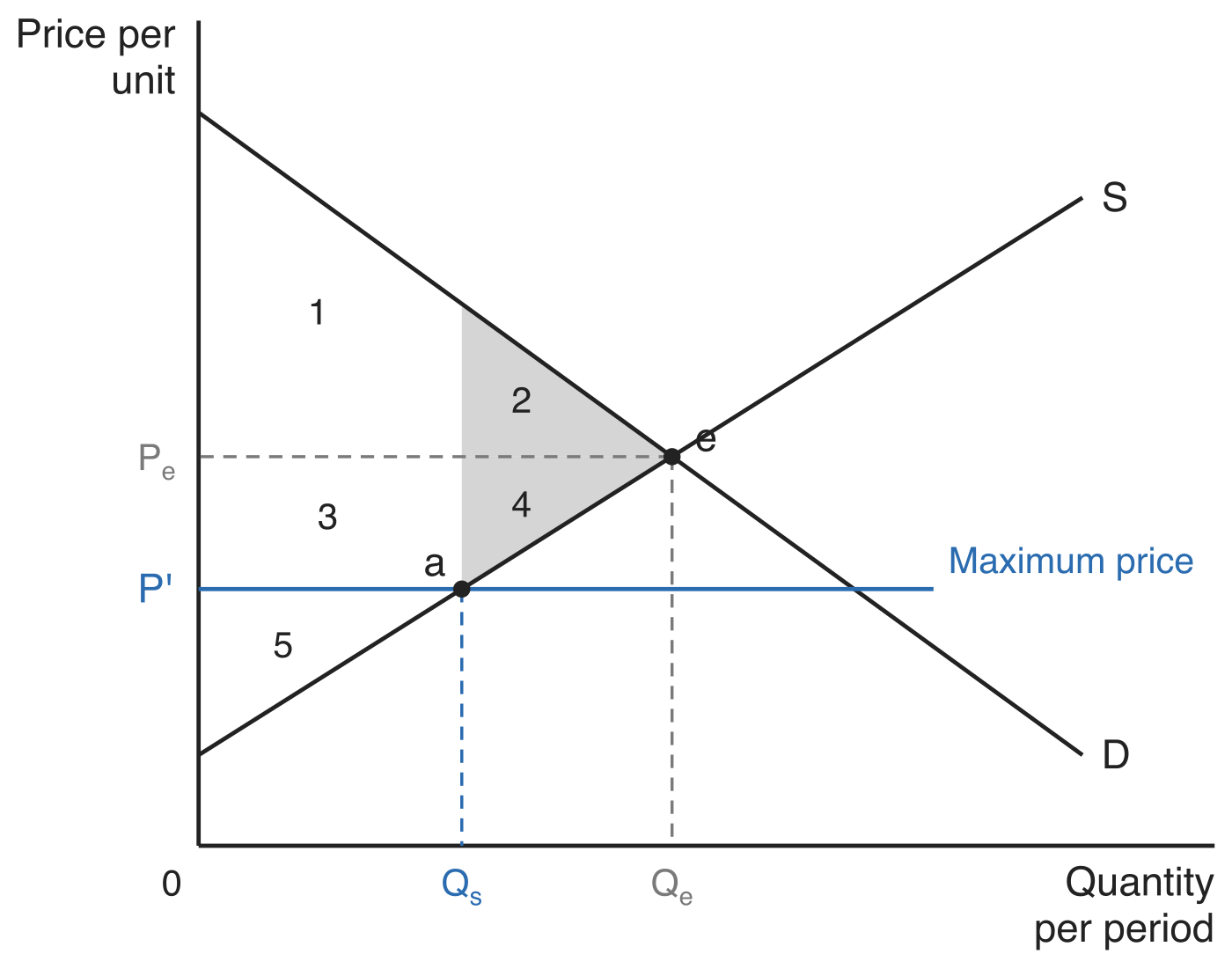
Before the ceiling, demand D and supply S clear the market at e, with price Pe and quantity Qe. The diagram below numbers the areas of surplus from 1 to 5: consumer surplus is area (1 + 2), which lies above Pe and below D, producer surplus is area (3 + 4 + 5), which lies below Pe and above S, and social surplus is all five areas together. Once the maximum price P' is imposed, only Qs units are traded, at point a on the supply curve.
- Gains and losses - Consumer surplus becomes area (1 + 3): area 3 is transferred to consumers from producers, so some consumers benefit from lower prices, but others face shortages and cannot access the good at all. Producer surplus shrinks to area 5, so producers suffer from reduced revenues.
- Overall effect - Social welfare declines due to deadweight loss: social surplus falls to area (1 + 3 + 5), and the shaded triangle made up of areas 2 and 4 is lost. These are trades between Qs and Qe that were worth more to consumers than they cost producers and that no longer happen, creating allocative inefficiency.
Welfare impacts of price floors
Before the floor, demand D and supply S clear the market at e, with price Pe and quantity Qe. The floor diagram below numbers its areas from 1 to 6: consumer surplus starts as area (1 + 2 + 3) and producer surplus as area (4 + 5).
- Gains and losses - Producers enjoy higher and more stable incomes: they sell Qs units at the minimum price P', at point b, so producer surplus rises from area (4 + 5) to area (2 + 3 + 4 + 5 + 6). Consumers face increased prices and buy only Qd units, at point a, so consumer surplus shrinks to area 1. Governments incur costs for surplus management: buying the surplus ab at P' costs the shaded rectangle Qd a b Qs.
- Overall effect - Overproduction causes deadweight loss and allocative inefficiency: resources are drawn into producing Qs units when only Qd are wanted at that price, and once the government's spending is set against the gain to producers, total social surplus falls.
Broader considerations of price controls
Despite inefficiencies, controls may be justified for policy reasons, such as equity or stability, where governments accept the economic costs for perceived social benefits. The table below sets the two controls side by side.
| Price ceilings (maximum prices) | Price floors (minimum prices) | |
|---|---|---|
| Aim | To protect vulnerable consumers | To protect vulnerable producers, typically farmers |
| Price is set | Below the market-determined price | Above the market-determined price |
| Results in | A shortage, non-price rationing, parallel markets, and worse quality and wider shortages in the long term | A surplus, the government being forced to buy that surplus, and taxpayers carrying the cost or losing some other government project |
| Impact on consumers | Some are better off, others are worse off | They are worse off |
| Impact on sellers | They are worse off | They are better off |
| Impact on welfare | Inefficiency and welfare loss | Inefficiency and welfare loss |
| Examples | Rent controls, food price controls | Agricultural price supports, minimum wage |