4.13 - Consequences of Changes in Exchange Rate
The components of the current account balance
The current account forms part of a country's balance of payments and tracks the flow of money from international trade in goods and services.
Key elements of the current account
- Current account balance - This measures the difference between the value of exports of goods and services and the spending on imports of goods and services, calculated as exports minus imports (X - M).
- Trade surplus - This arises when the value of exports exceeds imports (X > M).
- Trade deficit - This occurs when imports exceed exports (M > X).
- Net exports - Represented as X - M, net exports contribute to aggregate demand.
Currency depreciation - Trade and aggregate demand
Currency depreciation happens when the value of a country's currency falls relative to others, making its goods cheaper abroad and foreign goods more expensive at home.
Effects on exports and imports
- Lower foreign price of exports - Depreciation reduces the price of domestic goods for overseas buyers, increasing their competitiveness and encouraging higher export volumes.
- Higher domestic price of imports - Imported goods become more costly for local consumers and businesses, reducing demand for them.
- Narrowing of trade deficits - As exports rise and imports fall, any existing trade deficit tends to decrease over time.
- Boost to aggregate demand - The overall increase in net exports (X - M) raises aggregate demand.
The table below works the two price effects through with numbers, assuming the pound depreciates from £1.00 = €4.00 to £1.00 = €2.00.
| Good | Original rate: £1.00 = €4.00 | New rate: £1.00 = €2.00 |
|---|---|---|
| UK export priced at £100.00 | Price in the eurozone: €400.00 | Price in the eurozone: €200.00, so the export is cheaper abroad and more competitive |
| Eurozone import priced at €40.00 | Price in the UK: £10.00 | Price in the UK: £20.00, so the import is pricier at home and less attractive |
Currency appreciation - Trade and aggregate demand
Currency appreciation occurs when a country's currency rises in value against others, making its goods more expensive abroad and foreign goods cheaper domestically.
Effects on exports and imports
- Higher foreign price of exports - Appreciation increases the cost of domestic goods for foreign buyers, reducing competitiveness and leading to lower export volumes.
- Lower domestic price of imports - Imported goods become cheaper for local buyers, increasing their attractiveness and boosting import levels.
- Narrowing of trade surpluses - As exports decrease and imports rise, any existing trade surplus tends to shrink.
- Reduction in aggregate demand - The decline in net exports (X - M) lowers aggregate demand.
Macroeconomic impacts of exchange rate changes
Exchange rate fluctuations influence broader macroeconomic indicators, with depreciation generally stimulating activity and appreciation having a cooling effect.
Impacts on economic growth
- From depreciation - Higher net exports increase aggregate demand and real gross domestic product (GDP), supporting export-led growth, though it may cause inflation if the economy is near full capacity.
- From appreciation - Lower net exports reduce aggregate demand, slowing growth.
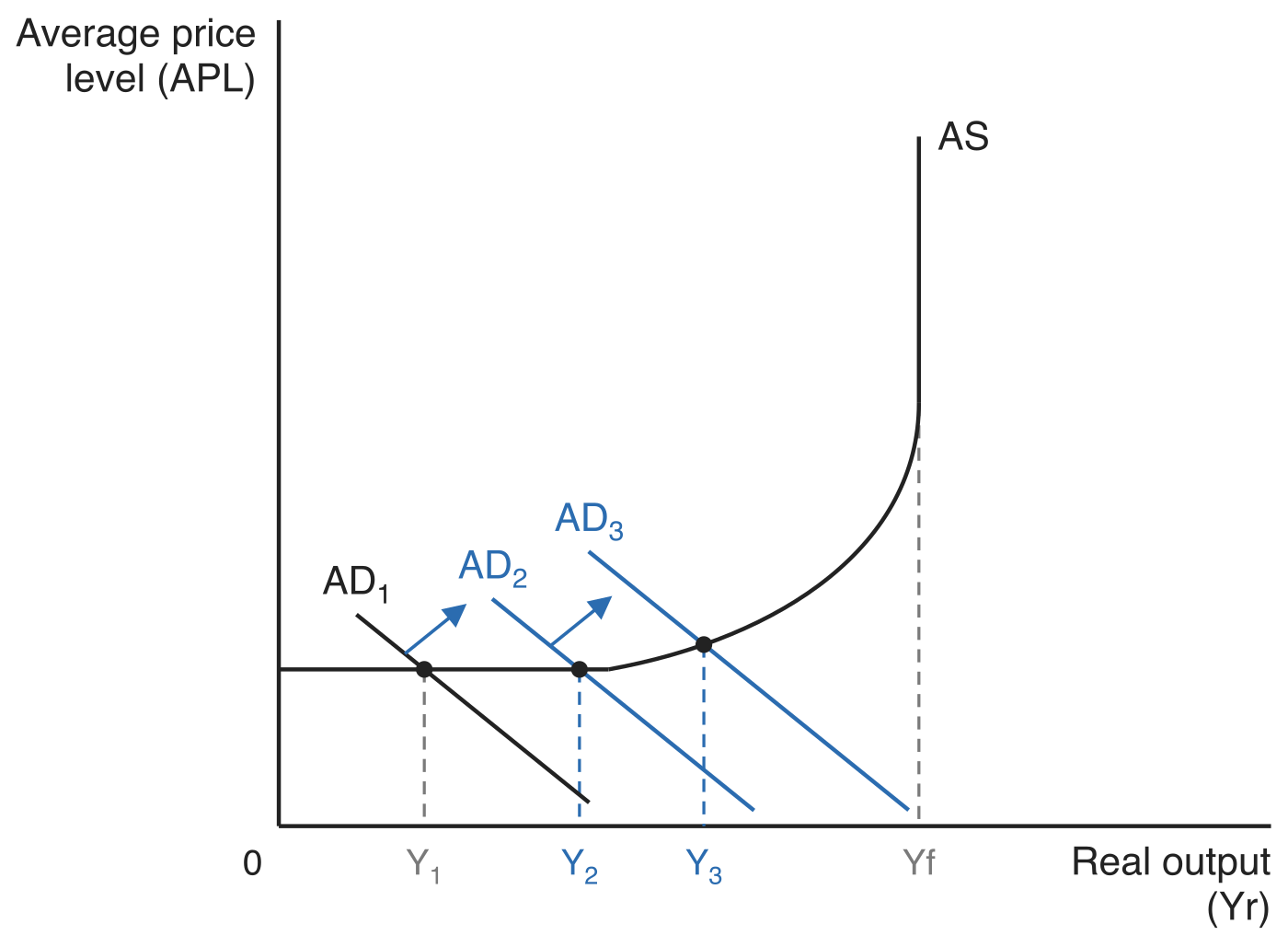
How much extra growth a depreciation delivers depends on where the economy is already producing, as the diagram below shows. Starting from AD1, real output Y1 sits well below the full employment level of output Yf. A depreciation that shifts aggregate demand right to AD2 therefore raises real output along the flat stretch of the aggregate supply curve AS, from Y1 to Y2, with the average price level (APL) unchanged and cyclical unemployment falling as output grows. Had the economy instead started at Y2, the same depreciation would shift demand to AD3 and real output would only reach Y3: because AS steepens as output approaches Yf, part of the extra demand now shows up as a rising APL rather than as extra output.
Impacts on unemployment
- From depreciation - Rising aggregate demand and output reduce cyclical unemployment.
- From appreciation - Falling aggregate demand may increase cyclical unemployment, though if it controls inflation, it could enable sustained non-inflationary growth and stable employment levels.
Impacts on inflation
- From depreciation - This can trigger demand-pull inflation (if near full employment) and cost-push inflation (if firms depend on imported inputs), but it helps prevent deflation by boosting demand.
- From appreciation - Lower aggregate demand and cheaper imported inputs reduce inflation, though excessive appreciation risks deflationary pressures.
Impacts on living standards
From depreciation:
- Benefits export industries (higher sales) and domestic tourism (attracts foreign visitors).
- Disadvantages importers (higher costs) and low-income groups reliant on affordable imports like food.
- Can raise average living standards through faster growth, but distribution depends on government measures for equitable benefits.
From appreciation:
- Benefits importers (lower costs) and low-income households (cheaper essentials like medicines), and domestic travellers abroad.
- Disadvantages export sectors (reduced competitiveness) and firms facing import competition.
- Benefits consumers through lower prices, but may harm employment in export-dependent areas.
Monetary policy and exchange rates
Monetary policy, set by central banks, influences exchange rates through interest rate adjustments, affecting net exports and the wider economy.
How easy monetary policy affects exchange rates
- Lower interest rates reduce the currency's value (depreciation), making exports more competitive and increasing net exports.
- This stimulates consumption, investment, and exports, which is particularly useful in recessions to boost confidence and demand.
How tight monetary policy affects exchange rates
- Higher interest rates increase the currency's value (appreciation), reducing export competitiveness and net exports.
- However, appreciation can lower production costs for firms using imported inputs, helping to control inflation.