21.2 - Electrophilic Addition Reactions in Alkenes
- 1
What electrophiles are and how they react
- 2
Electrophilic addition reactions of alkenes with halogens, hydrogen halides, and water
Electrophiles are electron-pair acceptors
An electrophile is an electron-deficient species that readily accepts a pair of electrons from a nucleophile to form a covalent bond.
Types of electrophiles include:
- Cations - Positively charged ions e.g. the methyl cation, CH3+.
- Neutral molecules with a partial positive charge (δ+) - Electron deficiency is caused by the polarisation of a bond due to an electronegative atom, e.g., boron trifluoride, BF3.
- Compounds with carbonyl or carboxyl groups - The carbon atom of the carbonyl group is electron-deficient and susceptible to nucleophilic attack, e.g., aldehydes, ketones, and carboxylic acids.
Electrophilic addition reactions of alkenes
Alkenes are unsaturated hydrocarbons containing a carbon-carbon double bond. The high electron density of the double bond makes it susceptible to electrophilic attack, resulting in electrophilic addition reactions.
Electrophilic addition of halogens:
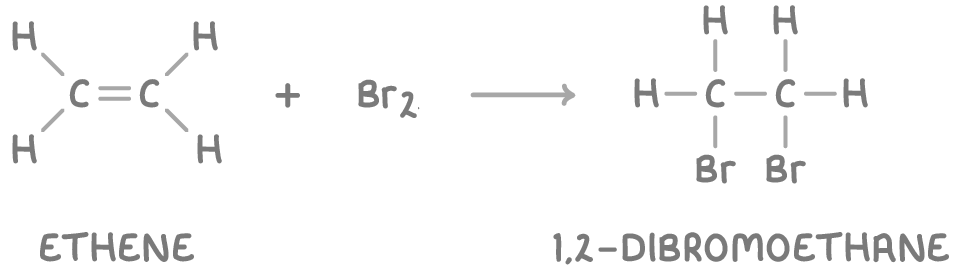
Halogens (X2) add across the C=C bond to form disubstituted halogenoalkanes (CnH2nX2).
For example, ethene reacts with bromine to form 1,2-dibromoethane:
Electrophilic addition of hydrogen halides:
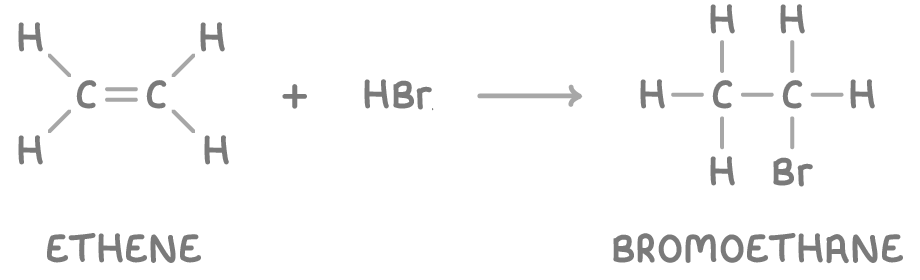
Hydrogen halides (HX) add across the C=C bond to form monosubstituted halogenoalkanes (CnH2n+1X).
Symmetrical alkenes produce one product e.g., ethene reacts with hydrogen bromide to form bromoethane.
Unsymmetrical alkenes produce two products e.g., propene reacts with hydrogen bromide to form a mixture of 1-bromopropane and 2-bromopropane.

Electrophilic addition of water (hydration):
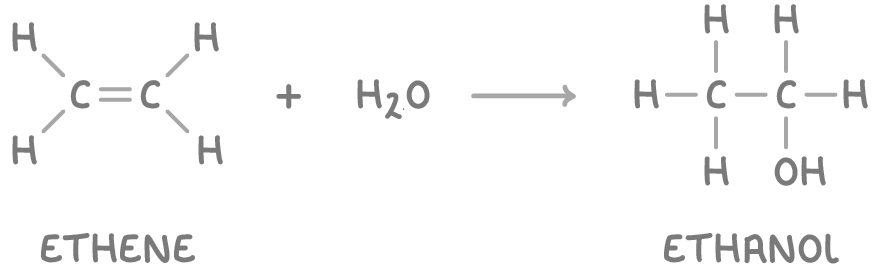
Water adds across the C=C bond in acidic conditions to form alcohols (CnH2n+1OH).
Symmetrical alkenes produce one product e.g., ethene reacts with water to form ethanol:
Unsymmetrical alkenes produce two products e.g., propene reacts with water to form a mixture of propan-1-ol and propan-2-ol.
