11.5 - Isomers
- 1
What structural isomers are
- 2
The three types of structural isomer: chain, positional, and functional group
- 3
How to determine if a compound is primary, secondary or tertiary
- 4
What stereoisomers are
- 5
The two types of stereoisomer: cis-trans, and optical
- 6
Optical activity and racemic mixtures
Types of structural isomer
Structural isomers are compounds that share the same molecular formula but have their atoms connected together in different ways.
There are several types of structural isomers, including:
- Chain isomers - Differ in the length of their carbon chain (e.g. straight vs branched).
- Positional isomers - Vary in the location of their functional group.
- Functional group isomers - Contain different functional groups.
Chain isomers differ in carbon chain length
Chain isomers are structural isomers that have carbon chains of different lengths. They can be either straight-chain or branched-chain molecules.
For example, butane and methylpropane are chain isomers - both have the molecular formula C_4_H_10_ but different carbon chain structures:
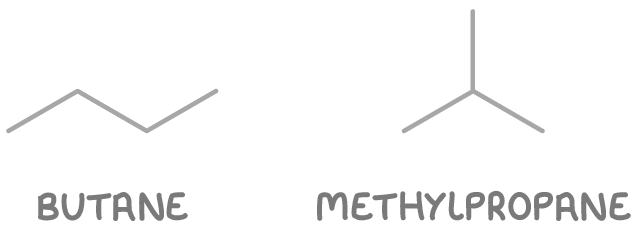
- Butane has a straight chain of 4 carbon atoms.
- Methylpropane has a branched 3-carbon chain with a 1-carbon alkyl substituent.
Positional isomers have functional groups in different locations
Positional isomers are structural isomers where the position of the functional group differs between isomers.
For example, chloropentane (C5H11Cl) has three positional isomers:

- In 1-chloropentane, the chlorine is on the first carbon.
- In 2-chloropentane, the chlorine is on the second carbon.
- In 3-chloropentane, the chlorine is on the third carbon.
Note: 4-chloropentane and 5-chloropentane mirror 2-chloropentane and 1-chloropentane due to the symmetry of the pentane chain, so they aren't distinct isomers.
Primary, secondary and tertiary compounds
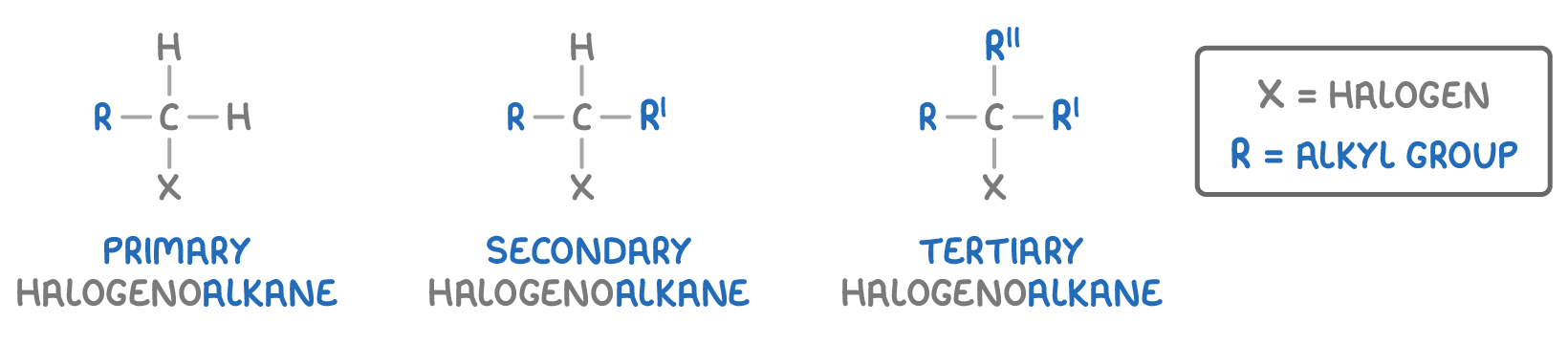
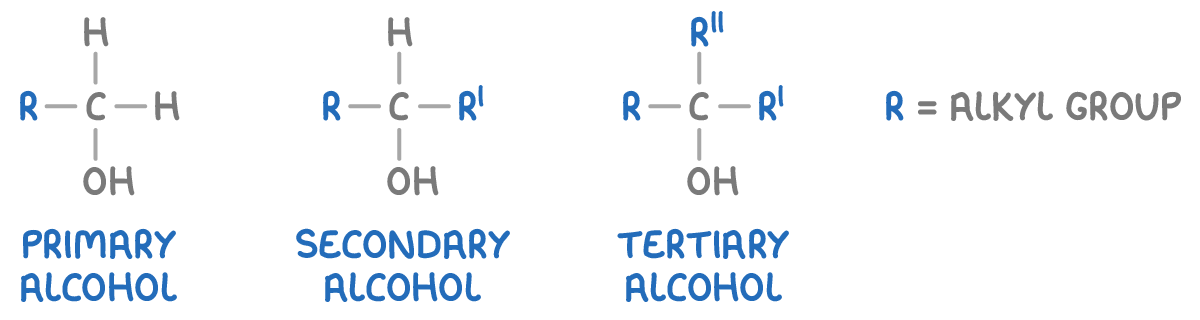
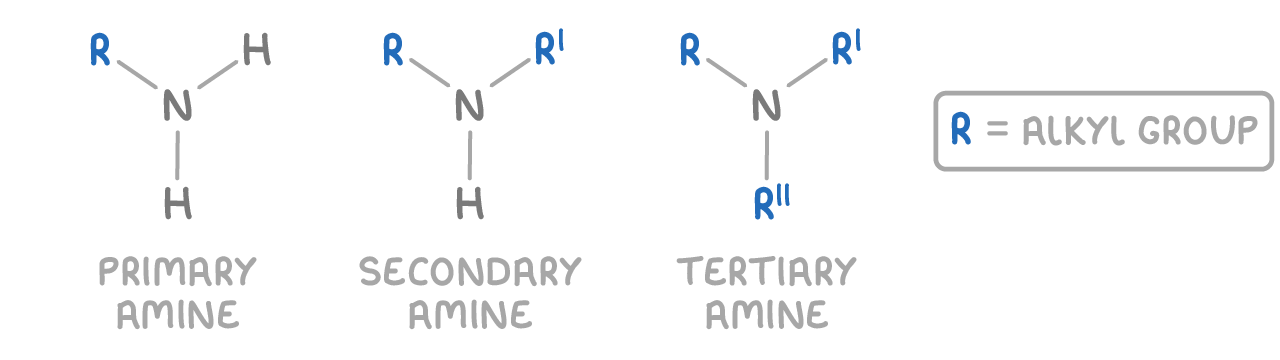
The position of a functional group can affect the chemical properties of a molecule. Halogenoalkanes, alcohols and amines can be classified as primary, secondary or tertiary based on the type of carbon or nitrogen atom the functional group is attached to.
Halogenoalkanes:
- Primary - The halogen is attached to a carbon atom connected to only one alkyl group (or no alkyl groups).
- Secondary - The halogen is attached to a carbon atom connected to two alkyl groups.
- Tertiary - The halogen is attached to a carbon atom connected to three alkyl groups.
Alcohols:
- Primary - The -OH group is attached to a carbon atom that is bonded to only one alkyl group (or no alkyl groups).
- Secondary - The -OH group is attached to a carbon atom that is bonded to two alkyl groups.
- Tertiary - The -OH group is attached to a carbon atom that is bonded to three alkyl groups.
Amines:
- Primary - The nitrogen atom is bonded to one alkyl group (or no alkyl groups) and two hydrogen atoms.
- Secondary - The nitrogen atom is bonded to two alkyl groups and one hydrogen atom.
When naming secondary amines, the letter 'N' is used to indicate the alkyl group attached to the nitrogen atom, e.g., N-methylpropan-1-amine.
- Tertiary - The nitrogen atom is bonded to three alkyl groups.
When naming tertiary amines, the letter 'N' is used twice to indicate the two alkyl groups attached to the nitrogen atom, e.g., N,N-dimethylpropan-1-amine.
Functional group isomers contain different functional groups
Functional group isomers are structural isomers that have their atoms arranged to give different functional groups.
Some examples of functional group isomers include:
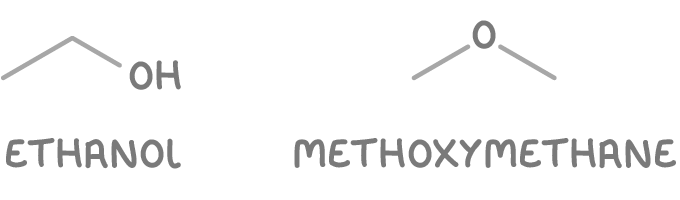
- Alcohols and ethers - both have the formula C_n_H_2n+2_O
For example, ethanol (alcohol) and methoxymethane (ether) are isomers with formula C_2_H_6_O.
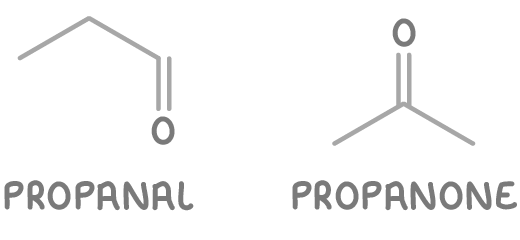
2. Aldehydes and ketones - both have the formula C_n_H_2n_O
For example, propanal (aldehyde) and propanone (ketone) are isomers with formula C_3_H_6_O.
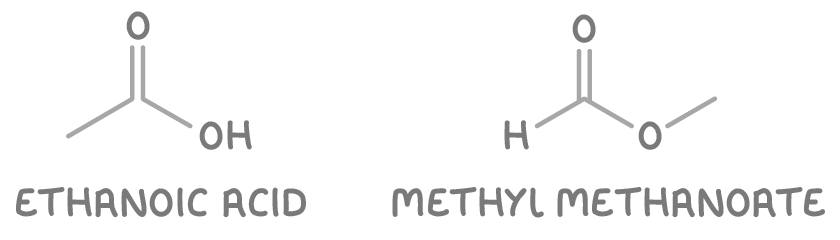
3. Carboxylic acids and esters - both have the general formula C_n_H_2n_O_2_
For example, ethanoic acid (carboxylic acid) and methyl methanoate (ester) are isomers with formula C_2_H_4_O_2_.
Types of stereoisomer
Stereoisomers are compounds that share the same molecular formula but have different spatial arrangements of their atoms.
There are several types of stereoisomer, including:
- Cis-trans isomers - Occur when two identical groups are on the same side (cis) or opposite sides (trans) of a double bond or ring structure.
- Optical isomers - Are non-superimposable mirror images of each other and rotate plane-polarised light in opposite directions.
Cis-trans isomers differ in orientation around double bonds or rings
Cis-trans isomerism can occur in straight-chain alkenes or cycloalkanes when the carbon-carbon double bond or ring structure restricts rotation. This leads to two configurations:
- Cis configuration - Identical substituent groups are positioned on the same side of the double bond or ring plane.
- Trans configuration - Identical substituent groups are positioned on opposite sides of the double bond or ring plane.
For example, but-2-ene exhibits cis-trans isomerism:
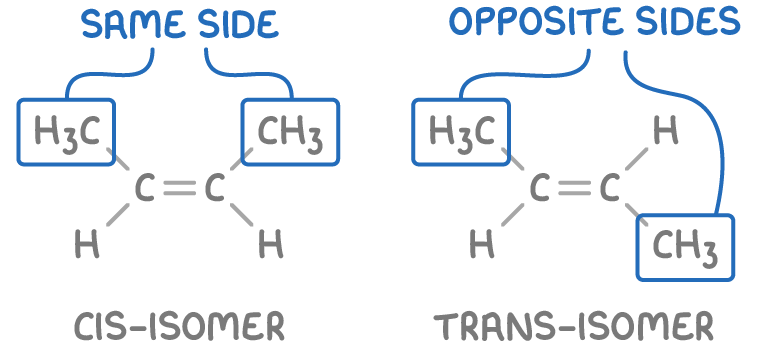
For an alkene to exhibit cis-trans isomerism, the two groups attached to each carbon atom of the C=C double bond must be different. Propene (CH_2_=CHCH_3_) does not show cis-trans isomerism because one carbon atom has two identical hydrogen substituents, resulting in identical potential isomers.
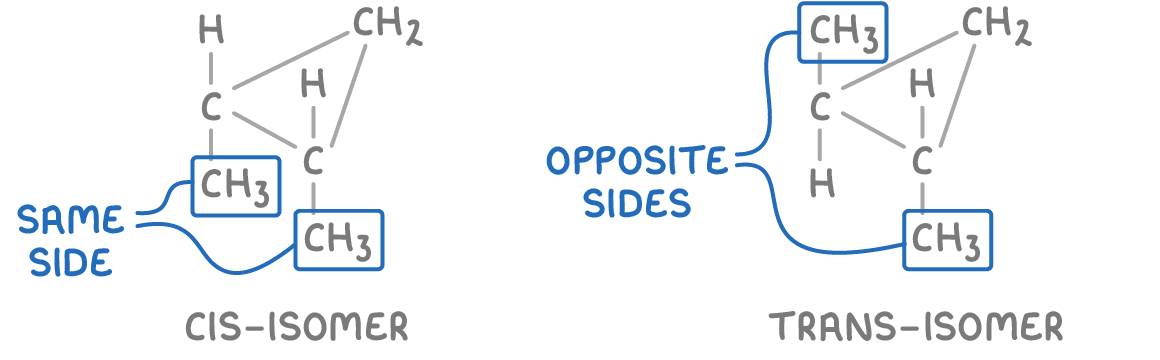
Cis-trans isomerism also occurs in disubstituted cycloalkanes, where the ring provides the reference plane instead of a double bond.
For example, 1,2-dimethylcyclobutane exhibits cis-trans isomerism:
Optical isomers are mirror images
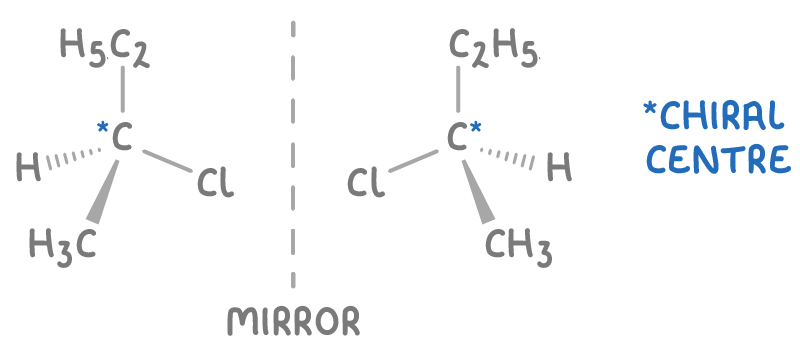
A chiral carbon is a carbon bonded to four different atoms or groups. Molecules with one or more chiral carbons exhibit optical isomerism.
The optical isomers are called enantiomers - non-superimposable mirror images without a plane of symmetry.
For example, 2-chlorobutane exhibits optical isomerism:
To identify and draw optical isomers, follow these steps:
- Identify the chiral carbon - Carefully draw all hydrogen atoms to clearly identify each attachment. Look for the carbon atom connected to four different groups.
- Sketch the optical isomers - Illustrate one enantiomer with its groups arranged tetrahedrally around the chiral carbon. Next, draw its mirror image.
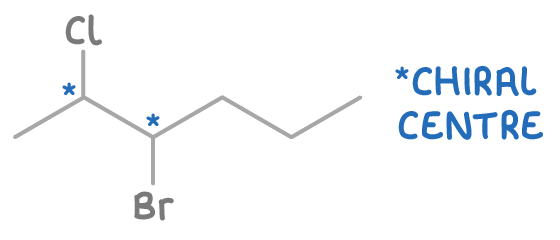
Molecules with multiple chiral centres can have more than two optical isomers, increasing the complexity and number of possible isomers.
For instance, 3-bromo-2-chloropentane has two chiral carbons and hence four optical isomers:
Optical activity and racemic mixtures
Enantiomers interact differently with plane-polarised light:
- Unlike normal light which vibrates in all directions, plane-polarised light vibrates in a single plane.
- Enantiomers are optically active, meaning they rotate the plane of polarisation of plane-polarised light.
- The two enantiomers rotate plane-polarised light by equal angles but in opposite directions; one enantiomer rotates light clockwise while the other enantiomer rotates light anticlockwise.
A 50:50 mixture of two enantiomers is called a racemic mixture or racemate. Racemic mixtures do not rotate plane-polarised light because the equal and opposite rotations of the two enantiomers cancel each other out, resulting in no net optical activity.