20.2 - Redox Reactions of Metals & Halogens
- 1
The relative ease of reduction of halogens
- 2
The relative ease of oxidation of metals
- 3
Redox reactions between acids and metals
Halogens as oxidising agents
Halogens can act as oxidising agents in redox reactions by gaining electrons to form halide ions (X-).
The strength of halogens as oxidising agents increases going up group 17 in the periodic table:
I2 < Br2 < Cl2 < F2
This trend means that:
- Fluorine (F2) is the strongest oxidising agent and most readily reduced to fluoride ions (F-).
- Iodine (I2) is the weakest oxidising agent and least readily reduced to iodide ions (I-).
For example, chlorine can oxidise iodide ions in solution:
Cl2(aq) + 2I-(aq) ➔ 2Cl-(aq) + I2(aq)
However, the reverse reaction, where iodine oxidises chloride ions, does not occur, as chlorine is a stronger oxidising agent than iodine.
I2(aq) + 2Cl-(aq) ➔ No reaction
Similarly, chlorine cannot oxidise fluoride ions because fluorine is an even stronger oxidising agent than chlorine:
Cl2(aq) + 2F-(aq) ➔ No reaction
Instead, fluorine gas can oxidise chloride ions in solution:
F2(g) + 2Cl-(aq) ➔ 2F-(aq) + Cl2(g)
Although iodine is the weakest oxidising agent among the halogens, it is still capable of oxidising many metals and other strong reducing agents. This is because iodine is still a relatively strong oxidising agent compared to many other substances.
Metals as reducing agents
Metals can act as reducing agents by losing electrons to form positively charged ions called cations.
In group 1 of the periodic table (the alkali metals), the ease of oxidation increases going down the group:
Li < Na < K < Rb < Cs
This trend arises because atomic radius and reactivity increase down group 1, so the larger group 1 metals lose their valence electron more readily to form 1+ cations.
Comparing reactivity of other metals
The relative ease of oxidation of other metals can be determined experimentally by reacting a pure metal with solutions containing ions of a different metal.
- If a reaction occurs and the pure metal dissolves, forming a solution of its own ions while the other metal is deposited, the pure metal is more easily oxidised and is a stronger reducing agent than the metal that was originally in the solution.
- If no reaction occurs, the metal that was originally in the solution is more easily oxidised and is a stronger reducing agent than the pure metal.
Example - Comparing the relative ease of oxidation of four metals
Four metals (Zn, Fe, Ca, Cu) were each added to separate solutions of the metal nitrates Zn(NO3)2, Fe(NO3)2, Ca(NO3)2 and Cu(NO3)2. The observed results are summarised below, where a ✓ indicates a reaction occurred and a ✕ indicates no reaction.
| Metal | Zn(NO_3_)2 | Fe(NO_3_)2 | Ca(NO_3_)2 | Cu(NO_3_)2 |
|---|---|---|---|---|
| Zn | ✓ | ✕ | ✓ | |
| Fe | ✕ | ✕ | ✓ | |
| Ca | ✓ | ✓ | ✓ | |
| Cu | ✕ | ✕ | ✕ |
From these results, we can deduce:
- Calcium reacts with all the other metal ion solutions, so it is the most easily oxidised and strongest reducing agent of the four metals tested.
- Copper does not react with any of the metal ion solutions, so it is the least easily oxidised and weakest reducing agent of the four metals tested.
Therefore, the order of reactivity from most easily oxidised to least easily oxidised is:
Ca > Zn > Fe > Cu
This order of reactivity is consistent with the metal reactivity series, which shows the relative ease of oxidation of metals. The reactivity series for some common metals is:
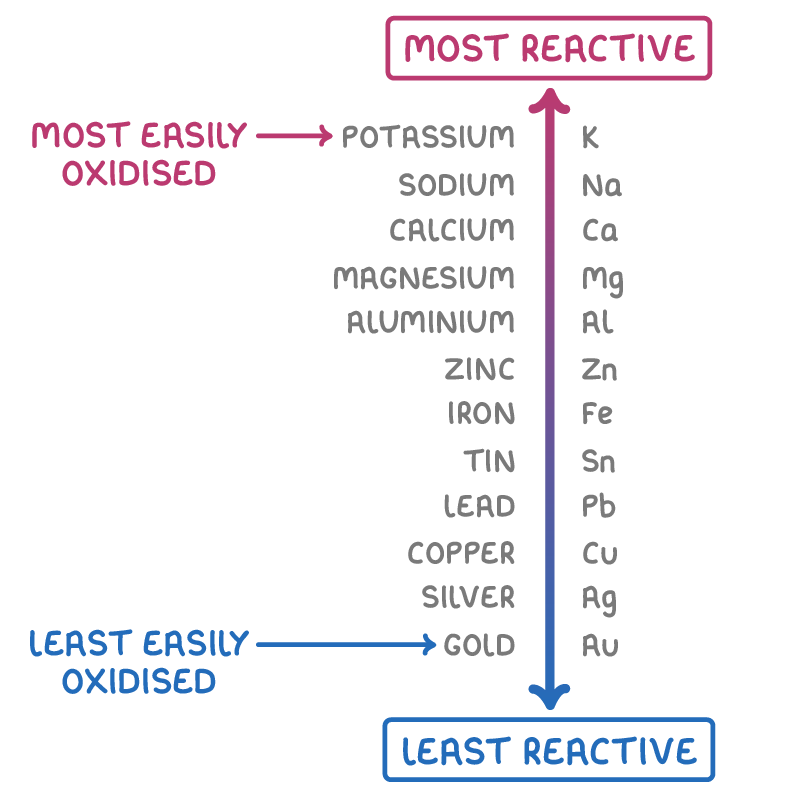
In this series, the most reactive metals (strongest reducing agents) are at the top, and the least reactive metals (weakest reducing agents) are at the bottom. A more reactive metal can displace a less reactive metal from a solution of its ions.
Redox reactions between metals and acids
Reactive metals like magnesium, zinc and iron are readily oxidised by dilute strong acids such as hydrochloric acid (HCl) and sulfuric acid (H2SO4), producing a metal salt and hydrogen gas.
For example, magnesium reacts with sulfuric acid to produce magnesium sulfate and hydrogen:
Mg(s) + H2SO4(aq) ➔ MgSO4(aq) + H2(g)
Similarly, magnesium reacts with hydrochloric acid to produce magnesium chloride and hydrogen:
Mg(s) + 2HCl(aq) ➔ MgCl2(aq) + H2(g)
The redox process in these reactions can be represented by two half-equations:
Oxidation: Mg(s) ➔ Mg2+(aq) + 2e-
Reduction: 2H+(aq) + 2e- ➔ H2(g)
In the overall reaction between a metal and an acid:
- The metal is oxidised, losing electrons to form cations, and acts as the reducing agent.
- H+ ions from the acid gain electrons and are reduced to H2 gas, so the acid acts as the oxidising agent.
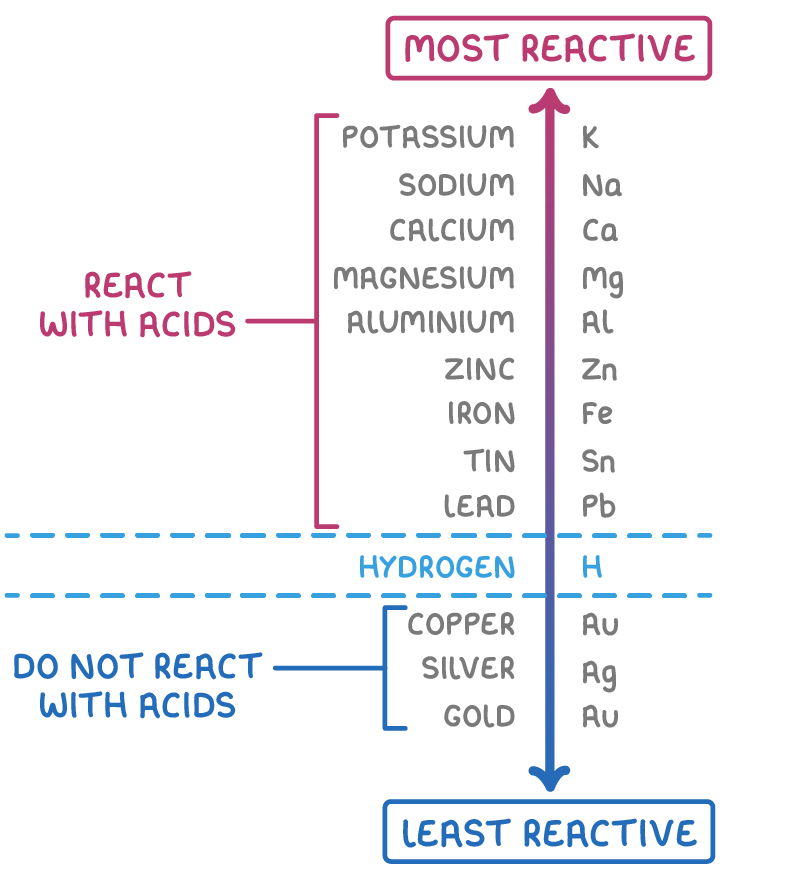
Metals that are less reactive than hydrogen, such as copper and silver, do not react with dilute strong acids because they are less easily oxidised than hydrogen ions (H+). These metals are found below hydrogen in the reactivity series.