22.1 - Nucleophilic Substitution Reactions in Halogenoalkanes
- 1
What nucleophiles are and how they react
- 2
The mechanism of nucleophilic substitution reactions
- 3
Comparing SN1 and SN2 reaction mechanisms
- 4
Factors affecting the rate of nucleophilic substitution reactions
Nucleophiles are electron-pair donors
A nucleophile is an electron-rich species that contains a lone pair of electrons. It can be neutral or negatively charged.
Examples of nucleophiles include:
- Anions - Halide ions (Cl-, Br-, I-), hydroxide ion (OH-), cyanide ion (CN-).
- Neutral molecules - Water (H2O), ammonia (NH3), methylamine (CH3NH2).
Nucleophiles donate an electron pair to electron-deficient species called electrophiles, forming a covalent coordination bond.
The strength of a nucleophile depends on how readily it can donate its electron pair to an electrophile. Stronger nucleophiles donate their electrons more easily.
Nucleophilic substitution reactions of halogenoalkanes
In nucleophilic substitution reactions, the nucleophile donates an electron pair to the electrophile, forming a new covalent bond. At the same time, one of the existing bonds in the electrophile breaks heterolytically, releasing a small molecule or ion called a leaving group (X-).

Where:
- Nu- = nucleophile
- R = electron-deficient atom in the electrophile
- X = leaving group
Halogenoalkanes (R-X) are ideal substrates for nucleophilic substitution because:
- They contain a polar C–X bond due to the high electronegativity of the halogen (X) - this polarises the bond, making the C slightly electron-deficient (Cδ+).
- The electron-deficient C atom is susceptible to attack by electron-rich nucleophiles.
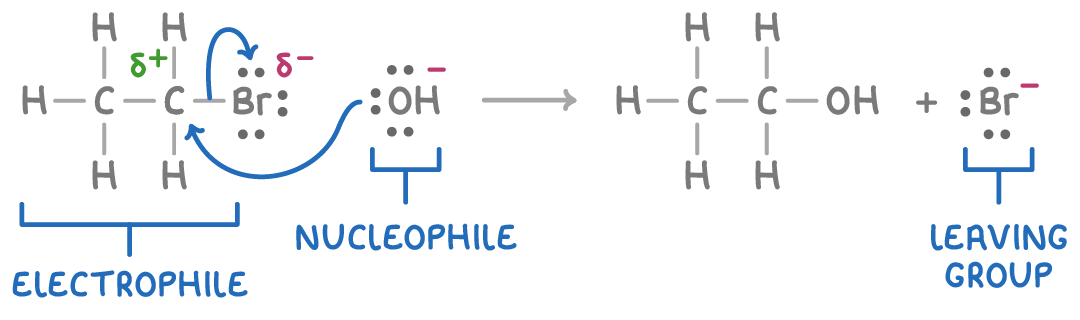
For example, when bromoethane reacts with hydroxide ions, the nucleophilic OH- attacks the electron-deficient C atom, displacing the bromide leaving group:
Heterolytic fission
Heterolytic fission is the unsymmetrical cleavage of a covalent bond, where the bonding electron pair is unevenly distributed between the two atoms. One atom receives both electrons, becoming an anion, while the other receives none, becoming a cation.
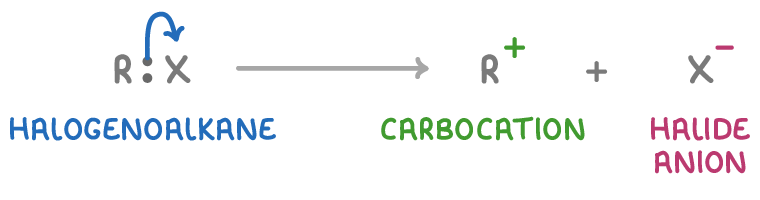
In halogenoalkanes, heterolytic fission of the carbon–halogen bond forms a halide anion (X-) and an alkyl cation (R+), also known as a carbocation. The equation for this heterolytic fission is:
The ease of heterolytic bond fission and the stability of the resulting carbocation intermediate determines whether nucleophilic substitution occurs via an SN1 or an SN2 mechanism.
SN2 reaction mechanism
The SN2 mechanism occurs in nucleophilic substitution reactions of primary halogenoalkanes.
The key features are:
- A concerted, one-step mechanism with no intermediate.
- Second-order kinetics as the rate determining step involves two species - the rate equation is: Rate = k[RX][Nu].
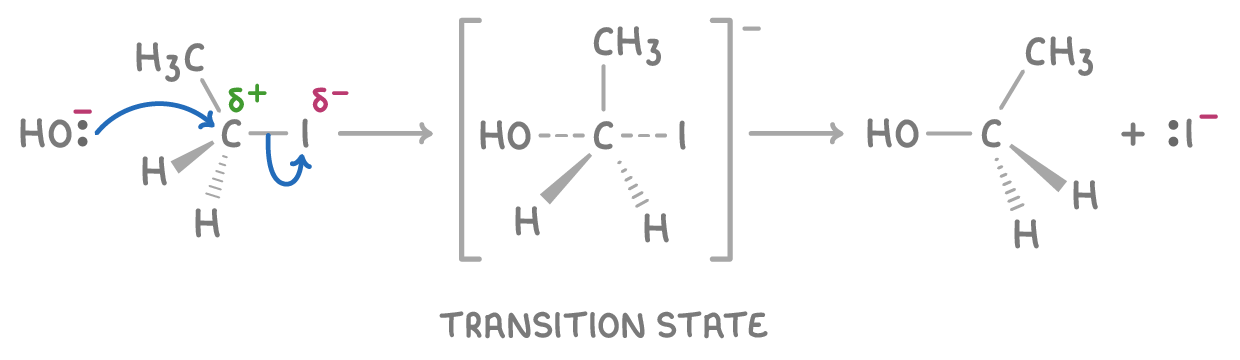
- Proceeds via a transition state with partial bonding to both the nucleophile and leaving group.
- Causes inversion of the stereochemistry at the carbon centre - the nucleophile attacks from the opposite side (180°) to the leaving group to minimise steric hindrance, making the reaction stereospecific. This means the product formed will have a specific stereochemistry, rather than be a mixture of isomers.
The SN2 mechanism for the reaction of iodoethane with hydroxide is shown below. Partial bonds in the transition state are represented by dotted lines.
SN1 reaction mechanism
The SN1 mechanism occurs in nucleophilic substitution reactions of tertiary halogenoalkanes.
The key features are:
- A two-step process with a planar carbocation intermediate.
- First-order kinetics as the rate determining step involves only the halogenoalkane - the rate equation is: Rate = k[RX].
- Stereochemistry at the carbon centre is scrambled - the nucleophile can attack from either side of the planar carbocation, leading to a racemic product mixture.
The SN1 mechanism for the reaction of 2-iodo-2-methylpropane with hydroxide is shown below.

Carbocation stability determines reaction mechanism
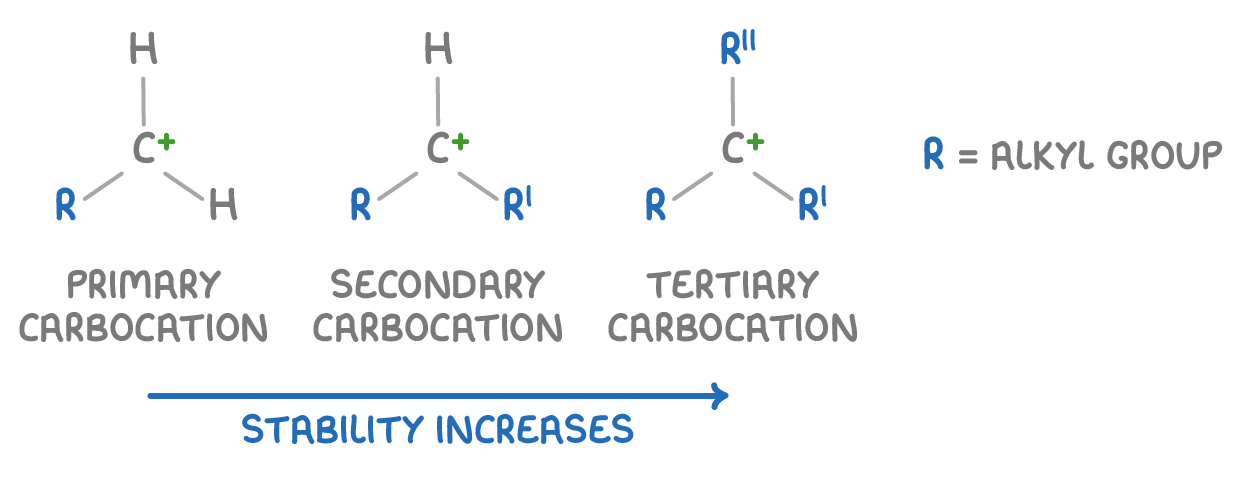
Carbocations are stabilised by the positive inductive effects of alkyl groups, which donate electron density through C-H σ-bonds, dispersing the positive charge on the central carbon atom. The extent of this stabilisation varies depending on the number of alkyl groups attached to the carbocation.
Tertiary halogenoalkanes:
- Form the most stable tertiary carbocations due to the combined stabilising effects of three alkyl groups.
- Readily undergo SN1 reactions, as the stable carbocation intermediate is easily formed.
Secondary halogenoalkanes:
- Form moderately stable secondary carbocations due to the stabilising effect of two alkyl groups.
- Can undergo both SN1 and SN2 mechanisms, depending on the reaction conditions.
Primary halogenoalkanes:
- Form the least stable primary carbocations, as they have only one stabilising alkyl group.
- Prefer to undergo SN2 reactions, as the formation of the unstable carbocation intermediate is less favourable.
Factors affecting the rate of nucleophilic substitution
Two factors influence the rate of nucleophilic substitution reactions in halogenoalkanes:
1. Carbon-halogen bond strength - Weaker C-X bonds undergo heterolytic fission more readily, resulting in faster nucleophilic substitution reactions. The bond enthalpies for carbon-halogen bonds are shown in the table below.
| C-X bond | Bond enthalpy (kJ mol-1) |
|---|---|
| C-F | 485 |
| C-Cl | 339 |
| C-Br | 276 |
| C-I | 240 |
Carbon-halogen bond enthalpies decrease down group 17, leading to an increase in the reaction rate in the order: chloroalkanes < bromoalkanes < iodoalkanes. Fluoroalkanes are essentially inert to nucleophilic substitution because the C-F bond is so strong.
2. Carbocation stability - More stable carbocation intermediates form faster, particularly in SN1 reactions. Stability increases with the number of electron-donating alkyl groups attached to the positively charged carbon. The rate of SN1 reactions decreases in the order: tertiary > secondary > primary halogenoalkanes.