9.2 - Alloys
- 1
What an alloy is
- 2
The properties of alloys compared to pure metals
- 3
Examples of common alloys and their uses
Alloys are mixtures of elements
An alloy is a mixture of a metal with one or more other elements, which can be either metallic or non-metallic. In an alloy, the different types of atoms or ions are held within the metallic structure while still maintaining the delocalised sea of electrons throughout.
As a result, alloys retain many of the characteristic properties of metals such as:
- High electrical conductivity.
- Metallic lustre.
- Malleability and ductility.
However, by combining a metal with other elements, the properties of the resulting alloy can be enhanced compared to the pure metal.
For instance, alloys may have improved:
- Hardness - The ability to resist deformation or scratching.
- Corrosion resistance - The ability to withstand deterioration due to chemical reactions with the environment.
- Melting point - The temperature at which a substance changes from a solid to a liquid state.
Alloys are considered mixtures because:
- The ratio of the components in an alloy can vary without changing the fundamental identity of the substance.
- For example, the proportion of carbon in steel can range from trace amounts up to about 2%.
- The components of an alloy largely retain their original properties.
These characteristics are typical of mixtures rather than pure substances.
Alloy properties differ from pure metals
In a pure metal, all the metal cations (positively charged ions) in the metallic lattice are the same size. This allows the layers of cations to slide past each other relatively easily when a force is applied, resulting in the metal being malleable.
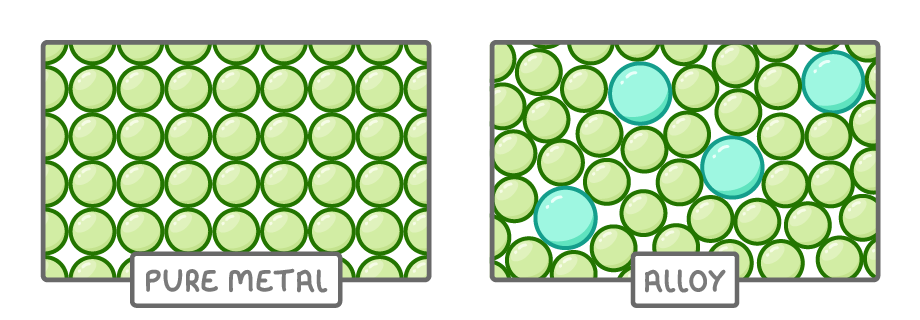
The left diagram shows a regular arrangement of identical spheres representing the metal cations in a pure metallic lattice.
The right diagram shows a disrupted arrangement of spheres of different sizes, representing the different types of atoms or ions present in an alloy.
While the malleability of pure metals is useful for some applications, greater strength is often required.
This is where alloying offers an advantage:
- Adding atoms or ions with a different radius to the metal cations disrupts the regular structure of the metallic lattice.
- When a force is applied to the alloy, the layers of cations can no longer slide past each other as easily.
- Consequently, alloys are typically stronger and harder than the pure metals they are based on.
Common alloys and their applications
Many alloys have been developed to optimise the properties of metals for specific purposes.
Some notable examples include:
- NaK (sodium-potassium alloy)
- Has a lower melting point than either sodium or potassium individually.
- Exists as a liquid at room temperature.
- Used as a coolant in some nuclear reactors due to its liquid state and low volatility, allowing it to be pumped like other fluids.
- Steel (iron-carbon alloy)
- Iron is abundant but relatively soft in its pure form.
- Alloying iron with carbon creates steel, which is much harder and stronger.
- Steels contain varying amounts of carbon (up to ~2%) and other elements.
- Widely used in construction, tools, and countless other applications.
- Stainless steel (iron-chromium alloy)
- Contains at least 11% chromium.
- Chromium reacts with oxygen to form a thin, protective layer of chromium oxide on the surface.
- This oxide layer prevents the iron from rusting.
- Commonly used in cooking equipment and medical instruments due to its corrosion resistance.
- Bronze (copper-tin alloy)
- Harder than pure copper and resistant to corrosion.
- Historically used in shipbuilding, tools, coins, and other household items before steel became widespread.
- Brass (copper-zinc alloy)
- Highly malleable.
- Used to make musical instruments because of its acoustic properties.
- The copper content gives brass antimicrobial properties, making it a popular choice for door handles in public buildings like hospitals.