20.5 - Electrolytic Cells
- 1
The structure and function of electrolytic cells
- 2
The electrolysis of molten salts and aqueous solutions
- 3
The process and applications of electroplating
Electrolytic cells
An electrolytic cell is an electrochemical cell that uses electrical energy from an external source to drive a non-spontaneous redox reaction. This process is called electrolysis.
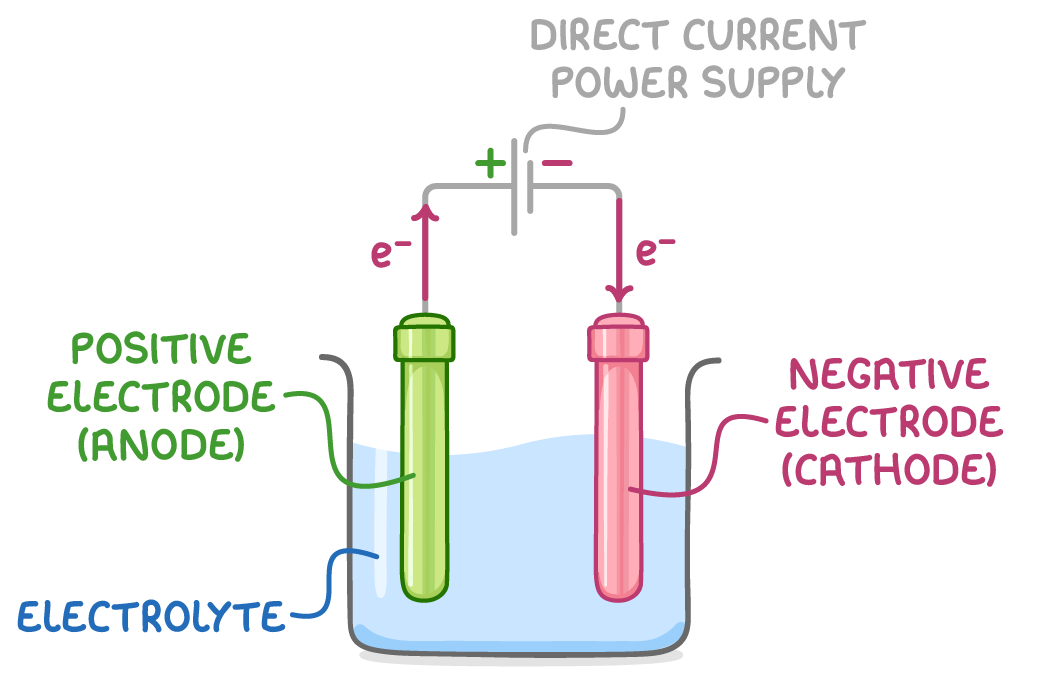
The key components of an electrolytic cell are:
- Electrolyte - A solution containing free-moving ions, either dissolved (aqueous solution) or molten ionic compound.
- Cathode - The negative electrode where reduction occurs and electrons enter the cell.
- Anode - The positive electrode where oxidation occurs and electrons leave the cell.
- DC power source - Provides the electrical energy to drive the non-spontaneous redox reaction.
In the closed circuit, electrons flow from the negative terminal of the power source to the cathode, where cations are reduced. The electrons then flow through the electrolyte to the anode, where anions are oxidised. Finally, the electrons return to the positive terminal of the power source.
Electrolysis of molten salts
When a molten ionic compound undergoes electrolysis, the cations (usually metals) are reduced at the cathode to form the pure metal, while the anions are oxidised at the anode. The identity of the products depends on the composition of the molten salt.
For example, in the electrolysis of molten sodium chloride (NaCl):
Sodium ions are reduced at the cathode to form liquid sodium: Na^+^ + e- ➔ Na
Chloride ions are oxidised at the anode to form chlorine gas: 2Cl^-^ ➔ Cl_2_ + 2e^-^
The overall equation is: 2NaCl_(l)_ ➔ 2Na_(l)_ + Cl_2(g)_
This process is used industrially to produce reactive metals like sodium, magnesium, and aluminium from their molten salts. An inert atmosphere is used to prevent the oxidation of the metal product.
Worked example 1 - Electrolysis of molten Al_2_O_3_
Deduce the products of the electrolysis of molten aluminium oxide, Al_2_O_3(l)_, with inert electrodes. Write the overall cell equation and the half-equations occurring at each electrode.
Step 1: Split the electrolyte into ions
Al2O3(l) ➔ 2Al3+ + 3O2-
Step 2: Predict direction of ion migration
Al3+ ions will migrate towards the cathode.
O2- ions will migrate towards the anode.
Step 3: Reaction at cathode
Al^3+^ ions will be reduced to liquid aluminium at the cathode.
Al3+ + 3e- ➔ Al
Step 4: Reaction at anode
O^2-^ ions will be oxidised to oxygen gas at the anode.
O2- ➔ 1⁄2O2 + 2e-
Step 5: Overall equation
Ionic: 2Al3+ + 3O2-➔ 2Al + 3⁄2O2
Full: Al2O3(l) ➔ 2Al_(l)_ + 3⁄2O2(g)
Electrolysis of aqueous solutions
In aqueous solutions, water molecules can also be oxidised or reduced at the electrodes, in addition to the solute ions. The reduction and oxidation of water occur at specific reduction potentials:
Reduction of water: H2O(l) + e- ➔ 1⁄2H2(g) + OH-(aq) E⦵ = $-$0.83 V
Oxidation of water: H2O(l) ➔ 1⁄2O2(g) + 2H+(aq) + 2e- E⦵ = $-$1.23 V
To deduce the products of electrolysis in aqueous solutions, compare the standard electrode potentials of the solute ions and water:
- At the cathode, the species with the most positive reduction potential will be reduced.
- At the anode, the species with the least negative oxidation potential will be oxidised.
For example, in the electrolysis of aqueous concentrated sodium chloride (NaCl):
Cathode: H2O is reduced instead of Na⁺ because its reduction potential (E⦵ = $-$0.83 V) is less negative than that of Na^+^ (E⦵ = $-$2.71 V).
Anode: Cl^-^ is preferentially oxidised because its oxidation potential (E⦵ = $-$0.83 V) is more negative than that of H_2_O (E⦵ = −1.23 V).
Worked example 2 - Electrolysis of aqueous CuSO_4_
The standard reduction potentials for Cu2+ and H2O are as follows;
Cu2+(aq) + 2e- ➔ Cu(s) E⦵ = +0.34 V
H2O(l) + e- ➔ 1⁄2H2(g) + OH-(aq) E⦵ = $-$0.83 V
Deduce the products of the electrolysis of aqueous copper sulfate, CuSO4(aq), with inert electrodes. Write the overall cell equation and the half-equations occurring at each electrode.
Step 1: Split the electrolyte into ions
CuSO4(aq) ➔ Cu2+(aq) + SO42-(aq)
Step 2: Predict direction of ion migration
Cu2+ ions will migrate towards the cathode.
SO42- ions will migrate towards the anode.
Step 3: Reaction at cathode
Cu2+ has a more positive reduction potential than H2O, so it is reduced to copper metal at the cathode.
Cu2+(aq) + 2e- ➔ Cu(s)
Step 4: Reaction at anode
SO42- ions cannot be oxidised further as sulfur is already in its highest oxidation state of +6.
Therefore, H2O will be oxidised to oxygen gas at the anode.
H2O(l) ➔ 1⁄2O2(g) + 2H+(aq) + 2e-
Step 5: Overall equation
Ionic: Cu2+(aq) + SO42-(aq) + H2O(l) ➔ Cu(s) + 1⁄2O2(g) + 2H+(aq) + SO42-(aq)
Full: CuSO4(aq) + H2O(l) ➔ Cu(s) + 1⁄2O2(g) + H2 SO4(aq)
Effect of electrolyte concentration
The concentration of the electrolyte can affect the products of electrolysis, particularly at the anode. This is because the concentration of ions in the solution determines their availability for oxidation or reduction at the electrodes.
For example, in the electrolysis of NaCl_(aq)_:
- In concentrated NaCl(aq) - Cl- is preferentially oxidised to Cl_2_ at the anode because its oxidation potential, E⦵ = −1.36 V, is more negative than that of H_2_O, E⦵ = −1.23 V.
- In dilute NaCl(aq) - H_2_O is more likely to be oxidised to O_2_, either along with Cl- or as the sole product, because the concentration of Cl- is lower.
In the case of CuSO4(aq) electrolysis, the concentration does not affect the products because Cu2+ is always preferentially reduced at the cathode, and water is always oxidised at the anode
Effect of electrode material
The nature of the electrode material can affect the products of electrolysis, especially at the anode. Inert electrodes, such as platinum or graphite, are often used to prevent the electrodes from participating in the reactions.
For example, in the electrolysis of CuSO4(aq):
- With inert electrodes (e.g., platinum or graphite), Cu2+ is reduced to Cu(s) at the cathode, and H2O is oxidised to O2 at the anode.
- With a copper anode, the anode is oxidised to Cu2+, which then migrates to the cathode and is reduced to Cu(s). This process is used in electroplating to deposit a layer of copper on the cathode.
Electroplating
Electroplating is the process of using electrolysis to coat an object with a thin layer of metal. It has various practical applications:
- Creating a protective, corrosion-resistant layer on objects.
- Improving the appearance of objects.
- Purifying metals by selectively dissolving impurities.
Electroplating involves the following steps:
- The metal to be plated (e.g. copper) is used as the anode and is oxidised to form cations in solution.
- The cations move through the electrolyte to the cathode.
- At the cathode, the cations are reduced and deposited as a thin layer of metal on the object being plated.
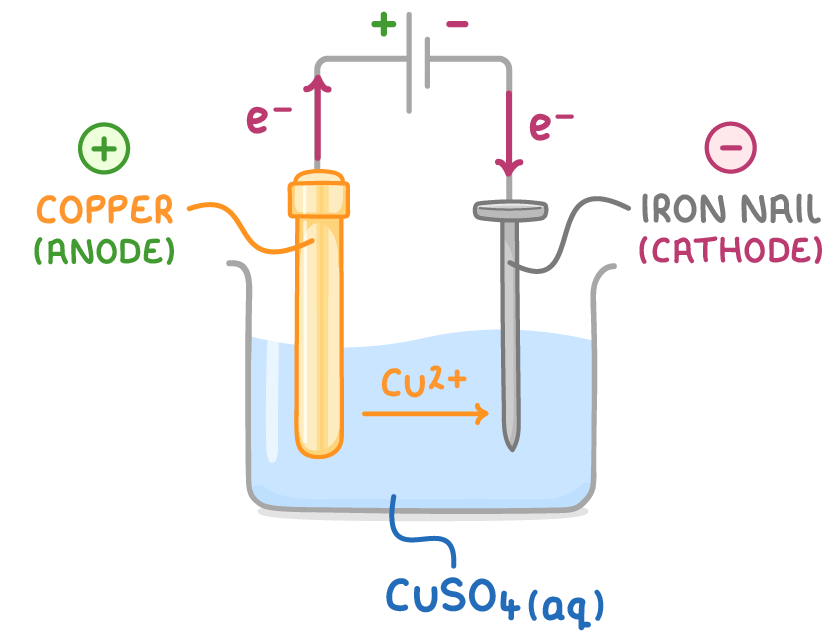
For example, consider the process of electroplating an iron nail with copper using a copper(II) sulfate electrolyte.
The half-reaction equations for the anode and cathode processes are as follows:
Anode (copper oxidation): Cu(s) ➔ Cu2+(aq) + 2e-
Cathode (copper(II) reduction): Cu2+(aq) + 2e- ➔ Cu(s)
During the electroplating process, copper atoms from the anode dissolve into the solution as Cu2+(aq) ions. These ions then migrate through the electrolyte to the cathode (iron nail), where they are reduced and plated onto the iron surface as a thin layer of Cu(s).
Worked example 3 - Deducing the half-equations for silver-nickel electroplating
A nickel fork is plated with a thin layer of silver in an electroplating experiment using a silver nitrate (AgNO3) electrolyte, as shown below.
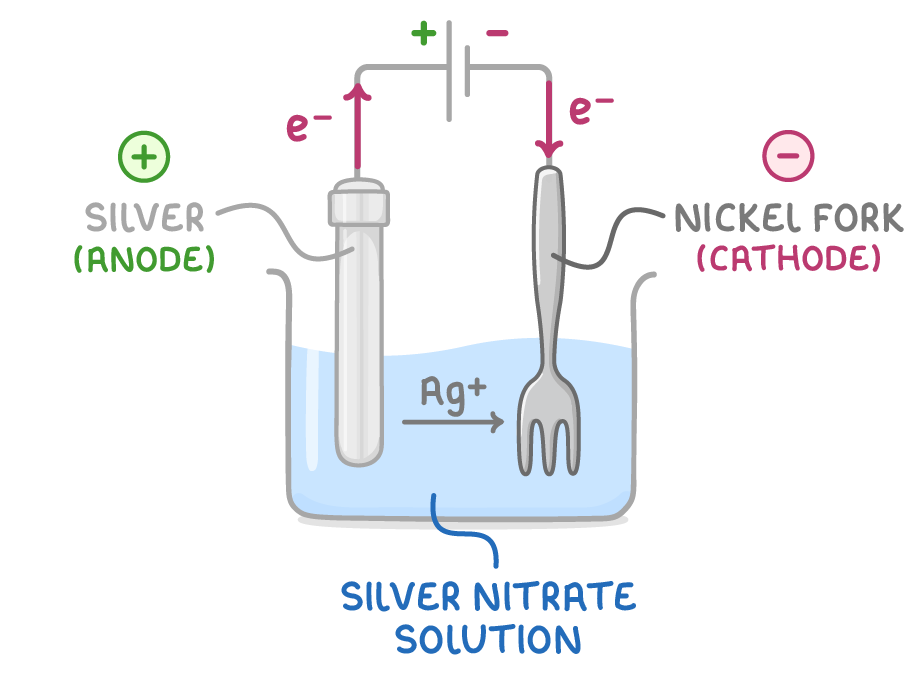
Give the half-equations for the reactions occurring at each electrode.
Step 1: Reaction at anode
At the anode, silver is oxidised:
Ag(s) ➔ Ag+(aq) + e-
Step 2: Reaction at cathode
At the cathode, silver(I) ions are reduced:
Ag+(aq) + e- ➔ Ag(s)