17.7 - The Arrhenius Equation
- 1
What the Arrhenius equation is
- 2
How activation energy affects rate constant temperature dependence
- 3
Determining activation energy and the Arrhenius factor from experimental data
The Arrhenius equation links reaction rate to temperature and activation energy
The Arrhenius equation quantitatively describes how rate constants change with temperature.
The Arrhenius equation is given by:
$\text{k }=\text{ A}e^{(\frac{-\text{E}_{\text{a}}}{\text{RT}})}$
Where:
- k = rate constant.
- A = Arrhenius factor.
- e = mathematical constant (the base of natural logarithms).
- Ea = activation energy (J mol-1).
- R = gas constant (8.31 J K-1 mol-1).
- T = temperature (K).
The Arrhenius factor (A) is specific to each reaction and accounts for the frequency of collisions between reactant particles with the correct orientation for reaction. Its units match those of the rate constant (k).
- For simple reactants like atoms or diatomic molecules, A values are high as collisions at any orientation can lead to reaction.
- For complex molecules, A values are lower as only certain collision orientations result in reaction.
Activation energy determines the temperature sensitivity of the rate constant
The Arrhenius factor (A) and activation energy (E_a_) are both nearly independent of temperature. However, the rate constant (k) increases exponentially with temperature (T) according to the following relationship:
$k \propto e^{-1 / T}=e^T$
The value of the activation energy (E_a_) determines how quickly the rate constant increases with temperature:
- Reactions with high E_a_ values are more temperature sensitive. Their rate constants increase rapidly with temperature, as more molecules have enough energy to overcome the high activation energy barrier.
- Reactions with low E_a_ values are less temperature sensitive. Their rate constants increase more gradually with temperature, as most molecules already have enough energy to overcome the low activation energy barrier.
Finding activation energy from rate constants at two temperatures
The activation energy (E_a_) can be determined using the logarithmic form of the Arrhenius equation:
$\ln{k}=-\frac{E_{\mathrm{a}}}{RT}+\ln{A}$
If you have two known rate constants (k_1_ and k_2_) at two different temperatures (T_1_ and T_2_), you can calculate E_a_ without the need for the Arrhenius factor (A). This is done by subtracting the equation for k_2_ at T_2_ from the equation for k_1_ at T_1_, resulting in:
$\ln \frac{k_1}{k_2}=\frac{E_{\mathrm{a}}}{R}\left(\frac{1}{T_2}-\frac{1}{T_1}\right)$
If the concentrations of the reactants are kept constant, the ratio of the reaction rates $\frac{\nu_1}{\nu_2}$ can be used instead of the ratio of the rate constants $\frac{k_1}{k_2}$, as the reaction rate is directly proportional to the rate constant under these conditions.
Worked example 1 - Calculating activation energy
The rate constants of a certain reaction at 28.0°C and 55.0°C are 0.145 dm^3^ mol^-1^ s^-1^ and 4.10 dm^3^ mol^-1^ s^-1^, respectively.
Calculate the activation energy (E_a_), in kJ mol^-1^. Give your answer to 3 significant figures.
The gas constant, R = 8.31 J K^-1^ mol^-1^.
Step 1: Conversion of °C into K
To convert from °C to K, add 273
28.0°C = 301 K
55.0°C = 328 K
Step 2: Equation
$\ln \frac{k_1}{k_2}=\frac{E_{\mathrm{a}}}{R}\left(\frac{1}{T_2}-\frac{1}{T_1}\right)$
Step 3: Rearrange equation
$E_a=\frac{R \ln \frac{k_1}{k_2}}{\left(\frac{1}{T_2}-\frac{1}{T_1}\right)}$
Step 4: Substitution and correct evaluation
$E_a=\frac{8.31\times\ln(\frac{0.145}{4.10})}{\left(\frac{1}{328}-\frac{1}{301}\right)}=\frac{8.31\times(-3.34)}{(-2.73\times10^{-4})}=102,000\text{ J mol}^{-1}$
Step 5: Conversion of J mol^-1^ into kJ mol^-1^
To convert from J mol^-1^ to kJ mol^-1^, divide by 1,000
102,000 J mol^-1^ = 102 kJ mol^-1^
Using Arrhenius plots to determine activation energy and the Arrhenius factor
An Arrhenius plot graphs the logarithmic form of the Arrhenius equation, plotting ln k against $\frac{1}{\text{T}}$.
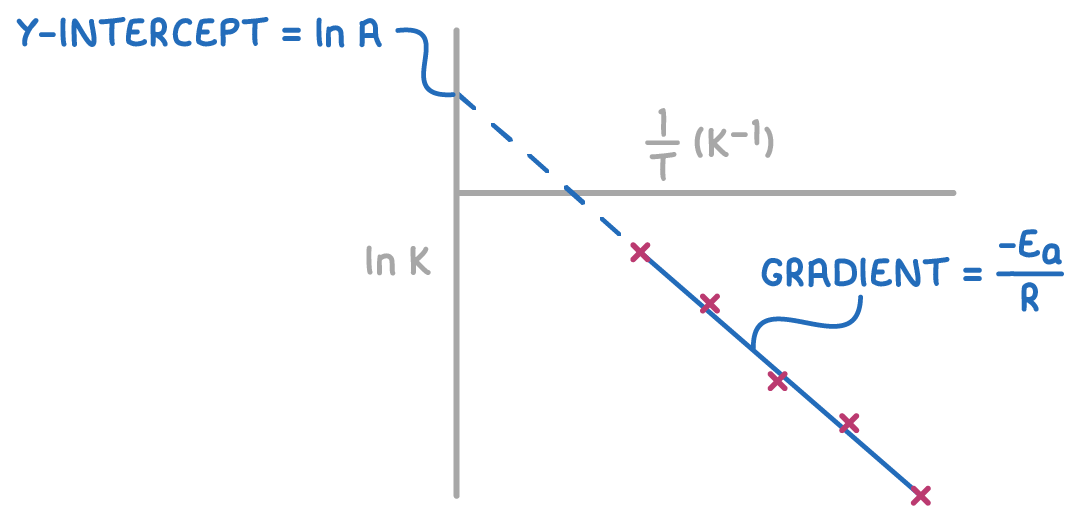
This yields a straight line from which we can determine:
- Gradient - $\frac{-\text{E}_{\text{a}}}{\text{R}}$, allowing us to calculate Ea.
- y-intercept - ln A, which lets us find A by taking the exponential (eintercept).
Worked example 2 - Calculating activation energy
The decomposition of dinitrogen pentoxide (N2O5) at 310 K has a rate constant of $2.50 \times 10^{-3}\text{ s}^{-1}$. The Arrhenius factor for this reaction is $6.90 \times 10^{12}\text{ s}^{-1}$.
Calculate the activation energy, in kJ mol-1, for this reaction. Give your answer to 3 significant figures.
The gas constant, R = 8.31 J K-1 mol-1.
Step 1: Equation:
$\ln{k} = \frac{-\text{E}_{\text{a}}}{\text{RT}}+\ln{A}$
Step 2: Rearrange equation:
$\text{E}_{\text{a}} = (\ln{A} - \ln{k})\times\text{ RT}$
Step 3: Substitution and correct evaluation
$\text{E}_{\text{a}} = (\ln (6.90 \times 10^{12}) - \ln (2.50 \times 10^{-3})) \times 8.31 \times 310$
$=35.6\times8.31\times310=91,600\text{ J mol}^{-1}$
Step 4: Conversion from J mol-1 to kJ mol-1
To convert from J mol-1 to kJ mol-1, divide by 1,000.
91,600 J mol-1 = 91.6 kJ mol-1
Worked example 3 - Calculating activation energy and the Arrhenius factor
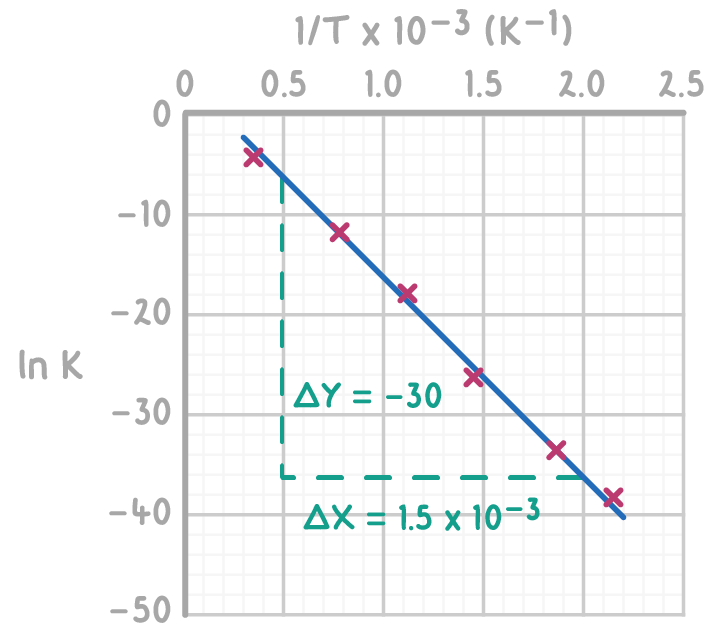
Calculate the activation energy (in kJ mol-1) and the Arrhenius factor (in dm^3^ mol^-1^ s^-1^) from the Arrhenius plot above.
Give your answers to 2 significant figures.
The gas constant, R = 8.31 J K^-1^ mol^-1^.
Step 1: Calculate the gradient of the line
$\text{Gradient } = \frac{-36 - (-6)}{(2.0 \times 10^{-3}) - (0.5 \times 10^{-3})}$
$= \frac{-30}{ (1.5 \times 10^{-3})} = -20,000$
Step 2: Calculate activation energy (Ea)
$\text{E}_{\text{a}} = -\text{Gradient } \times \text{ R }=-20,000\times8.31=170,000\text{ J mol}^{-1}$
Step 3: Conversion from J mol-1 to kJ mol-1
To convert from J mol-1 to kJ mol-1, divide by 1,000.
170,000 J mol-1 = 170 kJ mol-1
Step 4: Rearrange equation
$\ln{A} = \frac{\text{E}_{\text{a}}}{\text{RT}}+\ln{k}$
Step 5: Substitution and correct evaluation
Using the point ($0.5\times10^{-3}, -6$) and the calculated gradient from step 1
$\ln{A}= (20,000\times(0.5\times10^{-3}))-6$
= $10 - 6 = 4$
Step 6: Calculate Arrhenius factor (A)
A = e4 = 55 dm3 mol-1 s-1.