7.9 - Sigma Bonds & Pi Bonds
- 1
The formation of covalent bonds through orbital overlap
- 2
Sigma (σ) and pi (π) bonds and their characteristics
- 3
Hybridisation of atomic orbitals
- 4
The relationship between hybridisation and molecular geometry
Covalent bond formation
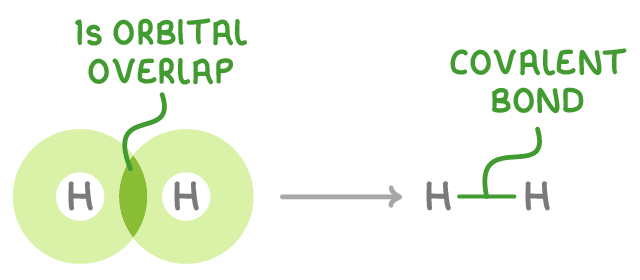
Covalent bonds are formed when the atomic orbitals of two non-metal atoms overlap, allowing electrons to be shared between them. The extent of this orbital overlap determines the bond strength - greater overlap leads to stronger bonds.
For example, the 1s orbitals of two hydrogen atoms overlap to form a covalent bond:
Sigma (σ) bonds
Sigma bonds are formed when atomic orbitals overlap directly in a linear, end-on fashion.
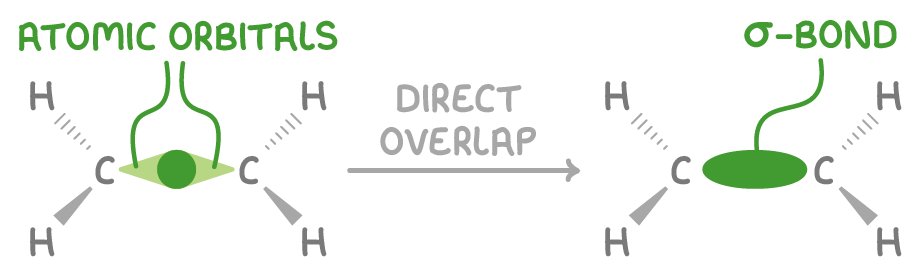
Key features of sigma (σ) bonds:
- The electron density is symmetrically distributed around the internuclear axis joining the bonded atoms.
- All single bonds in organic molecules are σ bonds.
Pi (π) bonds
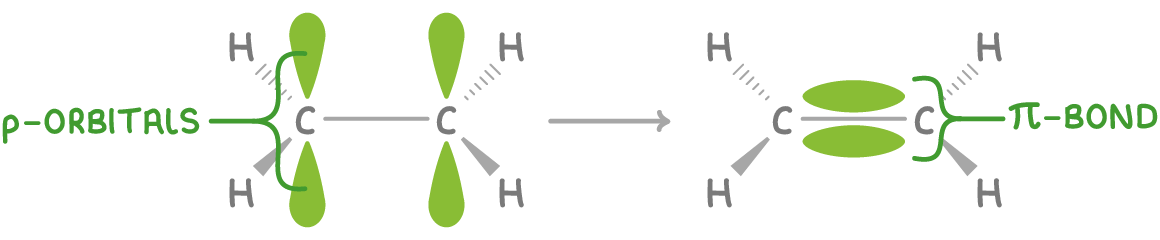
Pi bonds are formed when atomic orbitals, specifically p orbitals, overlap in a sideways manner, above and below the sigma bond.

Key features of pi (π) bonds:
- The electron density is not symmetrically distributed around the internuclear axis.
- Often represented as two electron clouds, one from each p orbital lobe, but together forming a single π bond containing two electrons.
- A double bond is formed from one σ bond and one π bond.
- A triple bond is formed from one σ bond and two π bonds. The π bonds are oriented at right angles to each other.
Worked example 1 - Determining the number of sigma and pi bonds
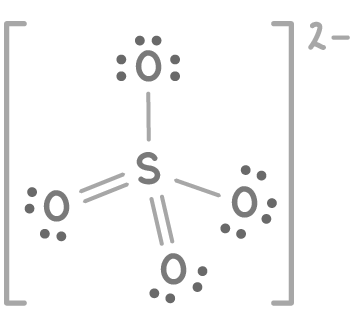
Determine the number of sigma and pi bonds in the sulfate anion, SO42-. The Lewis formula is given below.
Step 1: Count the sigma bonds
Each single bond between sulfur (S) and oxygen (O) represents one sigma bond.
Each double bond between sulfur (S) and oxygen (O) represents one sigma bond.
SO42- has 4 single bonds and 2 double bonds.
Therefore, there are 6 sigma bonds.
Step 2: Count the pi bonds
Each double bond between sulfur (S) and oxygen (O) represents one pi (π) bond.
SO42- has 2 double bonds.
Therefore there are 2 pi bonds.
Hybridisation of orbitals
When atomic orbitals combine to form covalent bonds, they undergo a process called hybridisation, where an s orbital mixes with one, two, or three p orbitals. The hybrid orbitals that form are more directional than the original atomic orbitals, enabling greater overlap between the atomic orbitals of bonding atoms, resulting in stronger covalent bonds and more stable molecules.
The three types of hybridisation you need to know about are:
- sp3 hybridisation
- sp2 hybridisation
- sp hybridisation
sp3 hybrid orbitals
In sp3 hybridisation, one s orbital and three p orbitals mix to form four equivalent sp3 hybrid orbitals. These orbitals are arranged in a tetrahedral geometry, with bond angles of approximately 109.5°.
Example 1 - Methane (CH4)
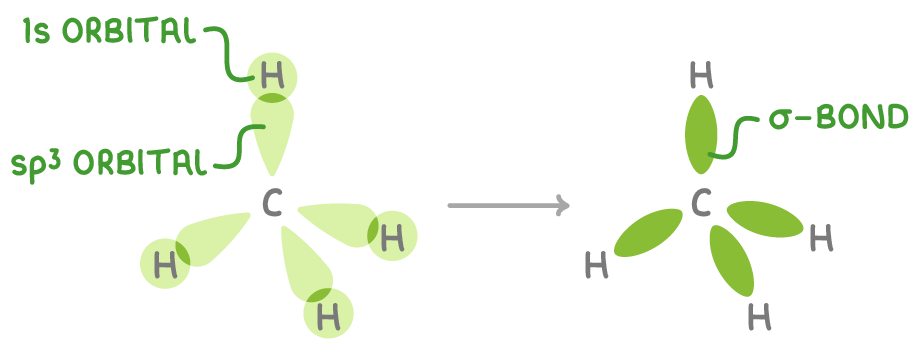
Methane consists entirely of σ (single) bonds formed by the linear overlap of sp3 hybridised orbitals. The four electron domains are evenly distributed, resulting in a stable, tetrahedral structure.
Example 2 - Water (H2O)
In water, the oxygen atom undergoes sp3 hybridisation. Two of the sp3 hybrid orbitals contain lone pairs, while the other two form σ bonds with the hydrogen atoms. The presence of lone pairs results in a non-linear molecular geometry with a bond angle of approximately 104.5°, slightly deviating from the ideal 109.5° angle.
sp2 hybrid orbitals
In sp2 hybridisation, one s orbital and two p orbitals mix to form three equivalent sp2 hybrid orbitals. These orbitals are arranged in a trigonal planar geometry with bond angles of 120°.
Example 1 - Ethene (H2C=CH2)
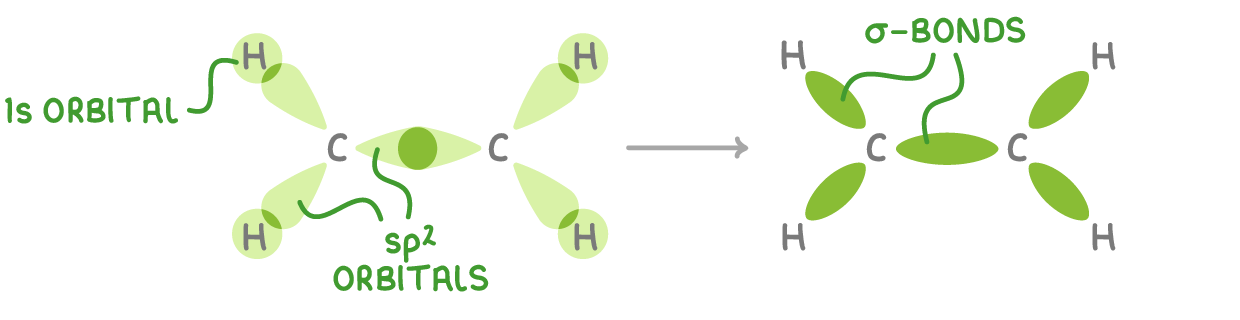
In ethene, each carbon atom forms three σ bonds using sp2 hybridised orbitals: two with hydrogen atoms and one with the other carbon atom. The remaining unhybridised p orbital on each carbon atom overlaps sideways, forming a π bond. This combination of σ and π bonds results in a double bond between the carbon atoms.
Example 2 - Carbonate ion (CO32-)
In the carbonate ion (CO32-), the central carbon atom undergoes sp2 hybridisation, forming three sp2 hybrid orbitals. These orbitals form σ bonds with the p orbitals of the three oxygen atoms, resulting in a trigonal planar geometry with three electron domains.
sp hybrid orbitals
In sp hybridisation, one s orbital and one p orbital mix to form two equivalent sp hybrid orbitals. These orbitals are arranged in a linear geometry with a bond angle of 180°.
Example 1 - Ethyne (H-C≡C-H)
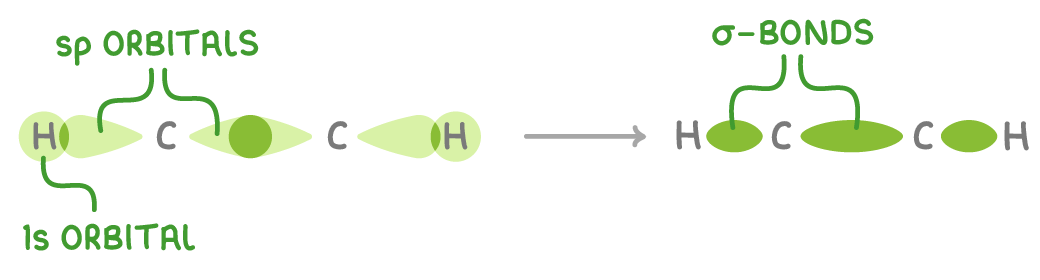
In ethyne, carbon atoms form a triple bond, consisting of one σ bond and two π bonds. The σ bonds between the carbon and hydrogen atoms form through the overlap of sp hybrid orbitals on the carbon atoms and the s orbitals of the hydrogen atoms.
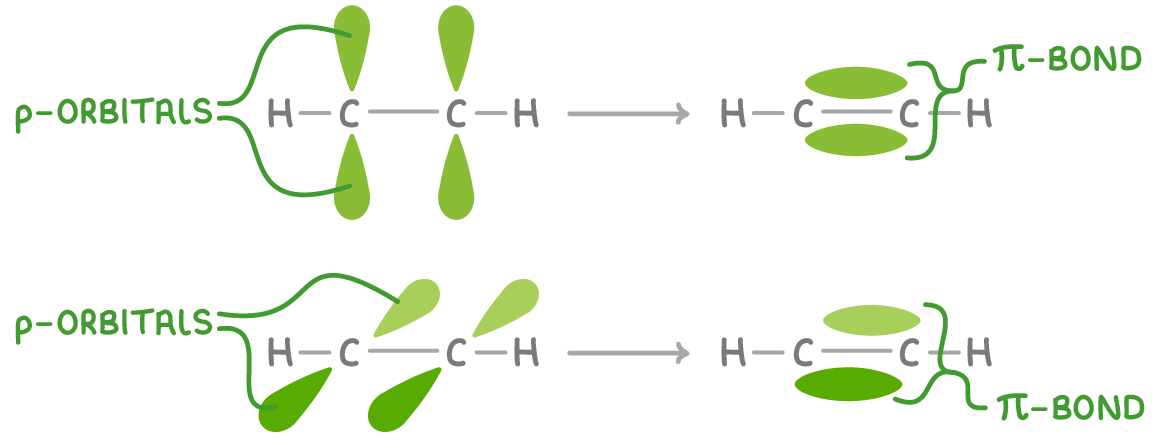
The remaining unhybridised p orbitals on each carbon atom overlap sideways, forming two π bonds oriented at right angles to each other.
Example 2 - Cyanide ion (C≡N-)
In the cyanide ion, the carbon atom undergoes sp hybridisation. The triple bond between the carbon and nitrogen atoms consists of one σ bond formed by overlapping sp hybrid orbitals and two π bonds formed by overlapping unhybridised p orbitals. The two electron domains result in a linear geometry.
Relationship between hybridisation and molecular geometry
The hybridisation of an atom is closely related to the electron domain geometry and molecular geometry of the molecule. The number of hybrid orbitals formed by an atom equals the number of its electron domains.
When determining molecular shape, double and triple bonds are treated as single additional electron domains. This is because π bonds do not involve hybridised orbitals, so they have a minimal effect on the overall geometry of the molecule.
Here is a summary of the relationships between hybridisation, electron domains, and molecular geometry:
| Hybridisation | Number of hybrid orbitals | Number of electron domains | Electron domain geometry | Number of non-bonding domains | Molecular geometry |
|---|---|---|---|---|---|
| sp^3^ | 4 | 4 | tetrahedral | 0 / 1 / 2 | tetrahedral / trigonal pyramidal / non-linear |
| sp^2^ | 3 | 3 | trigonal planar | 0 / 1 | trigonal planar / non-linear |
| sp | 2 | 2 | linear | 0 | linear |