20.3 - Electrochemical Cells
- 1
What electrochemical cells are and their types
- 2
How primary cells convert chemical energy to electrical energy
- 3
The key components and processes in a primary cell
- 4
How to represent primary cells using cell diagrams
Types of electrochemical cell
An electrochemical cell is a device that converts energy between electrical and chemical forms.
There are two main types:
- Primary (voltaic) cells, secondary (rechargeable) cells, and fuel cells - These convert the energy from spontaneous redox reactions into electrical energy.
- Electrolytic cells - These use electrical energy to drive non-spontaneous redox reactions.
In a redox reaction, electrons are transferred from the species being oxidised to the species being reduced. Most spontaneous redox processes are exothermic, which means the released energy can be harnessed to generate an electric current.
Generating electricity from redox reactions
Any two metals at different positions in the reactivity series can be used to generate electricity from redox reactions.
- The metal higher in the series acts as the reducing agent and is oxidised to its ions.
- The metal lower in the series has its ions reduced to the elemental form. These ions act as the oxidising agent.
For example, zinc metal reacts with copper(II) ions in a redox reaction:
Zn(s) + Cu2+(aq) ➔ Zn2+(aq) + Cu(s)
This redox reaction can be split into two half-equations:
- Oxidation: Zn(s) ➔ Zn2+(aq) + 2e-
- Reduction: Cu2+(aq) + 2e- ➔ Cu(s)
These two half-reactions can be physically separated into isolated containers called half-cells:
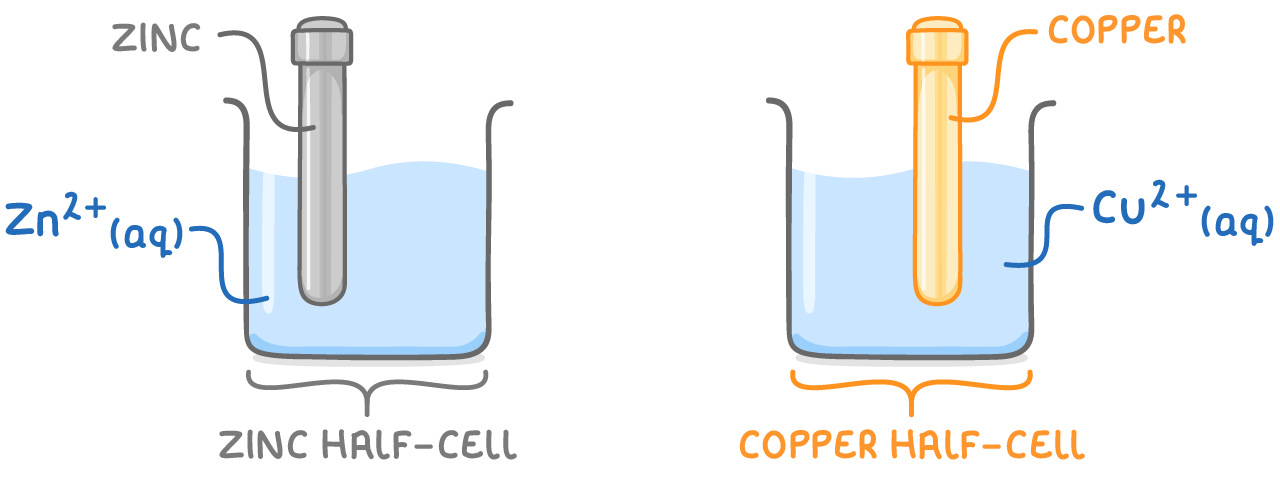
| Half-cell | Reaction | Role |
|---|---|---|
| Zn2+(aq) | Zn(s) ➔ Zn2+(aq) + 2e- | Oxidation (anode) |
| Cu2+(aq) | Cu2+(aq) + 2e- ➔ Cu(s) | Reduction (cathode) |
Connecting half-cells to create an electrochemical cell
Joining the two half-cells with a wire creates an electrochemical cell. In these cells:
- Oxidation always happens at the anode.
- Reduction always occurs at the cathode.
The mnemonic RED CAT is handy for remembering "REDuction at CAThode".
In the zinc-copper cell:
- The zinc electrode is the anode, where zinc is oxidised.
- The copper electrode is the cathode, where copper(II) ions are reduced.
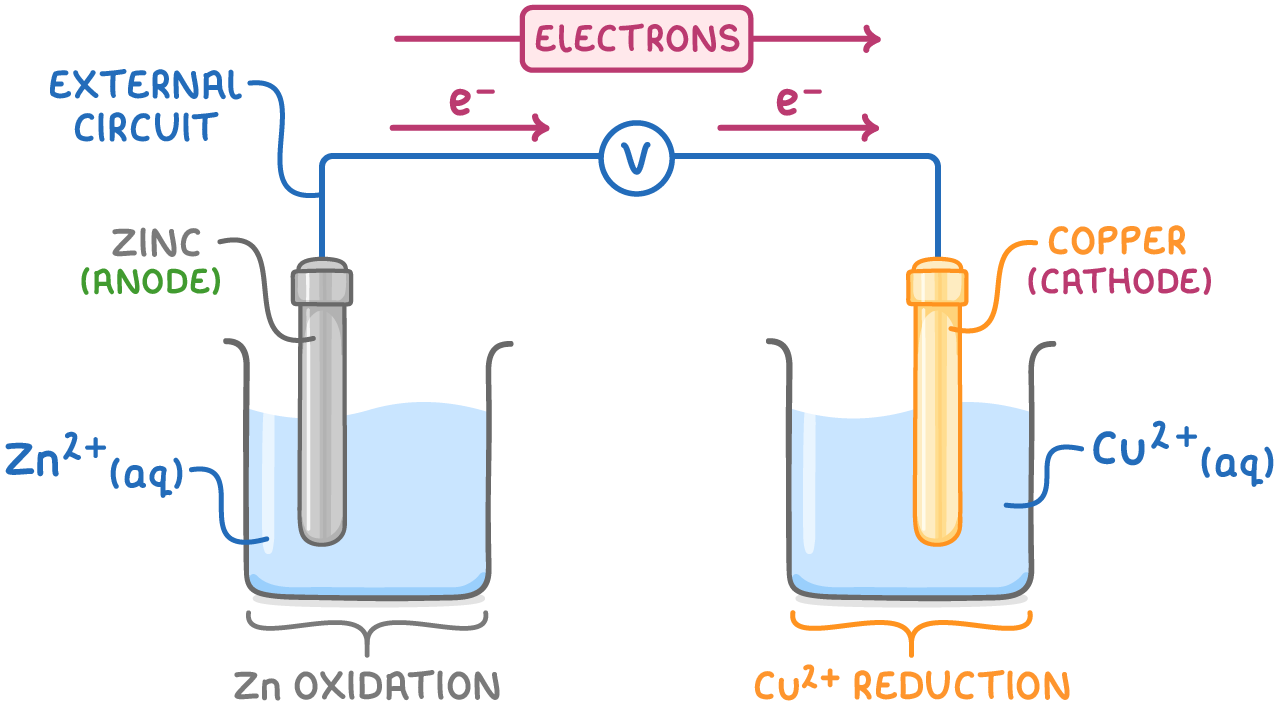
This cell can be represented by combining the two half-equations:
Zn(s) + Cu2+(aq) ➔ Zn2+(aq) + Cu(s)
When the half-cells are connected, electrons flow through the external circuit from the anode to the cathode. This flow of electrons causes a charge imbalance in the half-cells:
- The anode loses electrons and becomes slightly positive.
- The cathode gains electrons and becomes slightly negative.
The negatively charged cathode repels incoming electrons, preventing further zinc oxidation. The cell becomes polarised, and the redox reaction stops.
The salt bridge maintains charge balance
To overcome polarisation and allow the redox reaction to continue, the two half-cells are connected by a salt bridge. The salt bridge contains a concentrated solution of an inert ionic compound, commonly sodium sulfate or potassium nitrate.
The salt bridge enables the completion of the electrical circuit by allowing ions to migrate:
- Positive ions (cations) flow towards the negatively charged cathode.
- Negative ions (anions) flow towards the positively charged anode.
In the zinc-copper cell with a sodium sulfate salt bridge:
- Na+(aq) and Zn2+(aq) cations move to the cathode.
- SO42-(aq) anions move to the anode.
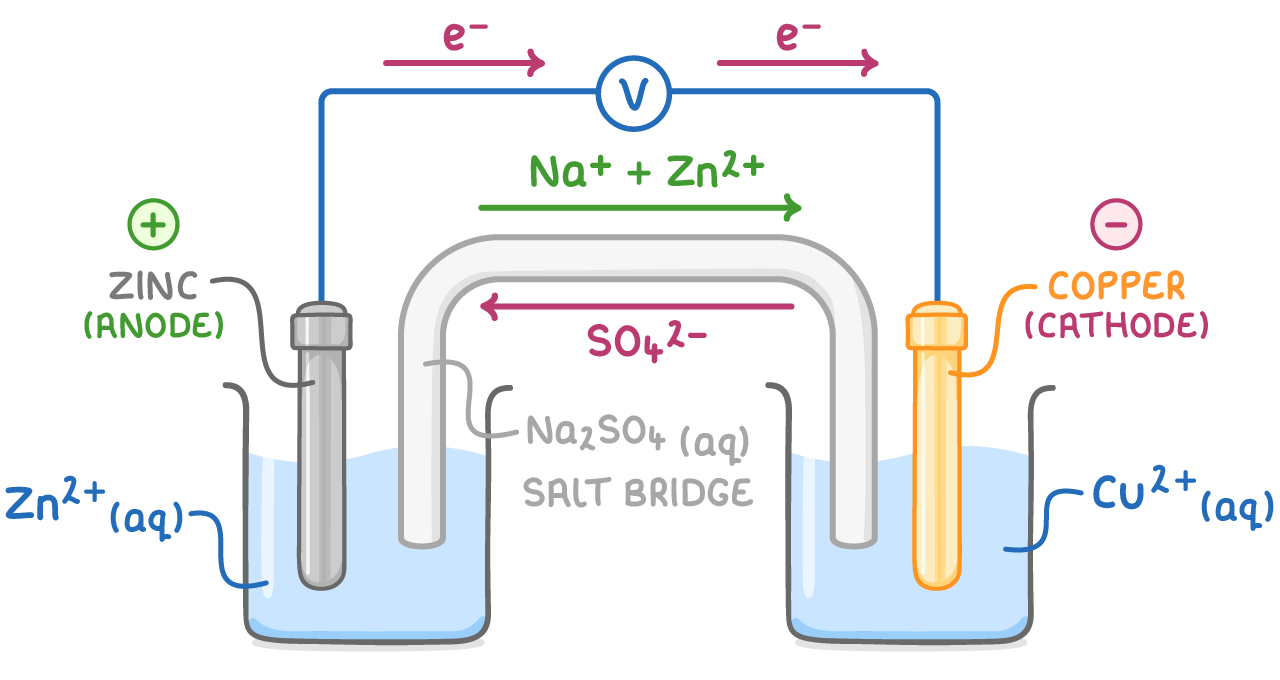
This migration of ions neutralises the charges in each half-cell, allowing the redox reaction to proceed continuously. The result is a complete, functioning primary cell.
As the cell operates:
- The blue colour of the CuSO4(aq) solution fades as Cu2+ ions are reduced to Cu metal.
- The copper cathode increases in size due to Cu metal being deposited.
- The zinc anode decreases in size as it is oxidised to Zn2+ ions.
The cell will eventually stop working once the concentration of Zn2+(aq) ions at the cathode becomes too high, preventing further reduction of Cu2+(aq) ions.
Representing primary cells using diagrams
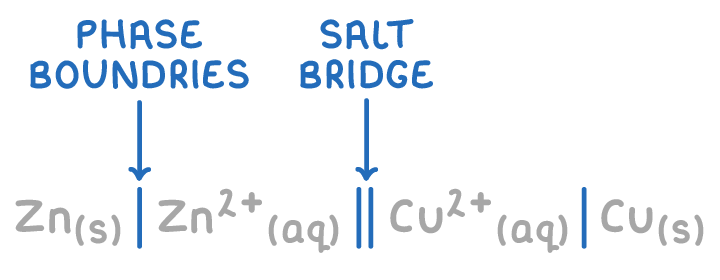
Cell diagrams provide a convenient shorthand representation of primary cells.
By convention:
- The anode (site of oxidation) is always written on the left.
- The cathode (site of reduction) is always written on the right.
- A phase boundary is shown by a single vertical line (|).
- A salt bridge is shown by a double vertical line (||).
The general template for metal-metal ion cells is:
Species being oxidised | Oxidation product || Species being reduced | Reduction product
Therefore, a zinc-copper cell diagram is written as:
Worked example 1 - Representing an iron-nickel cell
Iron metal reacts with nickel(II) ions to form iron(II) ions and nickel metal. Write the cell diagram for the primary cell formed by this redox reaction.
Step 1: Write the full redox equation
Fe(s) + Ni2+(aq) ➔ Fe2+(aq) + Ni(s)
Step 2: Write the half-equations occuring at each electrode:
At cathode (reduction): Ni2+(aq) + 2e- ➔ Ni(s)
At anode (oxidation): Fe(s) ➔ Fe2+(aq) + 2e-
Step 3: Write the cell diagram:
Fe(s) | Fe2+(aq) || Ni2+(aq) | Ni(s)