10.2 - Periodicity: Trends in the Periodic Table
- 1
What periodicity is
- 2
The periodicity of atomic radius, ionic radius, ionisation energy, electron affinity and electronegativity
Periodicity refers to trends in properties of elements
Periodicity is the study of trends in properties of elements across a period and down a group in the periodic table. These trends arise from the periodic table's arrangement based on electron configuration.
The periodic trends you need to know about are:
- Atomic radius - The distance from the nucleus to the outermost electron shell in an atom.
- Ionic radius - The distance from the nucleus to the outermost electron shell in an ion.
- Ionisation energy - The energy needed to remove one mole of electrons from one mole of gaseous atoms.
- Electron affinity - The energy released when one mole of electrons is gained by one mole of gaseous atoms.
- Electronegativity - A measure of an atom's ability to attract the shared electron pair in a covalent bond.
Trends in atomic radius
Atomic radius increases down a group
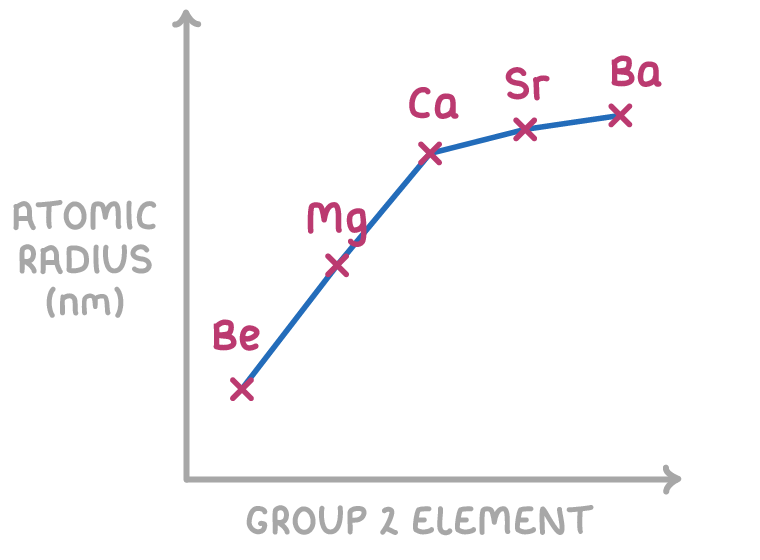
Atomic radius increases down a group, as shown by the group 2 elements in the graph above. This is because:
- More inner electron shells are added as you move down the group. This results in increased shielding of the valence electrons from the nucleus.
- As more shells are added, the valence electrons are found in higher energy levels. They are on average further away from the nucleus.
- With the increasing shielding and distance, the electrostatic attraction between the nucleus and valence electrons decreases. This causes the atomic radius to increase down the group.
Atomic radius decreases across a period
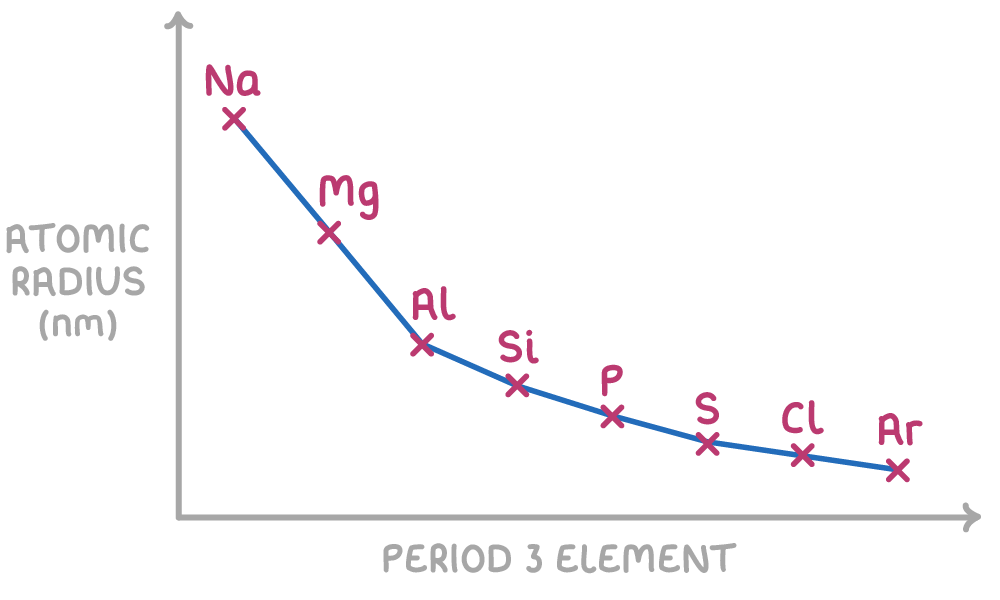
Atomic radius decreases across a period, as shown by the period 3 elements in the graph above. This is because:
- As protons are added across a period, the nuclear charge increases. This results in a stronger electrostatic attraction between the nucleus and valence electrons, drawing them closer.
- The electrons added across a period go into the same outer energy level. They provide little additional shielding for inner electrons.
- With increasing nuclear charge and minimal change in shielding, the stronger attraction causes the atomic radius to decrease.
Trends in ionic radius
Ionic radius increases down a group
Similar to atomic radius, ionic radius increases down a group for both cations and anions. This is due to the increasing number of electron shells and greater shielding of the nucleus by inner electrons as you move down the group.
Trend in ionic radius across a period
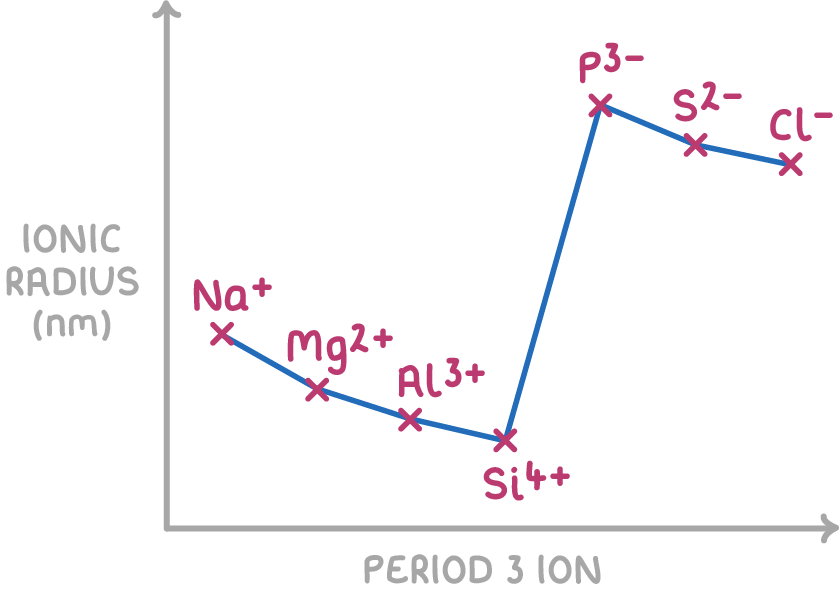
Ionic radius decreases for cations but increases for anions across a period, as shown by the period 3 ions in the graph above:
- For cations, the ionic radius decreases across a period as nuclear charge increases. With more protons, the electrostatic attraction between the nucleus and remaining electrons increases, drawing the electrons closer.
- For anions, the ionic radius increases across a period as the addition of electrons results in more shielding. This weaker attraction allows the valence electrons to locate further from the nucleus.
- Anions have larger ionic radii than cations from the same period because they have an extra electron shell. The increase in shielding outweighs the increase in nuclear charge.
Trends in electron affinity
Electron affinity is the energy released when one mole of electrons is gained by one mole of gaseous atoms to form one mole of gaseous ions. Electron affinity can be thought of as the opposite of ionisation energy.
An equation representing the first electron affinity of chlorine is:
Cl(g) + e− ➔ Cl−(g)
Electron affinity generally decreases down a group
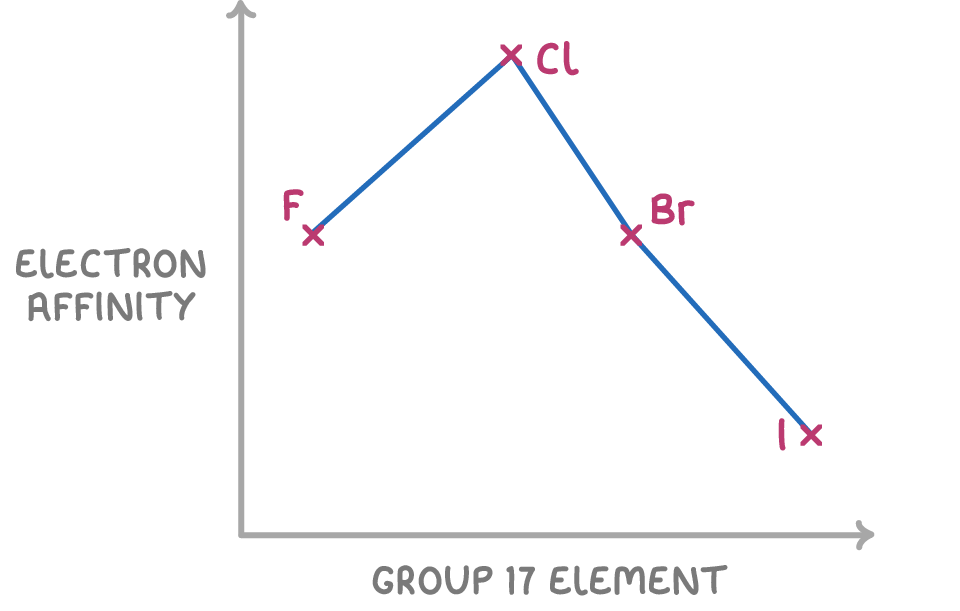
Electron affinity decreases down a group, as shown by the group 17 elements in the graph above. This is because:
- As the atomic radius increases down a group, the attraction for an additional electron decreases. This is due to increased shielding by inner electron shells.
- The increased distance between the nucleus and added electron, combined with greater shielding, weakens the electrostatic attraction. This makes the electron affinity less exothermic down the group.
- An exception is fluorine, which has a smaller electron affinity than expected. This is because fluorine is small, so an additional electron in the 2p subshell experiences considerable repulsion with the other valence electrons.
Electron affinity generally increases across a period
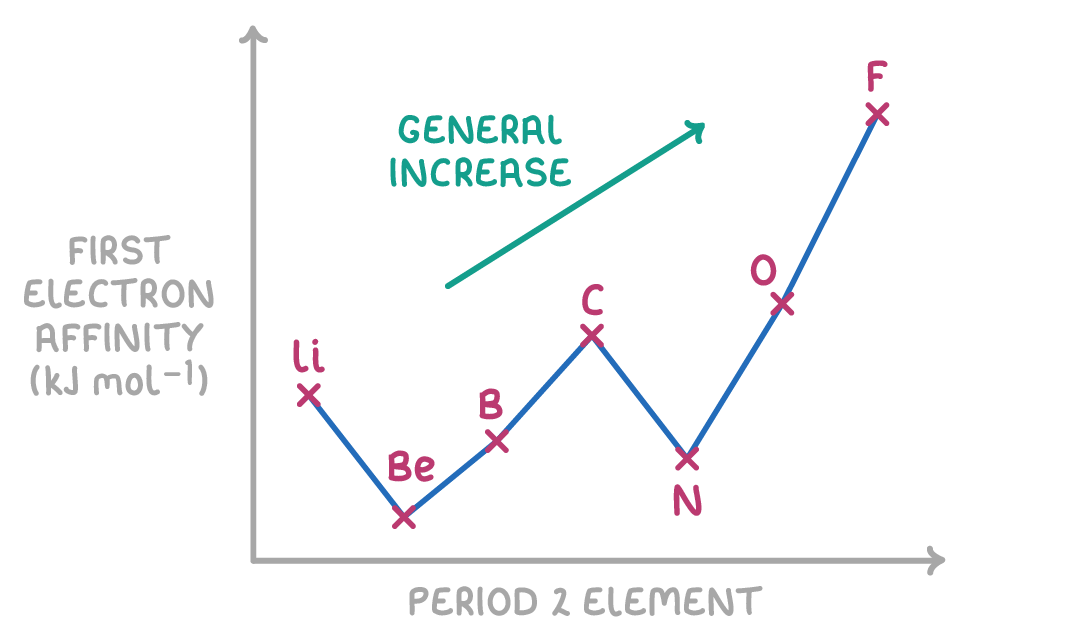
Electron affinity generally increases across a period, as shown by the period 2 elements in the graph above. This is because:
- The trend for first electron affinity across a period is similar to that of ionisation energy.
- As the nuclear charge increases across a period, more energy is released when an electron is added to the atom.
- The increasing nuclear charge effect outweighs the minimal change in shielding, resulting in a more favourable electron gain and higher electron affinity.
Trends in electronegativity
Electronegativity is a measure of an atom's ability to attract the shared electron pair in a covalent bond towards itself. It is measured on the Pauling scale; a higher value means an atom is more electronegative.
Fluorine is the most electronegative element.
Electronegativity decreases down a group
| Group 17 element | Electronegativity |
|---|---|
| F | 4.0 |
| Cl | 3.0 |
| Br | 2.8 |
| I | 2.5 |
| At | 2.2 |
Electronegativity decreases down a group, as shown by the group 17 elements in the table above. This is because:
- Down a group, although the nuclear charge increases, the atomic radius increases more significantly. The number of inner shell electrons shielding the valence electrons also increases.
- The increased distance between the nucleus and valence electrons, combined with greater shielding, weakens the electrostatic attraction. As a result, electronegativity decreases despite the increase in nuclear charge down the group.
Electronegativity increases across a period
| Period 2 element | Electronegativity |
|---|---|
| Li | 1.0 |
| Be | 1.5 |
| B | 2.0 |
| C | 2.5 |
| N | 3.0 |
| O | 3.5 |
| F | 4.0 |
Electronegativity increases across a period, as shown by the period 2 elements in the table above. This is because:
- The atomic radius decreases while the nuclear charge increases across a period. This results in a stronger electrostatic attraction between the nucleus and the valence electrons.
- The effect of the increasing nuclear charge dominates over the decreasing atomic radius. This leads to an increase in electronegativity across the period.
Trends in ionisation energy
Ionisation energy is the energy needed to remove one mole of electrons from one mole of gaseous atoms to form one mole of gaseous ions.
An equation representing the first ionisation energy of sodium is:
Na(g) ➔ Na+(g) + e−
Ionisation energy decreases down a group
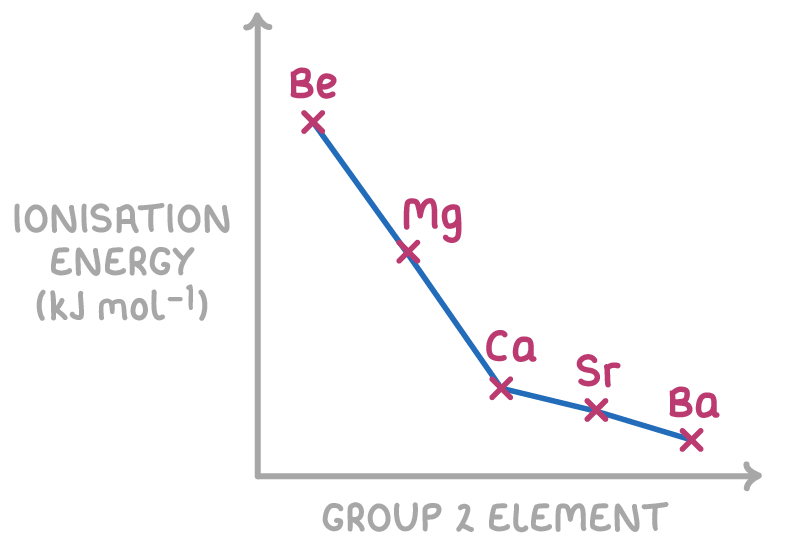
Ionisation energy decreases down a group, as shown by the group 2 elements in the graph above. This is because:
- Nuclear charge increases down the group as more protons are added. This increases attraction for electrons.
- Atomic radius increases down the group as more electron shells are added. This moves electrons away from nucleus.
- Electron shielding increases down group as more inner shells reduce nuclear attraction.
The increasing atomic radius and shielding effects are greater than the increasing nuclear charge, leading to an overall decrease in ionisation energies down a group.
Ionisation energy increases across a period
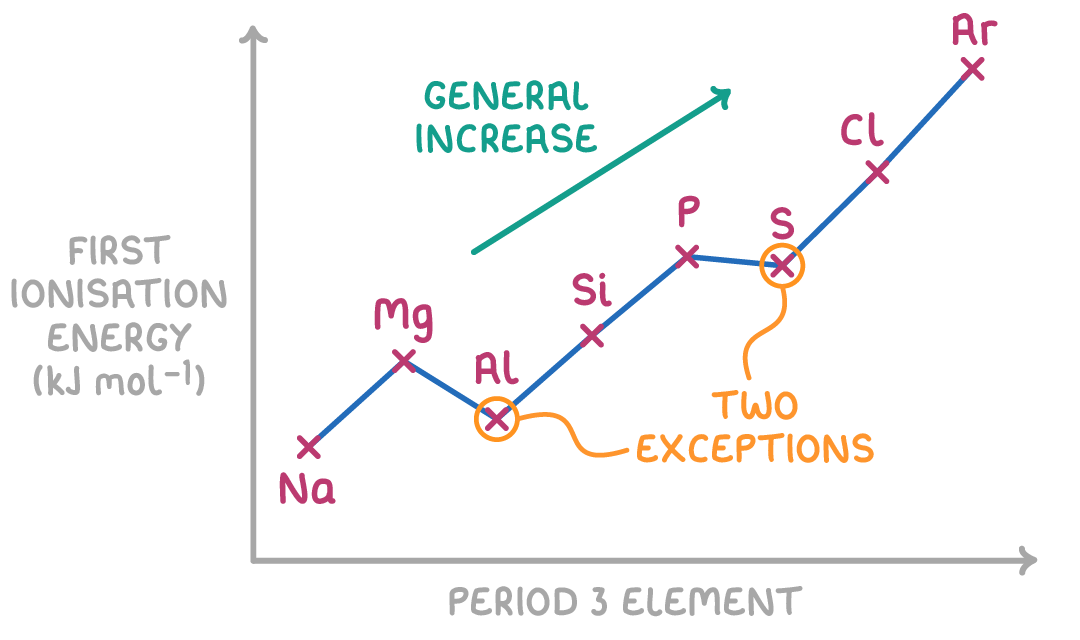
Ionisation energy generally increases across a period, as shown by the period 3 elements in the graph above. This is because:
- Nuclear charge increases as more protons are added across a period.
- Atomic radius decreases across a period as extra electrons are added to the same shell.
- Electron shielding stays similar across a period with no extra inner shells.
The increasing nuclear charge effect outweighs the similar shielding across a period, so ionisation energies generally increase across a period.
There are two exceptions between groups 2-3 and groups 5-6. These drops occur due to electron configuration effects.
The drop between groups 2 and 3
This drop occurs because:
- In group 3, the electron is removed from a p orbital rather than an s orbital like in group 2.
- p orbitals have slightly higher energy than s orbitals, so the outermost electron is on average further from the nucleus.
- The p orbital also experiences additional shielding from the nucleus provided by the s electrons.
- As a result, less energy is required to remove the outermost p electron from the group 3 element compared to removing the outermost s electron from the group 2 element.
For example, aluminium has a lower first ionisation energy than magnesium.
| Element | Group | Electronic configuration | First ionisation energy (kJ mol^-1^) |
|---|---|---|---|
| Magnesium | 2 | [Ne] 3s^2^ | 738 |
| Aluminium | 3 | [Ne] 3s^2^ 3p^1^ | 578 |
The drop between groups 5 and 6
This drop occurs because:
- In group 5, the electron is removed from a singly occupied orbital.
- In group 6, the electron is removed from an orbital containing two electrons.
- The paired electrons in the group 6 element experience greater electron-electron repulsion.
- As a result, less energy is needed to remove one of these paired electrons in the group 6 element compared to the unpaired electron in the group 5 element.
For example, sulfur has a lower first ionisation energy than phosphorus.
| Element | Group | Electronic configuration | First ionisation energy (kJ mol^-1^) |
|---|---|---|---|
| Phosphorus | 5 | [Ne] 3s^2^ 3p^3^ | 1,011 |
| Sulfur | 6 | [Ne] 3s^2^ 3p^4^ | 999 |